
How to Read a Chinese Invoice
Read Chinese invoice labels, identify the buyer and seller, and understand item details, tax and totals before checking the document.
Start with the Chinese legal name or USCC. Confirm the matching company before opening its profile.
Start with the labels, not a translation of every sentence. On a Chinese tax invoice, the company names tell you who bought and sold, the item rows describe what was invoiced, and the totals separate the price from the tax. Reading those parts together gives you a much clearer picture than copying the largest number on the page.
This guide explains common fields on Mainland Chinese invoices, or fapiao, for overseas buyers and finance teams. It focuses on ordinary goods and services. If the document is a supplier's commercial invoice or a quotation, first use the fapiao and commercial invoice comparison to identify what you have.
1. Identify the invoice
Keep the original open beside your notes. A translation is easier to use when each explanation stays attached to its Chinese label and original value. Do not replace a Chinese company name or a long identifier with a translated approximation: you may need the original characters for the next lookup.
The State Taxation Administration's 2024 digital invoice announcement lists the core fields and specifies a 20-digit number for fully digitalized invoices. Older invoice formats can present a separate invoice code and number. Identify the format before deciding that a field is missing.
| Chinese label | Read it as | What to record |
|---|---|---|
| 发票号码 | Invoice number | The complete identifier, including any leading zeros. It identifies this invoice, not the supplier. |
| 发票代码 | Invoice code | A separate field where the format has one. Keep it separate from the invoice number. |
| 开票日期 | Issue date | The date printed on the invoice, rather than the date the supplier emailed it. |
| 备注 | Remarks | Additional wording or references that may explain the invoiced transaction. |
Chinese dates commonly place the year before the month and day. The characters 年, 月 and 日 identify those parts. When transferring a date into a form that uses another order, check the field labels rather than pasting the same digit sequence. Keep a copy of the original date so a colleague can resolve any day-and-month ambiguity.
Read the title as well. A title referring to an ordinary invoice and one referring to a special VAT invoice identify different invoice categories. Translating both simply as “receipt” loses information. Copy the original title into your record even if you use a shorter English description when discussing the document.
Work from labels rather than memorized positions. The tax authority explains that digital invoice layouts can vary by business. A field that appeared in the lower corner of an older invoice may sit elsewhere on another format. A different arrangement alone does not establish whether a document is authentic.
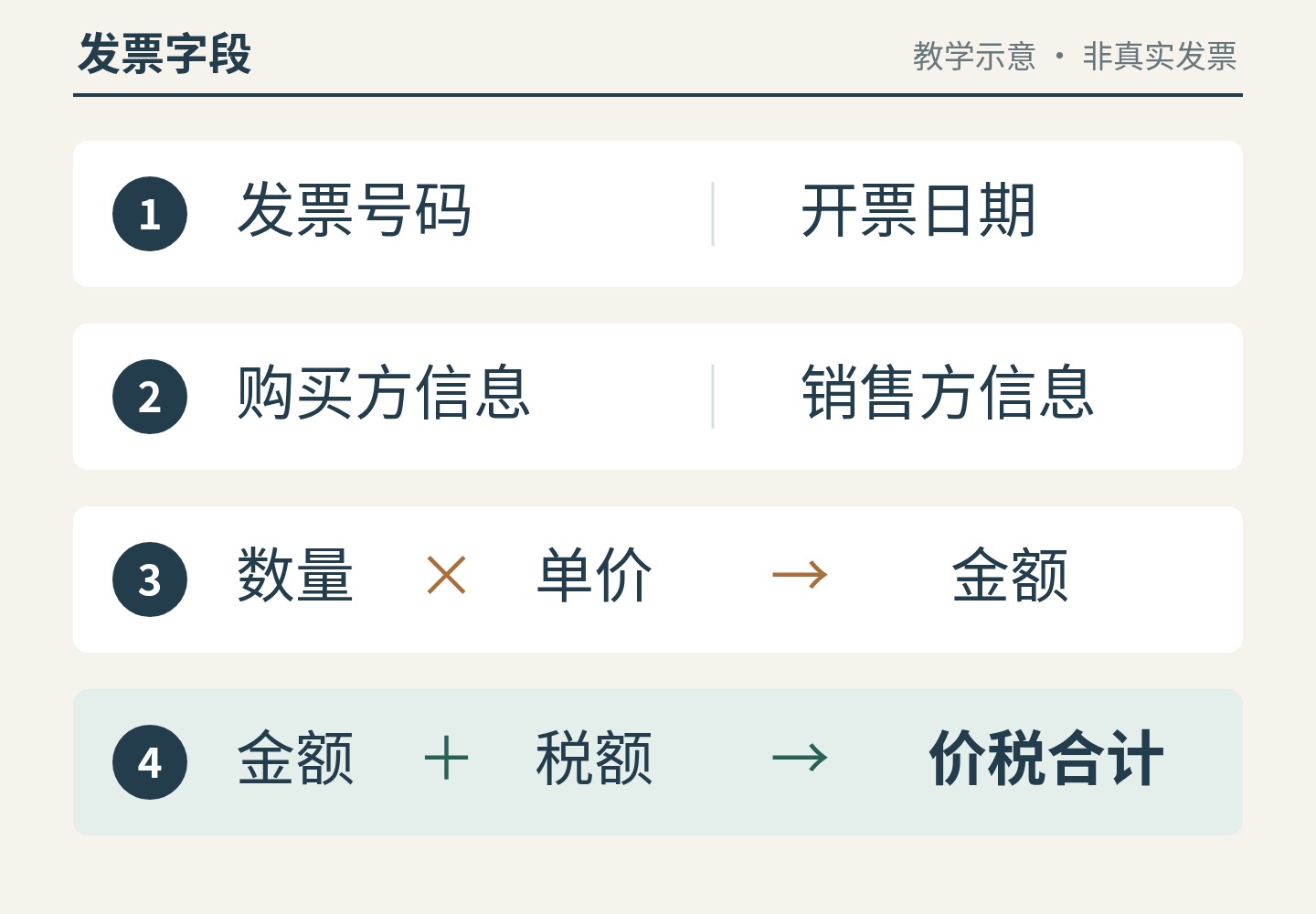
The diagram is a reading map. Use the first zone to identify the document, the second to identify the parties, and the remaining zones to understand the transaction and totals. It deliberately contains no usable invoice number, company identity or verification result.
2. Read the buyer and seller
Find the party heading before reading a company name. Both sides can contain a field called “name” and another called “taxpayer identification number.” If you copy those values without the heading, it is easy to assign the buyer's identifier to the seller.
- 购买方信息 — buyer information. Read the name and identifier inside this block together. They describe the purchaser shown on this particular invoice.
- 销售方信息 — seller information. Keep this block's name and identifier together too. This is the party to start from when you want to investigate the invoicing company.
- 名称 — name. The surrounding buyer or seller heading supplies the role. A repeated label does not mean the two names should be identical.
- 纳税人识别号 — taxpayer identification number. A field may instead refer to a unified social credit code. This belongs to the named party, not to the invoice itself.
Do not treat every empty buyer identifier as the same problem. The Shanghai tax authority's invoice guidance distinguishes enterprise purchasers from individuals, non-enterprise organizations and foreign customers, for whom a buyer tax identifier may be omitted. Check the purchaser's situation before asking a supplier to invent a Chinese identifier for an overseas company.
Also distinguish 开票人, the person who issued or prepared the invoice, from the seller company. A personal name in that field is not a second supplier. The invoice issuer explanation covers this distinction and the separate question of how an invoicing entity relates to the contract seller.
For a useful bilingual record, preserve the Chinese seller name and its identifier exactly, then put any English trading name in a separate note. Do not overwrite the legal name with a storefront brand. If you need to locate or interpret the identifier, follow the Chinese company tax number guide.
3. Decode the item rows
Read across one row before moving to the next. The description, quantity, unit price and amount belong together. If the invoice uses a broad product description, compare it with the order's supporting detail instead of assuming that the English product name must appear word for word.
The field 项目名称 identifies the item or service; older layouts may use a longer goods-or-services heading. 规格型号 means specifications or model. A model reference can help connect an unfamiliar Chinese description to the product ordered, but the invoice line alone may not describe every feature of the goods.
| Field | Meaning | Hypothetical reading |
|---|---|---|
| 单位 | Unit of measure | Pieces. Read the unit before interpreting the quantity. |
| 数量 | Quantity | 10 pieces in this example. |
| 单价 | Unit price | CNY 100 per piece, excluding tax in this example. |
| 金额 | Line amount | CNY 1,000 before tax: quantity multiplied by the assumed unit price. |
| 税率/征收率 | Tax rate or levy rate | Read the displayed entry; do not infer it from the product name alone. |
| 税额 | Tax amount | CNY 130 under the example's assumed 13% rate. |
This is a made-up arithmetic example, not a statement of the rate applicable to your purchase. It assumes one positive goods line, a tax-exclusive unit price and no discount. The actual invoice may contain several lines, different units or other adjustments. Preserve those distinctions when making your notes.
A carton is not a piece, and an invoice quantity is not automatically the shipment quantity in your packing list. Before flagging a difference, compare the units and the scope covered by the document. An order may also be invoiced in parts. Ask what the invoice covers rather than silently changing the quantity to match another document.
If the description wraps onto another line, check where the row's boundaries are. A visual line break can continue the same item; it need not introduce another charge. Likewise, distinguish a genuinely blank cell from a cropped screenshot or an unreadable character. A clearer source file is more useful than a confident guess.
When passing the invoice to a colleague, a short row note can be enough: original item description, model if present, unit, quantity and the related amount. Keep uncertain translations marked as uncertain. Translating a technical item name differently does not justify changing its model reference or numeric values.
4. Separate price, tax and total
The most consequential reading mistake is taking 金额, the amount before tax on a standard VAT item row, as the final total payable. Read it alongside 税额, the tax amount, and 价税合计, the total including tax. These labels answer different questions.
The row labelled 合计 can show separate sums under the amount and tax columns. Follow the column headings above each figure. Do not add the tax twice by treating a tax-inclusive total as another amount before tax.
| Example component | Value | How it fits |
|---|---|---|
| Amount excluding tax | CNY 1,000 | The example's goods amount, before the assumed VAT. |
| Tax amount | CNY 130 | The tax in this hypothetical single-line example. |
| Total including tax | CNY 1,130 | The amount excluding tax plus the tax amount. |
The calculation explains the labels; it does not validate the invoice. A fabricated document can contain correct arithmetic. Conversely, if your own calculation differs from the printed figure, inspect the complete lines, discounts and displayed precision before drawing a conclusion. Do not edit the supplier's values merely to make your spreadsheet balance.
Near the total, 大写 means the amount written in formal Chinese financial characters, while 小写 identifies the numeric representation. These are two representations of the same total, not two charges. “Uppercase” here does not mean capital letters or a larger payable amount.
In the example, the numeric total CNY 1,130 can be written as 壹仟壹佰叁拾元整. The last character indicates a whole-yuan amount without a fractional part. You do not need to learn the whole financial numeral system to locate the total, but a disagreement between the written and numeric amounts deserves clarification.
Keep the invoice's currency and original precision in your record. A separate commercial invoice might use another currency or cover a different set of charges. An exchange conversion or a total from that other document should not replace the value printed on the Chinese tax invoice when you enter a verification field.
5. Use the fields correctly
Once you have read the invoice, choose the next action according to the question you need answered. A document number belongs in an invoice lookup; a company identifier belongs in a company lookup. Successfully reading either one is preparation for a check, not evidence that the check has already taken place.
- Check the invoice record. Use the ChinaValidate invoice verification tool for supported Chinese VAT invoices. Follow the fields requested for that invoice type and copy values from the original. The VAT invoice verification guide explains the input combinations and results.
- Check the invoicing business. Use the seller's Chinese name or company identifier in company search. This is a separate company-information query; do not submit the buyer's details merely because that block appears first on your document.
- Resolve an unclear field. Ask for the complete, legible invoice or an explanation of the specific item, unit or total. If the query asks for a verification code, use the verification-code guide; the company tax number is not a substitute.
A compact handover should retain the original file, the invoice title and identifiers, both party blocks, the relevant item rows and the tax-inclusive total. Put your translation beside those details. This lets another reader trace an English description back to the actual Chinese field instead of relying on an unlabelled list of numbers.
The result should be concrete: you know whose invoice it is, what it describes, and how its figures fit together. You can then verify the invoice or investigate the seller with the right inputs. That is the useful purpose of reading the fields, even when a separate commercial or accounting question still needs an answer.