
How to Find a Chinese Company's Tax Number
Find a Mainland Chinese company's tax number from its name, business licence or invoice, and check that the identifier belongs to the company you need.
Start with the Chinese legal name or USCC. Confirm the matching company before opening its profile.
To find a Mainland Chinese company's tax number, look for the 18-character Unified Social Credit Code on its current business licence or matched company registration record. For a company that has obtained this code, it also serves as the taxpayer identification number, or TIN. On a Chinese tax invoice, read the identifier beside the relevant company's name: the buyer and seller have separate fields.
You can usually begin with one of three things: the company's full Chinese name, a licence copy, or an invoice. The useful result is a number attached to the right legal entity, with a source you can return to. Finding an 18-character string somewhere in a supplier's paperwork is only the beginning.
The State Taxation Administration's identifier rule establishes the use of the USCC for legal persons and other organisations that have obtained it. The China TIN note hosted by the OECD also points readers to the business licence. This guide concerns Mainland companies; personal tax identifiers and special registrations require their own rules.
Starting with a company name
If your supplier form has a blank Tax ID box, first decide whose number belongs there. A brand, a factory and the company selling you the goods may have different names. Use the legal entity the form is intended to record. Do not choose an affiliated company merely because its code is easier to find.
Obtain the full Chinese registered name from the supplier's company details, contract or licence. Keep the location wording and company ending. An English trading name can help you ask the supplier a question, but translating it back into Chinese does not reliably recover its registered name. If that is your only starting point, use the English-name lookup guide to establish a Chinese identity first.
Search the name in the National Enterprise Credit Information Publicity System. Beijing's official enterprise-information guidance confirms that this system accepts an enterprise name, USCC or registration number. Open the matching business and locate 统一社会信用代码. Copy that complete value alongside the Chinese name; a search-result title without the identifying field is not yet your answer.
Read enough of the returned record to establish that you selected the intended company. The full name should agree with the supplier material, and contextual details such as location should make sense. When several similar names remain, ask for a licence or another precise identifier rather than taking the first result. The broader company registration search guide explains the official entry points and basic fields.
The national USCC data service's help page describes another lookup route using an organisation name or its 18-character code. Follow that service's access instructions. Its help also explains that new or changed information may not yet have arrived, and that login requirements or temporary traffic limits can affect access. A failed page load therefore tells you something different from a completed search with no match.
Keep the result's source and retrieval date. If you arrived through a commercial directory or a translated company report, retain that service's identity too. A secondary result can help locate the code, but it should not be labelled as a government page or silently replace the Chinese name with an English approximation.
The number on the licence
A current licence provides a shorter route when the supplier has already sent one. Find the label 统一社会信用代码 and read the full value beside it. You are looking for the code of the company named on that licence, not its print date, registered capital, QR code or a number in the filename. The tax authority's Chinese and English TIN reference identifies the business licence as the document carrying the new company identifier.
Copy the value as text, preserving all letters and digits. “18-digit tax number” is common shorthand, but a USCC can contain letters. If a form strips letters or limits the field to fewer characters, check that it is asking for a Chinese corporate TIN and has the correct country selected. Do not shorten the supplied number, add a country prefix or invent a replacement to satisfy an unexplained validation rule.
With a photograph or scan, enlarge the original enough to inspect uncertain characters. A cropped corner, glare or a messaging-app thumbnail can make a code impossible to transcribe accurately. Request a clearer copy or retrieve the code by the company name. OCR is useful for copying a readable field; a plausible OCR result does not settle a character that the source cannot show.
Then search the complete code and compare the returned name with the licence. You have moved from a number printed on a supplied document to a number connected to a company record. The USCC validation guide covers the character rules and checksum if the string is rejected. That technical check helps identify copying errors; it does not establish tax compliance or make the licence image authentic.
Several numbers on one invoice
An invoice can contain the number you need, but begin with its document type. A Chinese tax invoice, often called a fapiao, has tax-administration fields. An English commercial invoice or pro forma invoice may use a supplier's own layout. Read the actual labels instead of assuming that every document headed “Invoice” has the same fields or can be checked through the same service.
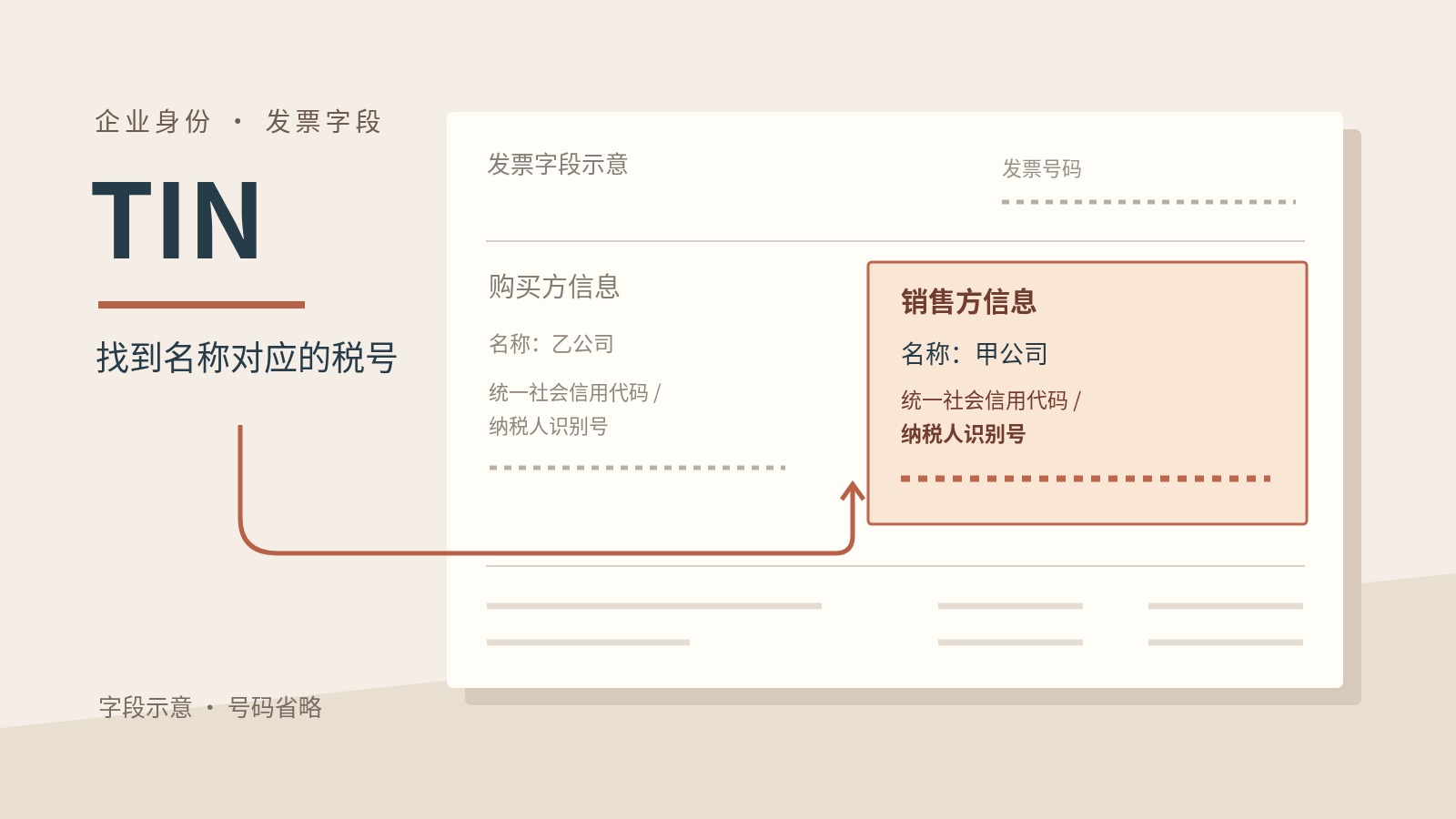
On a tax invoice, look for the party headings 销售方信息 and 购买方信息: seller information and buyer information. The identifier may be labelled 纳税人识别号 or 统一社会信用代码/纳税人识别号. Read the name and number inside the same party block. The official Shanghai digital-invoice specimen shows these separate blocks. It is an illustrative published format; use the labels on your document rather than relying on one fixed screen position.
The invoice's own number is another field. The national fully digital invoice announcement lists buyer information, seller information and invoice number separately, and specifies a 20-digit number for these fully digital invoices. That 20-digit value identifies the invoice. It is not the seller's 18-character company code. Older invoice formats have their own numbering arrangements, so length is a clue after you have identified the field, not a universal way to classify every number.
| Field on the document | What you have found |
|---|---|
| 销售方信息 — seller name and identifier | The identity stated for the company selling or invoicing in this document. |
| 购买方信息 — buyer name and identifier | The identity stated for the customer on this document. |
| 发票号码 — invoice number | The document's identifier, not either company's tax number. |
Consider a fictional document your supplier sends as supporting paperwork. The seller is labelled “Company A” and the buyer “Company B”; all numbers are omitted here. You need Company A's tax number for its supplier record. Copying the buyer's identifier would attach Company B's number to Company A, even if both strings were perfectly readable and structurally valid. Searching the seller's code and comparing its returned Chinese name exposes that error before it enters your records.
Now change one fact: your supplier sends an invoice for materials it bought from another business. Your supplier may be the buyer on that invoice. The seller block then identifies its upstream vendor. This is why “always copy the seller number” is incomplete advice: select the block naming the company you are actually looking up. If you cannot establish why that document identifies your supplier, return to its licence or registered name.
A number recovered this way is still an observed invoice field. Compare it with the company's registration identity. If you also need to authenticate the invoice, follow the separate Chinese VAT invoice verification guide. Finding the correct party's tax number does not complete that document check.
Missing or conflicting numbers
An old file has a 15-digit number. Keep its label and document date. It may be a historical tax identifier or another kind of registration number; those are not interchangeable merely because both have 15 digits. Look for a current company licence or a current name-based result. Do not pad the old value to 18 characters. The USCC and tax-number comparison explains the historical reconciliation.
The number returns a different company. Preserve the name returned by the search. A supplier may have sent an affiliate's licence, an upstream invoice or a document for another transaction. Ask which company the material represents and request the details for the entity you intended to record. A shared sales contact does not resolve a different identifier.
The same code appears with different names. First check transcription and source dates, then look for a documented company-name change. Do not replace the current name with a familiar older one simply to make a form agree. Equally, do not conclude that two entities are identical solely because a supplier says the names are equivalent. Keep the difference open until the supporting record is clear.
No usable result appears. Distinguish a verification challenge, unavailable service, broad-name search and genuine no-match response. Recheck the original Chinese name and ask for a legible current licence when the identifier is missing. An unresolved lookup should leave an empty or pending field, with the missing information stated, rather than a guessed number.
Completing the supplier details
When the identity is resolved, store the Chinese company name and full current code together. Add the supplier's English name as a separate display value if your team needs it. Keep the document or source URL and the date you checked it. This is enough to explain how the number was obtained without copying an entire invoice, bank instruction or unrelated personal information into a vendor form.
A short entry might read: “Tax ID: [complete current code]. Registered name: [full Chinese name]. Obtained from: [licence or public service]. Matched by: [name and code comparison]. Checked on: [date].” These are placeholders for your own verified information. If a historic number is relevant, retain it in a labelled previous-number field instead of mixing it into the current value.
For a field headed “VAT number,” check what the receiving organisation actually requires. A Chinese company identifier and evidence of a particular tax status are different requests. The code alone does not confirm general VAT taxpayer qualification, tax payment history or whether a transaction qualifies for any deduction. Ask for the appropriate supporting evidence if the request goes beyond company identity.
If reading the company result is the obstacle, ChinaValidate Company Search can help you find a Mainland company by name or USCC and review available company information across supported languages. Keep the original Chinese identity beside the translated explanation. The lookup is complete when the number, named entity and source agree; a field that still points to an unexplained second company needs clarification before it is filled.