
Chinese Invoice Red-Letter Status: What It Means
Understand full and partial red-letter adjustments, connect the original and corrected invoices, and distinguish invoice amounts from actual refunds.
Start with the Chinese legal name or USCC. Confirm the matching company before opening its profile.
A Chinese invoice marked as red-letter adjusted has been subject to a correction. The practical question is how much was adjusted and which documents explain the change. A partial adjustment leaves part of the original invoiced amount; a full adjustment reverses it. Neither label, by itself, tells you that money has arrived back in a bank account.
Start with the original invoice and the red-letter invoice actually issued against it. If the supplier has only sent a correction request or confirmation form, you still need to establish whether the red-letter invoice has been issued. This matters when the same purchase now appears in several attachments: an original, a negative adjustment and perhaps a replacement. Counting every positive document as a separate purchase can give you the wrong total.
Reading the adjustment status
In Mainland China, the original positive invoice is often called a blue-letter invoice. A red-letter invoice records a correction to it. For fully digital invoices, the State Taxation Administration lists returned goods, invoicing errors, interrupted services and sales discounts among the circumstances requiring a red-letter correction under the applicable rules. Returns and service interruptions can be partial. These are ordinary commercial situations, so the adjustment alone is not a finding that the supplier fabricated the invoice. See Article 8 of Announcement No. 11 of 2024.
Keep the verification result separate from the invoice's adjustment status. A response saying that the submitted information matches a record answers the lookup question. A label indicating a full or partial red-letter adjustment tells you something else about that invoice. Read both parts of the response, including the time of the check. A match does not mean that the original amount remains unchanged.
Also notice where the label appears. A supplier's billing account may show the progress of its own correction request, while a verification service may return an invoice status. Do not assume that two similarly translated labels describe the same completed event. If the service gives no adjustment detail, record that gap instead of treating an empty field as a normal status. For the broader lookup process and required inputs, use our Chinese invoice verification guide.
Connecting the original and red invoices
Put the original and the issued red-letter invoice next to each other. Record their invoice numbers and dates separately, then compare the buyer, seller, affected items, amounts before tax and tax amounts. Look for the reference or issuer-provided record connecting the correction to the original. The same supplier and a similar total are useful clues, but they do not establish the connection on their own.
There is no need to guess an association from file names such as “invoice-new” or “final-copy.” Ask the issuer to identify which original invoice each correction relates to. Where the relationship is recorded in an account history, a confirmation form or accompanying correspondence, retain that material with the actual invoices. Do not assume every invoice format displays the original number in the same place.
The distinction becomes important when a supplier sends several corrections together. Two red invoices from one seller might adjust two different purchases. Conversely, several red invoices can belong to one original. Build the group using the documented relationship before adding any figures. If the seller itself differs, resolve that identity question separately with the invoice issuer explanation; a plausible subtraction does not explain a different legal entity.
A partial adjustment, in numbers
Consider a hypothetical purchase with an original amount before tax of CNY 10,000 and tax of CNY 1,300. Its total including tax is CNY 11,300. Part of the goods is returned, and the issued red invoice shows CNY −2,000 before tax and CNY −260 in tax, a total of CNY −2,260. The assumed 13% rate is used only to make this example calculable; it is not a rate recommendation for your transaction.
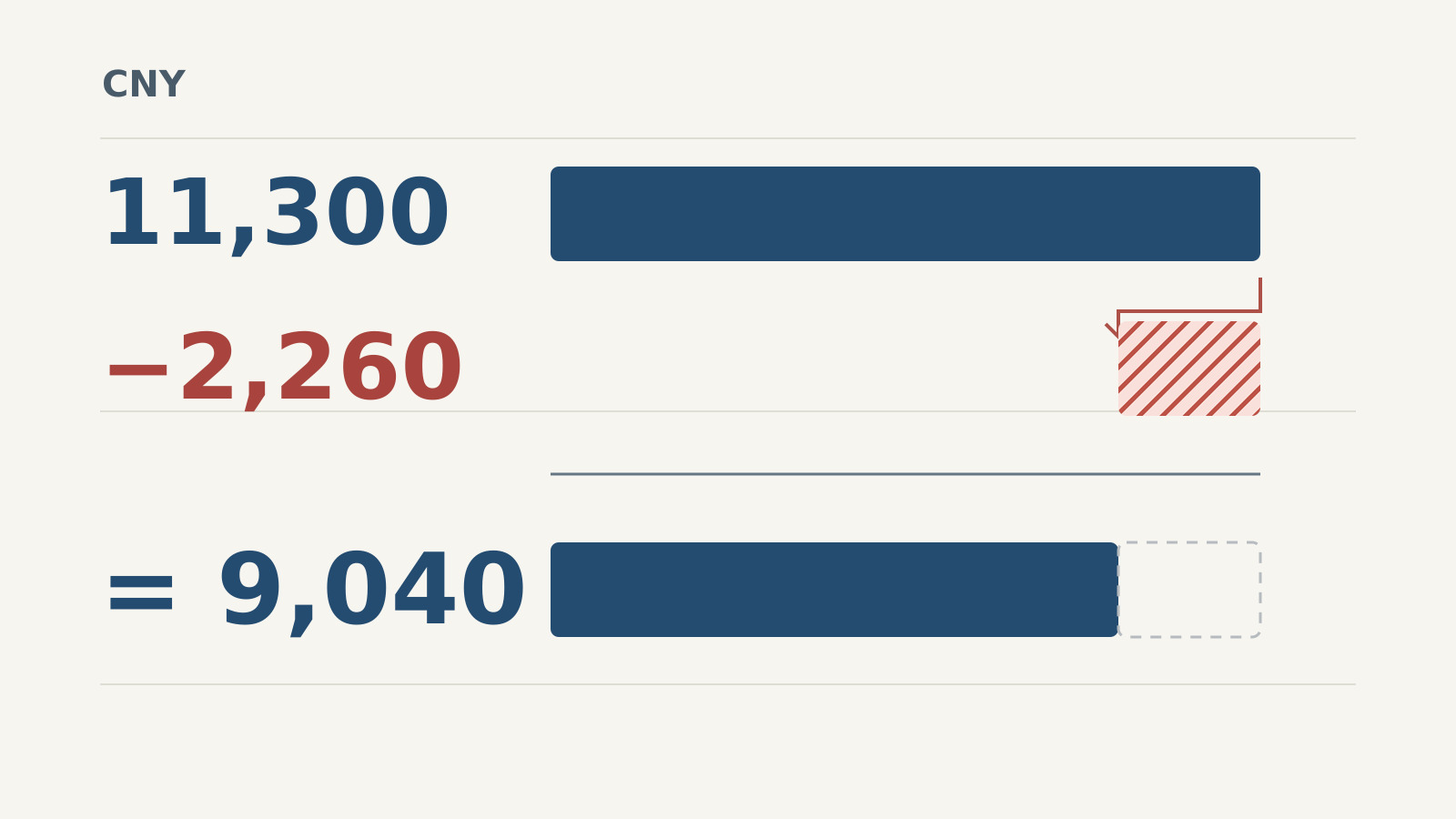
| Document or calculation | Before tax, CNY | Tax, CNY | Including tax, CNY |
|---|---|---|---|
| Original invoice | 10,000 | 1,300 | 11,300 |
| Issued red invoice | −2,000 | −260 | −2,260 |
| Combined amounts | 8,000 | 1,040 | 9,040 |
The arithmetic preserves three separate columns. Subtracting the red invoice's amount before tax from the original's total including tax would mix two bases and produce a misleading answer. Where the invoice has several items or tax treatments, compare the affected lines and their actual tax amounts instead of applying this example's percentage to the whole document.
The resulting CNY 9,040 describes the combined invoiced amount in this example. It does not necessarily describe the remaining payment due. The buyer might already have paid the full original total, paid a deposit, or agreed that a credit will offset a later purchase. To answer the payment question, compare the order adjustment and payment records separately. Likewise, the CNY 2,260 correction is not evidence that a refund has cleared.
More than one partial correction needs cumulative arithmetic. Suppose a second issued red invoice for the same original reduces the before-tax amount by another CNY 1,000 and the tax by CNY 130. The two adjustments together are CNY −3,390 including tax, leaving CNY 7,910 across the group. Looking only at the latest CNY −1,130 document would miss the earlier correction.
Tianjin's tax authority explains that fully digital invoices may undergo multiple partial corrections for qualifying reasons. Cumulative negative quantities, amounts and tax must not exceed the original corresponding values. For your own comparison, keep each distinct red invoice once: the same attachment forwarded by two colleagues is not a second adjustment.
Full reversal and a replacement
Now change the hypothetical situation. The supplier corrects the original CNY 11,300 invoice in full, issuing a red invoice for CNY −11,300. It then issues a new positive invoice for CNY 11,300 with corrected buyer details. Across these three related documents, the calculation is 11,300 − 11,300 + 11,300 = 11,300. Adding only the two positive invoices would incorrectly turn one purchase into CNY 22,600.
A replacement is not automatic evidence that the earlier reversal is complete. Obtain the actual red invoice as well as the new invoice and connect all three records. If the new total differs, ask which quantity, price, tax amount or other transaction detail changed. Keep that explanation alongside the documents; a different total should be explained by the corrected transaction, not silently forced to match the first invoice.
A full reversal also does not mean that a new invoice must always follow. An entirely cancelled purchase and an invoice reissued to correct details lead to different document sets. Ask whether the supplier intends to issue a replacement, and keep “expected” separate from “received.” This avoids chasing a replacement that is not part of the agreed correction, or treating a promised file as already available.
An issuer's progress labels can help. Alibaba Cloud's reinvoicing instructions distinguish a return request being processed, a completed red-letter adjustment and a subsequent application for a correct invoice. That is an example of one issuer's workflow, not a universal processing timetable. Its full-return procedure should not be read as a rule forbidding the partial adjustments described above.
The confirmation form
A red-letter invoice information confirmation form and a red-letter invoice are different documents. For fully digital invoices, Article 8 distinguishes direct issuance in specified circumstances from a process involving confirmation by the other party. The route depends on use or accounting confirmation, with additional exceptions. It is therefore inaccurate to say that every correction must receive buyer approval before issuance.
If a supplier sends only a confirmation form, describe precisely what you have: a form relating to a proposed correction, with whatever confirmation status is actually visible. Then request the issued red invoice or clarification of the remaining step. Do not rename the confirmation-form number as an invoice number, and do not mark the correction complete solely because a request was submitted. The national announcement treats confirmation and issuance separately.
For internal handover, this is often more useful than a loose note saying “invoice cancelled.” One colleague may mean that a cancellation was requested, another that a red invoice was issued, and a third that money was refunded. Use the document's actual name and the stage you can support. Your finance team should determine the accounting or deduction treatment from the applicable rules and the transaction's circumstances.
The record to keep after checking
Once the relevant files arrive, use an appropriate verification channel and retain the dated result. AWS China's digitalized e-fapiao guide, for example, directs recipients to the national verification platform or their tax digital account. The public entry is the National VAT Invoice Verification Platform. Follow the chosen channel's supported invoice types and field instructions. Do not remove a minus sign merely to force an amount into a form that rejects negative values.
An earlier successful lookup cannot establish what happened to the invoice afterwards. Retain the original invoice, every identified issued red invoice, any replacement actually received, and the time and result of the latest check. Link the payment or refund evidence separately. If attachments are incomplete or only cropped images are available, our invoice PDF guide explains how to recover a usable source file without confusing file reading with verification.
A concise supplier request can close the remaining gap: “Please send the issued red invoice linked to this original invoice and confirm whether the adjustment is full or partial. If a replacement has been issued, please include it and identify the corrected details. Please also confirm separately how the agreed payment or refund is being handled.” Add your actual original invoice number when sending it. That gives the next colleague something specific to follow up, while keeping the invoice correction and the movement of money distinct.