
Chinese Invoices After the Issuer Is Deregistered
Check an old Chinese invoice against the issuer’s company record, compare the dates and identify the evidence needed when a replacement cannot be obtained.
Start with the Chinese legal name or USCC. Confirm the matching company before opening its profile.
A Chinese supplier has been deregistered, but you still hold an invoice it issued. Start by checking the invoice and the company separately, then compare their dates. A current company status cannot, by itself, tell you what happened to an earlier invoice. Equally, a matching invoice record does not establish that the issuer still operates or that an expense qualifies for a particular tax treatment.
This situation often surfaces long after delivery: an accounts team reviews an old purchase, requests a corrected invoice, or discovers that its supplier contact has disappeared. The useful question is specific: which company issued this document, what does the invoice check return now, and did the relevant events occur before or after its deregistration?
Identify the seller
Begin with the seller's Chinese legal name and taxpayer identification number on the invoice. The buyer's details identify the recipient; the personal name in the invoicing field identifies an operator, not necessarily the issuing company. If you only have a foreign-language trading name, use the Chinese seller details to establish the legal entity before interpreting its status.
Compare both the name and identifier with the company record. A similar company name, shared address or familiar sales contact is not enough. If an old invoice shows a former name, look for a documented name change tied to the same entity. Do not assume that a newly established company with a similar name has inherited the old company's invoices.
You can start with ChinaValidate's invoice verification tool, using the original PDF or the requested invoice details. Then use the seller information for a separate company lookup. Keep any missing field marked as unknown. The two checks provide different records; neither should silently fill gaps in the other.
This article concerns Mainland Chinese tax invoices, often called fapiao. A supplier's commercial invoice or pro forma invoice may serve a different purpose and may not be eligible for the same tax-invoice lookup. If the document type is uncertain, identify it before treating a failed search as evidence against the supplier.
Read the two statuses separately
An invoice lookup may match the details you submitted and also return a status for that invoice. Read both. A result showing that details match is not the same as confirmation that an original invoice remains unaffected by a later correction. Conversely, a failed or unavailable lookup does not establish that the invoice is false.
On the company side, distinguish completed deregistration from a notice of intended deregistration, liquidation or revocation of a business licence. China's 2025 enterprise deregistration guide treats tax clearance and registration deregistration as distinct parts of the process. A public notice date should not be substituted for the date on which deregistration was completed. Our company-status explanation covers the main registration labels.
Record the actual wording you see. For an invoice, “voided,” “red-letter corrected” and “partially red-letter corrected” describe different outcomes. For a company, “deregistered” describes a registration event. Translating all of these as “cancelled” can erase the very distinction you need to investigate.
If the original invoice has a red-letter correction, establish which original it relates to and whether any replacement was issued. A saved original PDF does not show every subsequent event. Follow the linked documents rather than assuming that the issuer's closure caused the correction; the separate red-letter invoice article explains that relationship.
Put the dates on one timeline
Write down the transaction or delivery date, the invoice issue date, the confirmed deregistration date and the date of your checks. Use the invoice's issue date, not the date someone forwarded its PDF. Use a supported registration date, not the day you happened to notice that the supplier's website was unavailable.
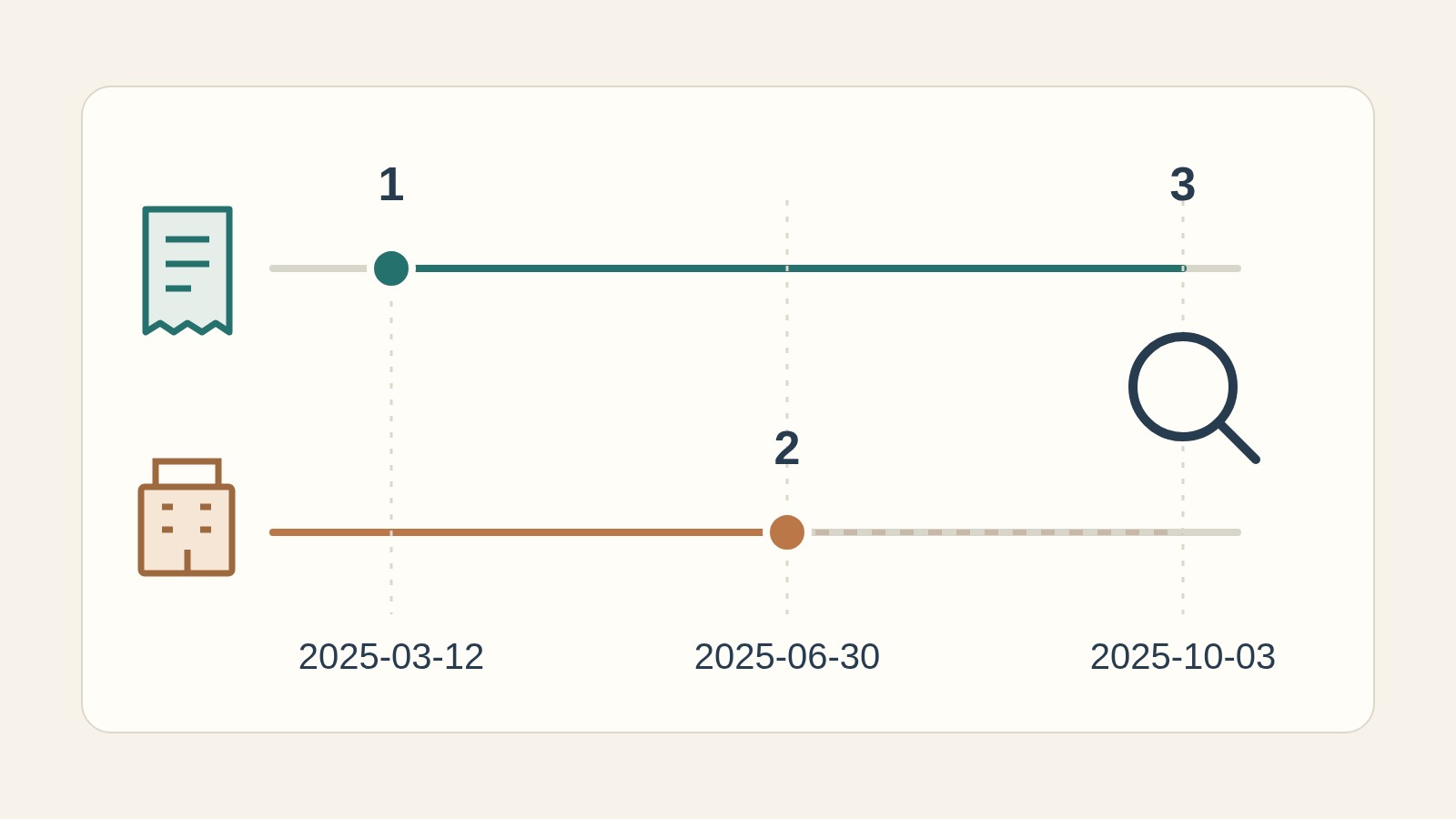
In this example, the invoice predates the company's deregistration. That sequence explains why an old invoice and a present-day deregistered company can appear in the same review. It does not establish that the transaction occurred, that every invoice field is correct, or that no later correction exists. Check those points using the transaction records and the invoice result.
Now change one fact: suppose the invoice carries a date after the confirmed deregistration date. First recheck the entity identifier, date labels and original document. If the discrepancy remains, keep it unresolved and ask for a documented explanation. Do not move the date in your records merely to make the sequence look consistent.
If you have only a deregistration notice, the timeline is incomplete. Record it as a notice and obtain the final registration status where available. Likewise, if a company report gives the current status but no deregistration date, it does not establish whether the invoice came before or after that event. Preserve that uncertainty for whoever makes the accounting or tax decision.
A practical case note might say: “The seller identifier matches the company record. The invoice is dated 12 March 2025. The registration record gives 30 June 2025 as the deregistration date. The invoice was checked on 3 October 2025; the attached result shows the returned status.” Add the real outcome, source and missing information rather than replacing this record with a single “valid” label.
If the supplier cannot replace the invoice
A different problem arises when the purchase is real but the required invoice is missing or noncompliant, and the former supplier cannot issue or replace it. That is a documentation and tax-treatment question, not something an invoice lookup can resolve.
For Chinese enterprise income tax, the State Taxation Administration's January 2026 answer about a deregistered supplier points to a conditional evidence route under Article 14 of the deduction-voucher rules. It concerns substantiating expenditure when specified circumstances prevent obtaining or replacing the required document. It is not permission to treat every unsupported payment as deductible.
The specified evidence includes:
- Proof of why the invoice or other external voucher cannot be obtained or replaced, such as evidence of the supplier's deregistration.
- The contract or agreement for the relevant business activity.
- Proof of payment by a non-cash method.
- Goods-transport evidence, internal goods-receipt or dispatch records, accounting records and other supporting material, as applicable.
The first three categories are mandatory under that rule; the remaining evidence should support the actual transaction. A contract and bank transfer alone omit the required explanation of why the document cannot be obtained.
Have the finance team check the applicable timing as well. Articles 13–17 of the deduction-voucher rules distinguish correction before the annual settlement deadline, the response after notification by a tax authority, and certain prior-year cases. The appropriate route depends on the circumstances; discovering the supplier's closure does not create an unrestricted deadline.
This rule concerns deduction of expenditure for Chinese enterprise income tax. It does not, by itself, establish entitlement to a VAT input credit. An overseas buyer also needs to apply the rules relevant to its own accounting and tax position. Keep these questions separate when referring the file for advice.
Follow up on the missing evidence
The next action should follow the unresolved point. If seller identity is uncertain, resolve that identity first. If the company identity is established but invoice details do not match, check the original fields and document type. If the result is unavailable, retain that outcome and seek an appropriate verification route instead of marking the invoice as false or approved.
Where authenticity remains disputed, Article 38 of the invoice implementation rules provides for an application to the tax authority for verification. The official English text is a reference translation; the Chinese text prevails. A commercial lookup is useful evidence, but it does not replace the authority's examination of a disputed invoice.
Make the inquiry easy to answer. Identify the invoice number and issue date, give the seller's name and tax identifier, and describe the precise discrepancy. For example, ask whether the returned invoice status relates to this original document, or which evidence is needed for an unobtainable replacement. These are different requests and may need different supporting records. Sending only a screenshot of a company marked as deregistered leaves the recipient without the invoice details needed to investigate.
Keep the original file, the dated invoice result, the dated company record and the relevant transaction documents together. If someone sends a replacement, retain the earlier version and establish how the documents relate. Avoid editing a seller name, identifier or date inside the invoice merely to align it with another record.
For this particular review, a useful handover states what is established and what is still missing: the identified issuer, the invoice outcome, the supported company status and date, and the precise question that needs follow-up. That gives an accountant or tax adviser something they can assess. Neither “the company closed” nor “the invoice matched” is a complete answer on its own.