
Check a Chinese Company's Paid-in Capital
Find shareholder contribution records, read the amounts and dates, and compare annual reports with later disclosures without double counting.
Start with the Chinese legal name or USCC. Confirm the matching company before opening its profile.
To check a Chinese company's paid-in capital, find the company by its Chinese registered name or Unified Social Credit Code, then look for shareholder contribution disclosures and the relevant annual report. Read the 实缴出资额 field with its shareholder, currency, contribution method and date. The registered-capital number at the top of a company profile answers a different question.
The difficult part often comes after finding a number. A company can show one amount in an annual report and a higher amount in a later disclosure without either entry being wrong. This guide follows those records through a fictional two-shareholder example, so you can produce a dated result rather than add incompatible figures together.
Open the correct company record
Start with the full Chinese name and the 18-character USCC from the supplier's business license or other company document. In the National Enterprise Credit Information Publicity System, search that identity and open the matching company. If the search returns several candidates, compare the code before reading their capital figures. Similar names, shared addresses and a common salesperson do not make two records interchangeable.
Check the entity type as well. The shareholder-level walkthrough below concerns a Mainland limited liability company. A branch does not have its own set of company shareholders, and a listed group's consolidated accounts do not describe only the legal entity on your purchase order. Keep the supplier company, its parent and its subsidiaries separate. Use the shareholder lookup guide if you first need to establish who owns the company.
The business license helps you identify the company, but its registered-capital field is not a receipt for completed contributions. Before copying any amount, write down the Chinese name, USCC and date of your search. When using a third-party company profile, also retain the source date shown for the field. A recently retrieved profile can still contain an older annual-report figure.
Find the contribution disclosures
Within the company record, look for information published by the enterprise itself. Labels can include 企业自行公示信息, 股东及出资信息 and 企业年报信息. Regional screens and access requirements vary; follow the section labels rather than assuming that a particular button is always in the same place. You are reading public information, not entering the enterprise's filing account.
Inspect two sources. First, open the separately disclosed shareholder contribution information where available. Second, open the latest relevant annual report and its shareholder or founder contribution section. Record the report year before reading the rows. A page headed “2025 annual report” does not become a 2026 contribution statement merely because you opened it in 2026.
These sources have different reporting schedules. Article 11 of the Company Registration Administration Measures requires relevant LLC shareholder contribution amounts, methods and dates to be publicized within 20 working days after the information arises. The annual-report system, meanwhile, reports on the preceding year. The Enterprise Information Disclosure Interim Regulation includes contribution information among annual-report contents.
A search result showing only shareholder names and subscribed amounts is not yet the paid-in answer. Open the contribution details rather than treating the summary as complete. If the source offers an export, compare its headings with the displayed page: an export that omits dates or methods may lose the context needed to interpret its total. Preserve the original labels alongside any working translation.
Read each shareholder's row
Locate the paid-in column explicitly. 认缴出资额 is the subscribed commitment; 实缴出资额 is the amount reported as contributed. Nearby columns may show 实缴出资时间 or 实缴出资日期, and 实缴出资方式. A date beside the subscribed amount can be a future commitment deadline, so do not move it into your paid-in note.
Read the unit before the digits. A field stated in 万元 uses units of ten thousand yuan: a value of 40 means RMB 400,000, not RMB 40. Retain the original unit and currency even if your own worksheet converts them. Do not add figures in different currencies or combine a company total with the shareholder rows already included in it.
The contribution method matters too. Money, equipment and other qualifying non-cash property are not the same thing. Articles 48 and 49 of the Company Law distinguish monetary contributions and eligible property contributions, including the relevant payment or transfer requirements. A reported amount should not be rewritten as “cash deposited” unless that is what the underlying evidence establishes.
Only calculate a company-wide disclosed total when you have all the relevant rows on a consistent basis. Check whether there are additional pages, expandable entries or a separate list of historical shareholders. When a shareholder has changed, establish which rows belong to the selected date before adding anything. The same contributed interest may appear under different holders across successive records; a list of every historical name is not a current contribution ledger.
If the record is incomplete, retain the amounts you can identify as a partial result. “Two visible shareholder rows total RMB 600,000” is a narrower statement than “the company's paid-in capital is RMB 600,000.” The second requires evidence that those rows cover the company for the stated date.
Compare dates, not cumulative totals
The following company and figures are fictional. Assume an LLC has the same two shareholders throughout the comparison, uses RMB in every record and has no capital reduction, shareholder transfer or filing correction during the period. Each amount shown is a cumulative contribution figure for the named shareholder at the stated date.
| Record and cut-off | Shareholder A | Shareholder B | Disclosed total |
|---|---|---|---|
| 2024 annual report: 31 December 2024 | RMB 200,000 | RMB 100,000 | RMB 300,000 |
| 2025 annual report: 31 December 2025 | RMB 400,000 | RMB 200,000 | RMB 600,000 |
| Later contribution disclosure: 30 June 2026 | RMB 500,000 | RMB 300,000 | RMB 800,000 |
Beijing's annual-report filing instructions explain that shareholder contribution amounts are cumulative through 31 December of the report year. They also describe one contribution entry per shareholder, rather than a transaction-by-transaction bank history. The amount in the 2025 report therefore includes earlier contributions; it is not an additional RMB 600,000 paid during 2025.
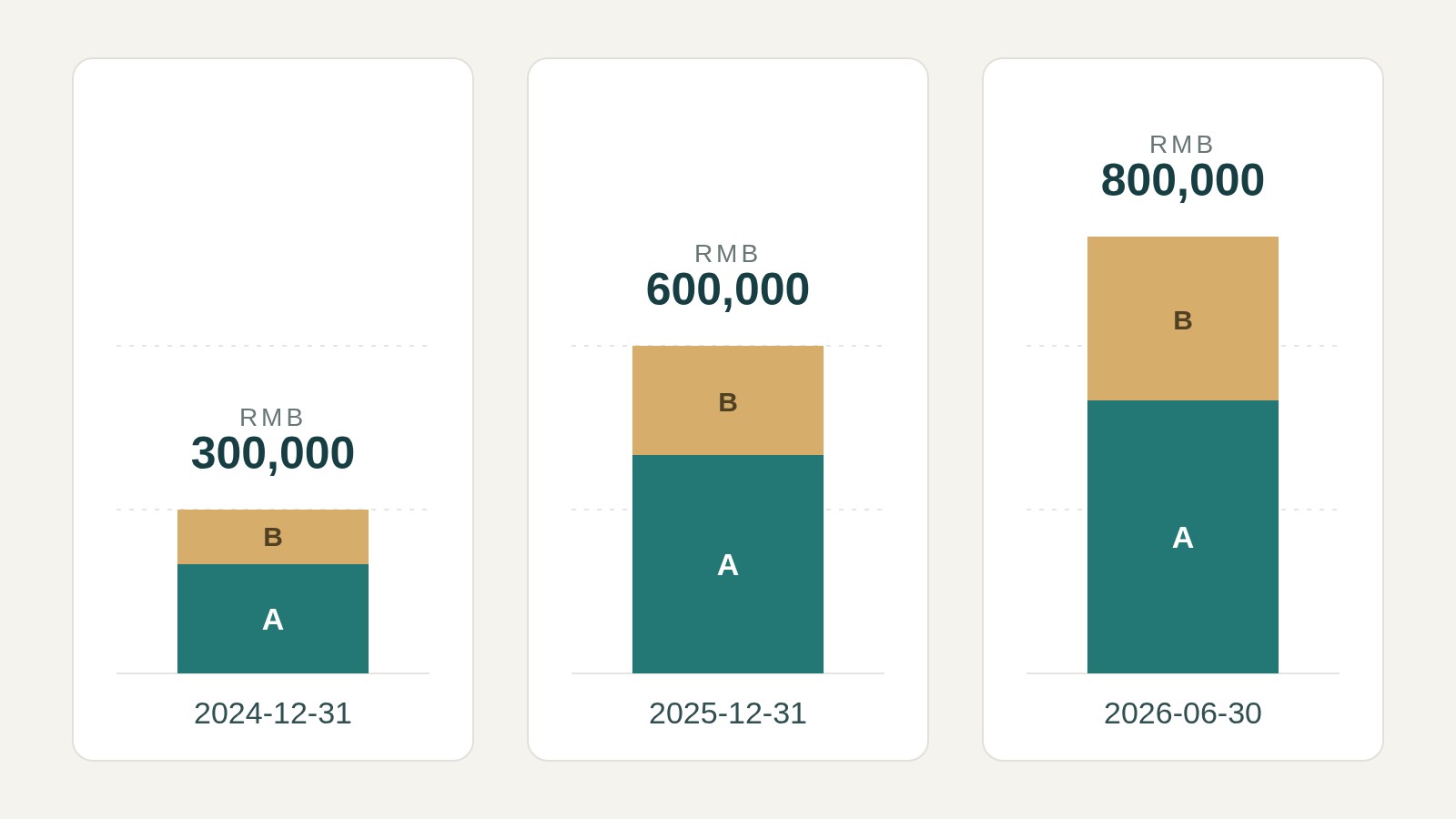
For a question about 31 December 2025, the example supports a disclosed total of RMB 600,000. For the later June 2026 disclosure, it supports RMB 800,000. Adding all three totals would count earlier contributions again. Even adding only the last two would repeat the amounts already included in the later balance.
Under the example's assumptions, the reported cumulative increase from year-end 2025 to June 2026 is RMB 200,000. That arithmetic is a change between two disclosed positions. It is not independent proof of a bank transfer, and it is not safe to perform unchanged when a shareholder transfer, capital reduction, correction or currency change intervenes.
If two records disagree about the same cut-off date, the example's simple progression no longer resolves the difference. Compare the shareholder names, units, currencies and correction history first. A more recently retrieved page is not necessarily a more recently filed disclosure. Keep both source references and ask the company which entry reflects its corrected position. Until that is explained, report the conflicting amounts separately. Do not average them, choose the larger figure to make the supplier look stronger, or label the difference as a new contribution merely because one page was downloaded later.
Suppose a supplier sends only the older annual report while saying a contribution was completed this summer. Ask for the later shareholder contribution disclosure and its date. If that disclosure is not available, record the newer amount as unverified rather than silently replacing the older figure. For a broader comparison of reporting years, continue with the annual-report reading guide.
When the amount is missing
A blank, a dash, an explicit zero and an inaccessible section are different findings. Record what the source actually shows. Beijing's shareholder disclosure guidance tells companies to enter zero where a shareholder has not yet contributed. That does not authorize a reader to turn every missing field into zero.
First check whether you opened the contribution section rather than a basic registration summary, and whether an annual report exists for the year you selected. A newly established company may not yet have reached its first annual-report cycle. A third-party database may omit a field that appears in the underlying source, while a browser or verification failure may prevent the source from loading at all. Name the actual access problem in your note.
If a supplier says that the contribution changed after year-end, ask which later public disclosure records it. Wuxi's 2026 annual-report guidance distinguishes report-year information from later shareholder and contribution changes that belong in the separate self-disclosure module. This is a reason to check another record, not to amend an old report yourself.
Where the number matters to the transaction, request a focused explanation or supporting document for the specific gap: the shareholder involved, contribution amount, method and date. Depending on the question, that might involve accounting records, payment evidence or property-transfer documents provided through an authorized channel. A public disclosure alone is company-reported information. Do not describe it as independently audited, and do not ask for account passwords or access to the company's filing credentials.
Keep a dated result
Your finished lookup should say which company, which shareholders, which source and which date the amount covers. For the fictional example, a useful note is: “The June 2026 contribution disclosure for the identified LLC reports cumulative paid-in contributions of RMB 800,000 across shareholders A and B. The 2025 annual report reports RMB 600,000 at year-end. The difference reflects later reported contributions under the stated assumptions; independent payment evidence was not reviewed.”
Attach the source reference or permitted capture and your retrieval date. If the public page does not establish a complete total, say which rows were visible and leave the company-wide amount unresolved. This makes the finding reusable without giving the next reader a more certain answer than the evidence supports.
Paid-in capital does not show how much cash remains available today. It also does not establish current assets, supplier credit or manufacturing capacity. The paid-in capital definition explains those limits; the capital-deadline guide addresses whether a contribution date is due. Neither question should be answered by changing a blank field into a number.
To begin the lookup, search the company's Chinese name or USCC and confirm the legal entity. Follow the available contribution and annual-report sources from that identity, retaining any gaps in coverage. A correctly identified company and a clearly dated amount are more useful than an undated capital figure copied from a search result.