
How to Find a Chinese Company's Shareholders
Find a Mainland Chinese company’s shareholders and read contribution records, source dates and annual-report differences without confusing ownership roles.
Start with the Chinese legal name or USCC. Confirm the matching company before opening its profile.
To find a Mainland Chinese company's shareholders, search for the company in the National Enterprise Credit Information Publicity System, open the matching entity, and look for shareholder or promoter information and contribution disclosures. Keep the company name and Unified Social Credit Code beside the result. A person's name on a business license is not, on its own, a shareholder list.
The useful result is a list you can explain: whose interest is recorded, which company it belongs to, where the information came from, and the date it describes. This guide focuses on direct shareholders of ordinary Mainland limited liability companies. It also explains why a company limited by shares needs a different reading, without turning a simple lookup into an investigation of ultimate control.
Start with the company record
Use the full Chinese registered name or USCC from the supplier's documents. If the search returns several candidates, compare the complete identifier before opening the ownership details. Similar names are especially easy to confuse when one company is a trading business and another is its manufacturing affiliate. A shareholder list for the affiliate will not answer who owns the seller named in your order.
Shanghai's official English market-access FAQ identifies GSXT as a channel for company registration information, including shareholder names. If you need help reaching the correct official service, use the separate company registration search guide. Once the entity is open, concentrate on its ownership information rather than repeating the whole registration search.
Look for labels such as 股东及出资信息, meaning shareholder and contribution information, or wording that distinguishes shareholders from promoters. Layout, access requirements and available detail can differ between views. Follow the service's current access instructions. During research for this guide, the national entry could not be retrieved by our browsing tool; the directions here are grounded in official descriptions, not a claim that we completed a live shareholder search.
Keep public lookup separate from enterprise filing. Beijing's instructions for submitting shareholder information lead a company's authorized user into a reporting area. Those instructions explain how disclosures are supplied; they are not a reason for a buyer to enter another company's filing account. You want to read a published record, not change it.
Check what the list represents
Read the entity type and the section heading before copying names. Under Articles 32 and 40 of the Company Law, registered matters include limited liability company shareholders and joint-stock company promoters; contribution and specified equity-change information are also subject to publicity. These are related records, but their labels are not interchangeable.
For a limited liability company, a shareholder can be an individual or another legal entity. Preserve a corporate shareholder's full Chinese name so it can be searched separately if needed. Do not shorten it to a brand that several companies share. For an individual, retain the displayed name without trying to identify an unrelated person from a matching name in a web search.
For a company limited by shares, a list of promoters is not necessarily a list of every person currently holding shares. Beijing's shareholder-disclosure guidance explicitly distinguishes promoter registration. If your task requires current ownership of that type of company, name the limitation and obtain the appropriate additional records rather than relabelling the promoter list.
A legal representative, director or manager may also be a shareholder, but the personnel role alone does not establish the holding. Likewise, a company shown under outward investments is a business the searched company has invested in, not automatically an owner of the searched company. Read the direction of the relationship. The shareholder glossary explains the wider terminology; here the task is to collect the correct list.
Keep the source beside each row
The same company's shareholder information can appear in registration data, company disclosures and a particular year's annual report. A neatly formatted result can hide those differences. Before exporting or translating it, note the section you actually opened. That small step is more useful than trying to reconcile an undated spreadsheet later.
| Where the information appears | What to preserve | How to label your note |
|---|---|---|
| Registration shareholder or promoter section | Entity type, names, section title and retrieval date | Registration information viewed on the stated date |
| Company shareholder and contribution disclosure | Each shareholder's amounts, units, methods, dates and any displayed update information | Company-disclosed contribution information |
| A selected annual report | Report year, the shareholder rows and any displayed filing or correction date | Shareholder information within that year's report |
| A document provided by the company | Document title, issue date, named entity and who supplied it | Company-provided material, with verification still identified separately |
SAMR's 2024 system-upgrade notice describes improvements to immediate shareholder contribution disclosures. This is a reason to look beyond an annual-report tab when your question concerns a current contribution entry. It is not a promise that every company has complete information in every view.
A report year, a contribution date and the day you downloaded the page answer different questions. Keep all three when available. If the interface does not display an update date, write that it was not shown; do not replace it with your retrieval date and describe the result as updated today. A fresh download can still contain information about an earlier period.
Read the contribution fields together
Once you have the correct shareholder row, capture its fields as a group. Copying the largest number while dropping its column heading is an easy way to turn a contribution commitment into a claim about money already received.
-
股东名称— shareholder name - Keep the complete displayed name. If a row opens a detail view, verify that the expanded information still belongs to that shareholder before copying it.
-
认缴出资额— subscribed contribution - Read this as the stated contribution commitment, with its currency and unit. It is a different field from the amount reported as paid.
-
实缴出资额— paid contribution - Record the reported paid amount and its associated details. Preserve an explicit zero; distinguish it from a blank cell, an unavailable field or a section that failed to load.
-
出资方式— contribution method - Copy the displayed method rather than assuming all contributions were cash. Keep the method attached to the subscribed or paid entry it describes.
-
出资日期— contribution date - Check whether the column refers to a commitment deadline or a reported payment event. Do not collapse several dates into one generic ownership date.
The Beijing guidance explains subscribed timing as the agreed final contribution deadline and paid timing as the date of a completed contribution. It also treats each shareholder's subscribed and paid information separately. Preserve those distinctions when translating a record into English or another language.
Check the unit in the header as well as the value in the cell. A heading using 万元 expresses ten-thousand-yuan units; a value of 100 in that column corresponds to RMB 1,000,000. Keep the original value and unit beside any conversion. Apply the same discipline to totals: do not add a cumulative total to its own component entries, or add figures taken from different reporting dates.
If you want a percentage, first ask what it would describe. Dividing one subscribed contribution by a compatible subscribed total may produce a contribution-based ratio. It does not, by itself, establish voting power, entitlement to profits or actual control. A simple shareholder lookup can stop at the reported amounts; an unsupported percentage is not an improvement over an accurately copied row.
One lookup note, with dates attached
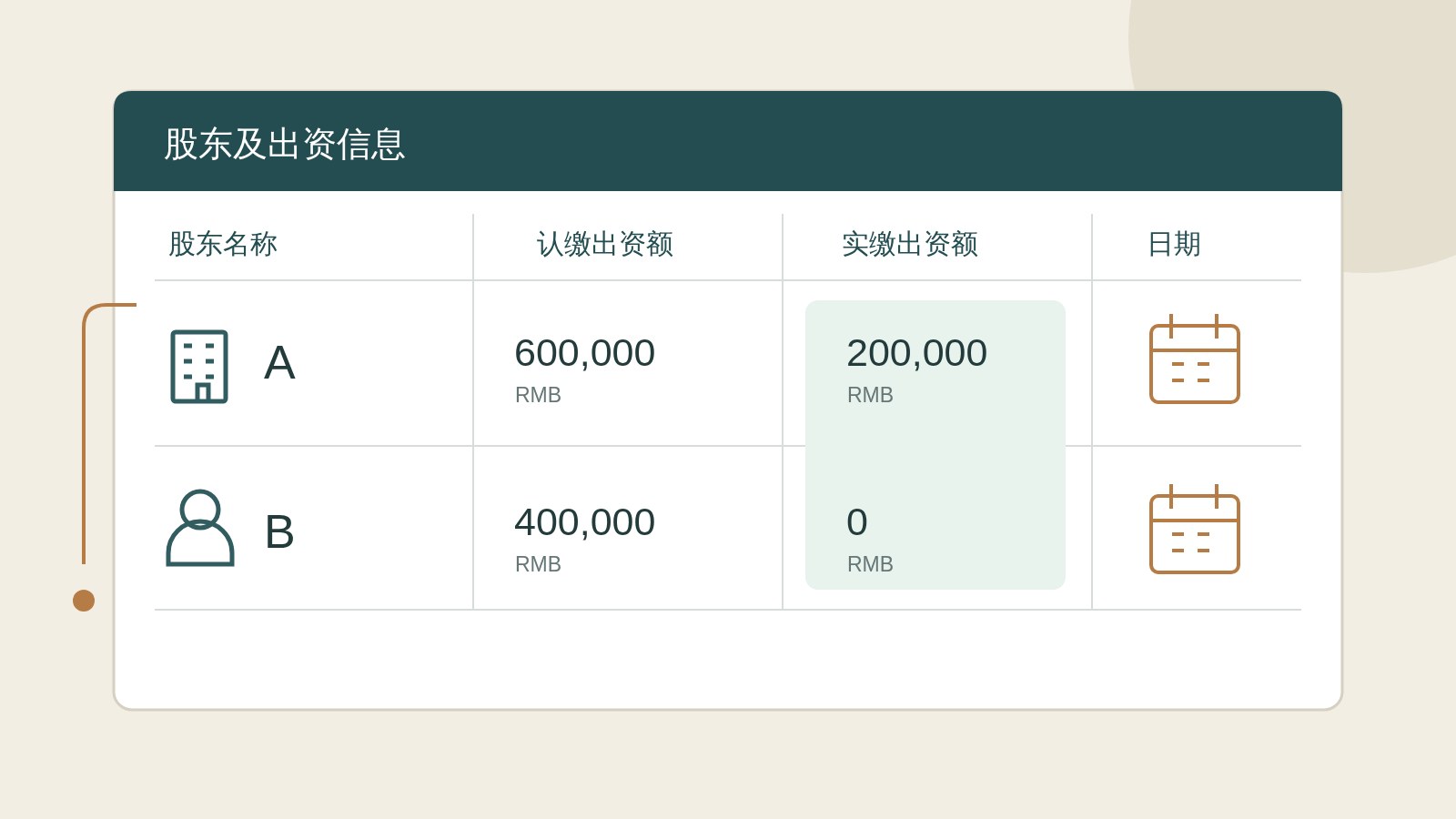
Consider a fictional limited liability company with two shareholder rows. The names below are placeholders, not real businesses or people. Its contribution disclosure shows Corporate Shareholder A subscribing RMB 600,000 and Individual Shareholder B subscribing RMB 400,000. The corresponding paid amounts are RMB 200,000 and zero. A separate annual report shows different paid amounts for its reporting year.
A useful note would identify A and B as the direct shareholders shown in the reviewed source, then retain both subscribed and paid columns. It would place the annual-report figures in a separate dated note. The buyer should not replace the zero with the subscribed amount, add both sources' paid figures together, or treat the discrepancy alone as an undisclosed change of owner.
The row for A presents another practical choice. If the only question is who directly holds the supplier, A is a valid corporate name to record. If the question is which individual ultimately controls the group, this first list is only a starting point. That deeper task belongs in the beneficial-owner guide; it should not be presented as a fact already established by this lookup.
Keep a short accompanying sentence: “These names and contribution entries were viewed in the stated company profile on the retrieval date; the annual-report figures are retained separately for their report year.” Add the actual source link, Chinese company name and USCC to your private working file. Another colleague should be able to tell which result you read without relying on your memory.
When the information does not line up
If no shareholder rows appear, first check that you opened a company rather than its branch, selected the intended section, and completed any normal access steps. An empty area caused by a loading failure is not a statement that the company has no shareholders. Save the error or missing-field description so that a second attempt can be compared with the first.
If two sources show different names, compare their company identifiers, section labels and dates before choosing one. A historical annual report may describe an earlier position. A current company-supplied chart may be an assertion that still needs support. A genuine unresolved difference should remain visible until a relevant record explains it. The change-history guide covers a fuller review when a transfer or restructuring matters.
Ask for a specific missing item when public information is insufficient: a dated shareholder list for the named company, clarification of which contribution date a figure represents, or the record supporting a stated ownership change. A general request to “prove who owns everything” is harder to answer and may pull the conversation away from the company you intended to check.
For help locating the business in a multilingual interface, start with ChinaValidate company search and confirm the exact Mainland entity. Inspect the information and access options shown for that company; do not assume a field is available merely because it appears in this guide. Keep Chinese names beside translations so colleagues can return to the same record.
The lookup is complete when your note identifies the direct shareholder list supported by the source, preserves the contribution fields you actually obtained, and makes its date and gaps clear. That gives the next reader a usable company record without turning a partial public result into an unsupported statement about the whole ownership chain.