
Find a Chinese Company's Subsidiaries
Find investment disclosures, check the companies named in them, and distinguish subsidiaries from minority holdings, sister companies and branches.
Start with the Chinese legal name or USCC. Confirm the matching company before opening its profile.
To find a Mainland Chinese company's subsidiaries, begin with the company's investment disclosures, then look up the businesses named there and check their shareholder records. This gives you a way to test each relationship. A list headed “investments” is a starting point: it can contain minority interests as well as businesses the company controls.
This guide is for a buyer who already knows the supplier's Chinese legal name or Unified Social Credit Code (USCC). Perhaps the supplier has named a factory as its subsidiary, or you want to find the operating companies behind a group. The aim is a useful list of identified companies and supported relationships, with gaps kept visible. It is not a promise to recover every entity in a private group's structure from one search.
Start with the investment list
Search the exact starting company in the National Enterprise Credit Information Publicity System. Match its full Chinese name and USCC before opening the annual reports. The separate company registration search guide explains how to identify the right public service and company record.
In a report, look for 对外投资信息, or wording describing enterprises established through investment and equity acquired in other enterprises. “Outward investment” in a company-information interface need not mean overseas investment. Here you are looking for other companies in which the starting company has an interest, including other Mainland businesses.
This is a defined disclosure category. Article 9 of the Interim Regulation on Enterprise Information Disclosure includes information about establishing enterprises through investment and purchasing equity in the annual report. It treats that information separately from the reporting company's own shareholders. Article 11 also places responsibility for enterprise disclosures on the enterprise; appearing on an official website does not turn a company-filed list into an independent investigation.
Copy the invested company's complete name and its identifier where displayed. Save the report year with the list. The date when you open the page is useful, but it cannot make a past year's disclosure current. If a report has been corrected, note the version you actually used. The annual-report explanation covers the filing cycle and the difference between the reporting period and the submission date.
A commercial company database may collect these relationships into a dedicated investment section. Treat its entries as candidates to examine, keeping the provider and any displayed date. Do not silently combine current entries, historical investments and branches into one list of subsidiaries. If the database uses separate tabs for those categories, preserve that distinction when exporting or taking notes.
If the supplier has already named the alleged subsidiary, you can also search that company directly. You do not need to discover its name again through the parent's annual report. The parent-side disclosure and the candidate's own shareholder record provide different views of the relationship; examining both can help explain a missing or older entry.
A factory nickname needs an extra step. “Plant Two” on a supplier's website might describe a production site operated by the supplier itself, a subsidiary, or an outside manufacturer. It is not necessarily a registered company name. Ask which legal entity operates that site and obtain its Chinese name or USCC before searching for a subsidiary. Likewise, a website menu headed “Our businesses” may mix brands, facilities and incorporated companies. Copy those labels as leads, then identify the legal entities behind them instead of treating every menu item as a company.
Check the other company's owners
Open a separate record for each candidate that matters to your purchase. Read its Chinese name and USCC, rather than relying on a short name carried over from a results list. Two companies sharing a brand can still have different registered names, owners and operating roles. Keep the starting company and the candidate in separate rows or browser tabs while you compare them.
For an ordinary limited liability company, look for the starting company in the candidate's shareholder information. The Company Law, Article 32, distinguishes shareholders of limited liability companies from promoters of companies limited by shares. A promoter list for the latter is not necessarily a complete list of its current shareholders. Check the entity type before deciding what the names prove.
The direction matters. Suppose you opened Company A to find businesses it owns. A corporate name in A's shareholder list points upward to an owner of A. A name in A's investment list points toward another business in which A has invested. To test an A-to-B holding, open B and inspect the evidence that identifies A as its shareholder. Do not copy A's own shareholders into a list labelled “A's subsidiaries.”
Retain any reported holding or contribution with its original label, unit, source and date. If the source supplies contribution amounts without a percentage, record those amounts as presented. Calculating a proportion from unlike dates or mixing subscribed and paid contributions can produce a convincing-looking but meaningless figure. Use the shareholder lookup guide for interpreting those fields.
Sometimes the candidate's shareholder is an intermediate company rather than A itself. That does not settle whether the supplier's statement is wrong. You have found another relationship to investigate. Record the intermediate company's exact identity, then check the next link. A note saying “B names Holding Company H as shareholder; H's relationship to A remains unconfirmed” is more useful than changing H's name to A in the table.
The public record may give you only part of the answer. A current company-provided chart can explain what the supplier claims, but its arrows still need support. Ask for the document or current record relating to the particular missing link. There is little value in requesting a large corporate presentation if the unresolved point is simply which legal entity holds an interest in one named factory company.
Separate the relationship types
A subsidiary is a controlled entity; an investment entry alone does not establish control. The Ministry of Finance's Accounting Standard for Business Enterprises No. 33 uses control to define the parent–subsidiary relationship in financial reporting. That helps explain why a small shareholding and a subsidiary are different descriptions. It does not mean a buyer can determine the full accounting conclusion from one public percentage.
Record the narrowest relationship your evidence supports. A source showing an equity interest can support a statement about that interest. Describing the business as a subsidiary needs a supported basis for control. Voting rights, agreements and other arrangements can matter; neither the largest visible holding nor a familiar group name resolves every case. If those details are unavailable, leave control unconfirmed rather than giving the investment a stronger label.
A branch is a separate category. Under Article 13 of the Company Law, a subsidiary has legal-person status and independently bears civil liability, while a branch lacks legal-person status and its civil liability is borne by the company. The branch-office guide explains the registration and responsibility distinctions. Finding a branch name does not add another incorporated subsidiary to your list.
Shared ownership can also create sister companies. If the same owner holds both the seller and the factory, the factory is not necessarily a subsidiary of the seller. Draw the common owner above both businesses. This small change in the diagram keeps the relationship accurate and prevents a sales team's phrase “our factory” from becoming an unsupported claim that the contracting seller owns the manufacturing company.
Follow an indirect link
Consider a fictional example using four placeholders. A's investment information names B and D. A separate record for B names A as its sole shareholder. B's investment information then names C, and C's record names B as its sole shareholder. D's record shows A holding a minority interest, with no additional evidence establishing A's control.
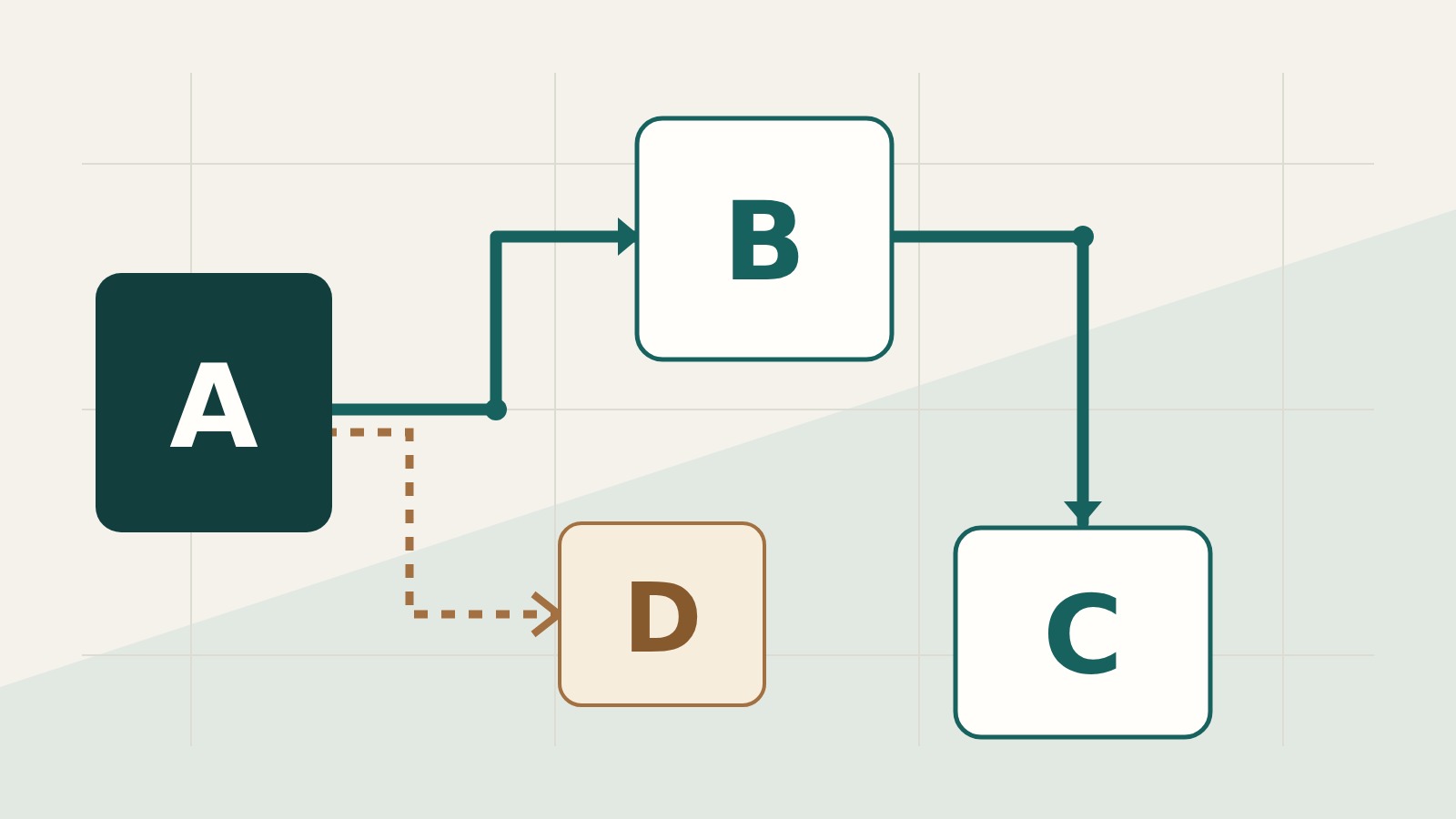
The findings should preserve the two different paths. B is directly held by A. C is reached through B, so A's relationship to C is indirect. D remains an investment with control unconfirmed on the stated evidence. The diagram is a way to keep track of those findings; its arrows do not supply evidence that was missing from the source records.
Now suppose C's latest record no longer names B. Do not keep the old arrow simply because it appeared in last year's group chart. Compare the relevant dates and inspect the disclosed change. The investment may have ended, an intermediate entity may have changed its name, or the sources may concern different periods. The company change-history guide explains how to investigate a material change.
You can usually stop at the level needed for the question. If the supplier identified C as the factory company, establish that particular path and C's identity. A complete map of every investment owned by A is a different, larger project. Keep unrelated companies out of the answer unless their relationship changes the conclusion you need to make.
Resolve gaps in the list
Different lists do not automatically mean one source is false. An annual report describes a reporting period, a commercial database may include historical records, and a supplier chart may have been prepared for a particular date or purpose. Write those dates beside the entries before deciding which relationships conflict. Avoid combining every company ever mentioned into an undated “current subsidiaries” list.
If no investment rows appear, describe the observable result. You may have found a report with no disclosed entries, an unavailable section, a loading problem or an incomplete provider response. Those are different situations. None gives you permission to claim that a company has no subsidiaries anywhere. If you already have a candidate's name, continue with that entity's own record instead of abandoning the investigation at the empty parent-side list.
When the relationship remains unresolved, ask the supplier a precise question: “Please provide the full Chinese legal name and USCC of the factory company, identify whether our seller holds it directly or through another company, and provide a dated record supporting that relationship.” Request the intermediate name when one is claimed. You are trying to resolve the link, not asking the supplier to repeat the phrase “same group.”
Your final record can be short. For each business, retain its legal name and USCC, the immediate investor shown, the direct or indirect path, the source and date, and any unresolved control question. Keep an older relationship as historical when the evidence supports that description. Do not overwrite it with a present-tense conclusion merely because you downloaded the document today.
Start a new lookup through ChinaValidate company search when you have the next exact entity name or code. Review the information and report coverage available for that company; a blank investment section is not a complete group chart. An ownership link also leaves separate questions about who operates the physical factory and which entity owes delivery or warranty obligations. Use the identified companies to ask those questions of the right business.