
China Company Registration Certificate
Find the right registration document for a Mainland Chinese supplier, map overseas form fields and check the company behind the business license.
Start with the Chinese legal name or USCC. Confirm the matching company before opening its profile.
For a company registered in Mainland China, the document to request as evidence of registration is its business license, 营业执照. An overseas form may call the requested upload a “Certificate of Incorporation” or “Company Registration Certificate,” even though those English words are not the title printed on the Chinese document.
Start by identifying what the recipient needs to establish. A license copy identifies the registered company; a current company lookup adds information about its present record. Shareholder documents, filed articles and certified translations answer other requests. Choosing the right material first saves a supplier from chasing an English-titled certificate that your reviewer may not actually need.
1. Identify the requested document
Read the instruction beside the upload box, not just its label. “Proof of company registration” is a purpose. “Certificate of Incorporation” may be the platform’s generic name for documents from several jurisdictions. Before rejecting a Chinese business license because the headings differ, check the instructions for Mainland Chinese companies.
The legal starting point is straightforward. Article 33 of China’s Company Law provides for a business license to be issued to a lawfully established company. It also recognizes electronic and paper licenses as having equal legal effect. This explains the document’s role; it does not determine every overseas recipient’s submission requirements.
There is a practical example in WorldFirst’s onboarding instructions. Under its Certificate of Incorporation category, the Mainland China section asks for a color image of the business license. That is one provider’s actual document policy, not a promise that another bank, marketplace or procurement team will accept the same submission.
For a supplier review, keep three questions together: which legal entity is being registered in your system, what information the recipient requires, and what form of evidence it accepts. If the instruction asks for a government-issued document, an attractive company profile prepared by the supplier is not an equivalent attachment.
This guide concerns Mainland companies. Check the entity type before applying company terminology: a branch or another business form should not automatically be described as a separately incorporated company. The company-type guide explains those distinctions. Here, the immediate task is selecting evidence for an existing supplier, rather than applying to establish a new business.
2. Match the evidence to the request
Several files can contain the same company name while proving different things. A registration document, a public search result and a commercial report should retain their own descriptions in your records. Renaming all three “registration certificate” makes it harder for the next reviewer to understand what was actually obtained.
| Material | Useful for | Keep separate |
|---|---|---|
| Business license | Identifying the company and its recorded license particulars. | A supplied copy and the company’s current registration position. |
| Public registration information | Checking the identified company against available public records. | The online result and a document issued for a specific official procedure. |
| Articles or registration archive copies | Examining a particular filed document or registration event. | The requested version, its provenance and access requirements. |
| Commercial company report | Organizing available company information for review. | The provider’s report and a government-issued certificate. |
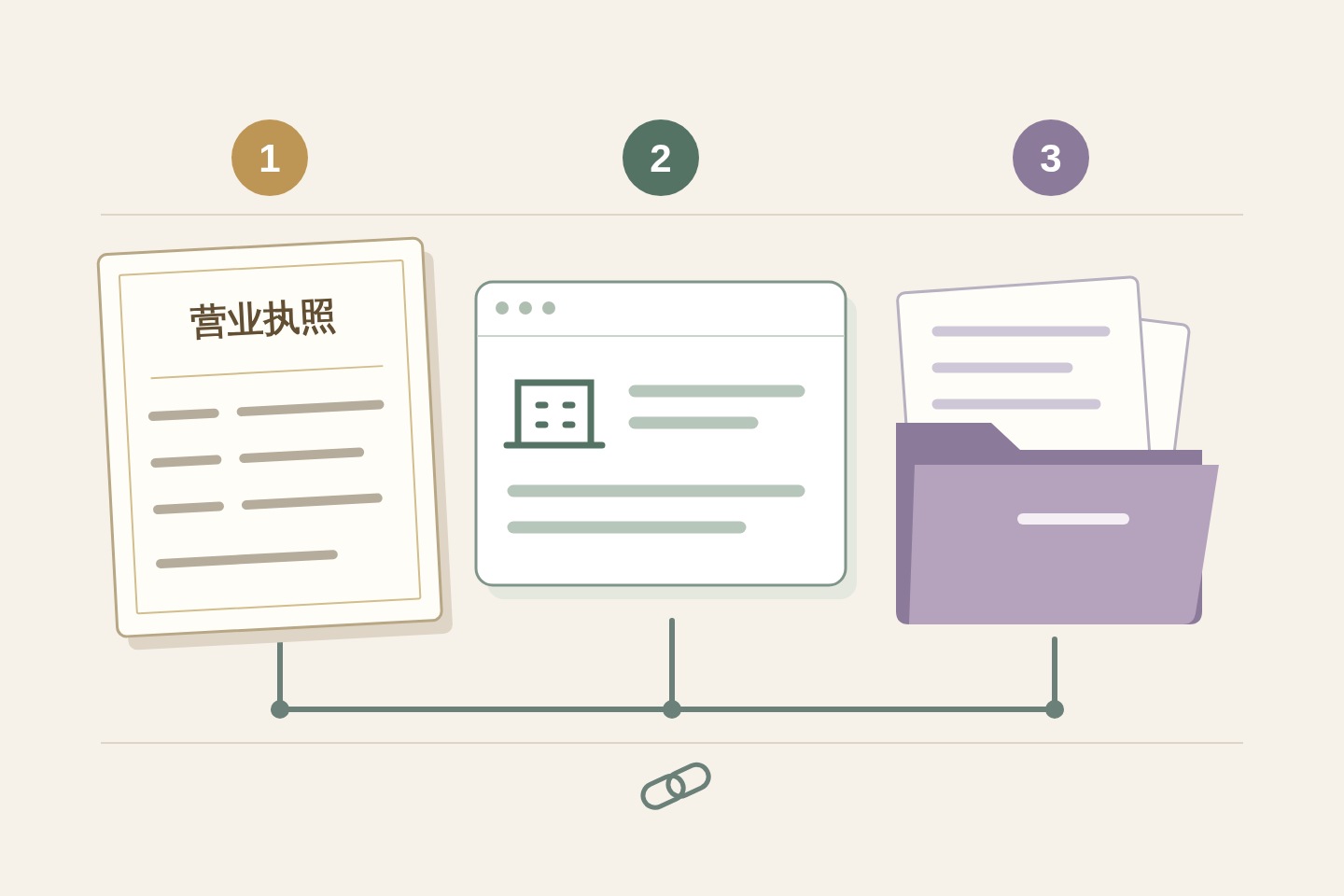
For example, an internal supplier form may need a license attachment and the registration number. A separate ownership review may need shareholder information. Uploading a clearer license can help the first task, but it does not add a shareholder list to the document. Identify the missing information before asking the supplier to send the same file again.
Likewise, a recipient asking for an official registration extract may mean something more specific than a screenshot. Article 22 of the 2025 registration-archive measures provides a route to registration-particulars information and an authority’s archive-query stamp according to the applicant’s needs. Wider archive access has separate eligibility rules. Confirm the requested result rather than assuming every company search produces it.
Use the registration-files guide when that distinction affects your submission. For ordinary public company information, the registration-search guide owns the lookup steps. You do not need to request historical applications merely to identify the business on a current license.
3. Connect the form to the company
A form written for international suppliers may use labels that do not appear word for word on a Chinese license. Treat the task as a documented correspondence between fields. Preserve the original value, explain the English label where needed, and keep the source attachment available to whoever approves the entry.
The Unified Social Credit Code is particularly useful here. Shanghai’s official English market-access explanation identifies it as the enterprise identifier recorded on the business license. For a modern company license carrying this code, use the full code when the recipient asks for that registration identifier; do not substitute a document filename, internal vendor number or invoice number.
| Form label | Document reference | Entry check |
|---|---|---|
| Legal company name | 名称 | Retain the complete Chinese name. Record an English rendering separately if required. |
| Company registration number | 统一社会信用代码 | Copy the complete identifier and follow any Mainland-specific form instructions. |
| Incorporation or establishment date | 成立日期 | Use the company’s establishment field, not the date the attachment was received. |
| Registered address | 住所 | Preserve the registered location; record a different delivery or factory address separately. |
| Document type | 营业执照 | Describe the actual attachment as a Chinese business license. |
Consider a hypothetical buyer setting up a supplier under an English sales name. The upload box says Certificate of Incorporation, while the attachment is headed 营业执照. The buyer should first connect the sales name to the company on the license. Simply copying the sales name into “legal company name” leaves that connection untested.
In the same example, suppose the license shows establishment in 2018, but the email arrived in 2026. The date of the email describes receipt of the evidence; it is not an incorporation date. If another date appears beside the issuing authority, preserve its label rather than choosing whichever date is newest. The establishment-date guide covers that specific comparison.
Where a form permits only Latin characters, ask the recipient how it wants the legal name recorded and attach the Chinese original through its accepted route. Do not silently treat your own translation as an officially registered English name. A short note linking the English rendering to the exact Chinese name and code is more useful than several inconsistent translated names across attachments.
A fixed-length input can also reveal a form configured for another jurisdiction. If it rejects the full company identifier, do not cut characters off to make the submission pass. Check the selected country and entity type, then ask the recipient which field or supporting document should carry the complete value. Keep any written instruction with the submission.
4. Resolve additional document requirements
Once the basic registration evidence is identified, separate any remaining request into a concrete item. “More company documents” is difficult to act on. “A current shareholder record for the company identified by this code” gives the supplier and reviewer something they can resolve without changing the meaning of the license.
| Additional request | Clarification to obtain | Next material |
|---|---|---|
| Ownership information | Which ownership level, date and evidence source are required? | The relevant shareholder information or specified supporting records. |
| An official stamped result | Which authority-issued result or archive document is acceptable? | The identified official service’s output. |
| An English version | Is a reading translation sufficient, or is a particular certification required? | The Chinese original plus the requested form of translation. |
| A more recent document | Is the concern a changed field, the copy’s date or current company status? | A current copy, change evidence or a dated registry check, as appropriate. |
For ownership, begin with the shareholder lookup guide. Do not fill an ownership section with the legal representative’s name just because it is easy to locate on the license. The person holding that registered role and the company’s owners are different questions, even when a particular person appears in both records.
For translation, establish the recipient’s requirement before commissioning work. A translated company report may make Chinese information easier to read, but that does not make it a certified translation of the supplied license. Preserve the source document with the translation so a reviewer can connect the wording to the actual fields. Avoid paying to translate the wrong version or an attachment belonging to another entity.
For a recent-document request, identify what is out of date. A new scan of an old license changes the scan date, not its contents. A company may have changed a registered name or address since the copy was issued. Keep both versions if available and investigate the particular difference instead of editing the attachment to resemble today’s company profile.
These questions are especially useful when a form gives little explanation. You can ask the recipient to confirm whether it needs the registration credential, current public particulars, a filed document, or a specified translation. The response establishes the submission target; it should not be replaced by a general internet claim that one file is accepted everywhere.
5. Check the company behind the document
After selecting the right attachment, verify that it belongs to the supplier you intend to record. ChinaValidate’s business license check accepts a readable license image or supported PDF, extracts information and compares available fields with retrieved company data. It is useful when the name and code are trapped in a photograph and need to be connected to a company record.
- Review the extracted identity. Compare the Chinese name and complete code with the supplied document before using the result in your form.
- Read the individual differences. Distinguish a recognition error, a changed field and unavailable information. A partial comparison should remain described as partial.
- Continue with the same company. Open its available company information and retain the identity used for the lookup.
- Keep the evidence descriptions. Store the license, lookup result and any additional documents under their actual names and dates.
This comparison does not issue a government registration certificate, certify a translation or authenticate every pixel of an uploaded image. If a recipient needs official electronic-credential validation or a particular authority-issued document, use that required route. The license-upload guide explains the comparison workflow and its result states.
A supplier file is clearer when it distinguishes what was received from what was checked. For example: “Chinese business license supplied by the company; name and code matched to the selected company record; the recipient’s ownership-document request remains outstanding.” That is a hypothetical handover note, not a completed verification of a real supplier.
When the name and code are already available as text, you can begin with company search directly. Keep the outcome tied to the original request: the right registration document, the right company, and any specifically requested evidence still to obtain. A different English heading on the form should not prevent that work—or substitute for it.