
How to Check a Chinese Company's Establishment Date
Find a Chinese company’s establishment date, distinguish later approval and licence dates, and calculate its age from the correct registration record.
Start with the Chinese legal name or USCC. Confirm the matching company before opening its profile.
To check when a Mainland Chinese company was established, find the company by its Chinese registered name or Unified Social Credit Code, then read the field labelled 成立日期. Keep that label beside the date. A more recent date beside the registration authority, a separate approval date, or a year in the supplier's brochure may describe something else.
This matters when you are filling in a supplier's incorporation date or trying to understand why an apparently long-established business has a recently issued licence. The task is to identify the beginning of the particular legal entity you found. You can usually resolve it without reconstructing the supplier's entire commercial history.
Find the company and its date
Begin with the National Enterprise Credit Information Publicity System, or an official local market-regulation service linked by the relevant authority. Search with the complete Chinese company name or the full 18-character Unified Social Credit Code. The code is especially useful when a familiar trading name points to several companies.
Open the matching company's basic registration information. Look for 成立日期, commonly translated as establishment date or date of establishment. An English onboarding form may call the requested value the incorporation date. Preserve the Chinese source label even when your form uses a different English heading; it lets another person confirm exactly which value you copied.
Keep the company's name and code visible while checking the date. A group may operate through an older manufacturer and a newer export company. If your onboarding record concerns the exporter, the manufacturer's earlier date does not become the exporter's incorporation date. Search and record the two entities separately when both matter.
The government's basic-information sharing notice lists establishment date and approval date as separate public information fields. It also describes lookup by company name or identifier. That is a useful distinction to carry into today's search, although regional layouts and access requirements can change. Use the labels on the page you actually open.
If you need help reaching the correct search function, follow the separate company registration search guide. Once you have the correct company page, concentrate on the dated fields rather than copying every number shown in the result.
Read the label before the number
A business licence can contain more than one date. The establishment field describes the company; another date can relate to the document or a subsequent registration action. Reading only the largest or most recent number is an easy way to enter the wrong year in a supplier database.
Articles 33 and 36 of the current Company Law need to be read together. Article 33 connects the business licence issued on lawful establishment with the company's establishment date. Article 36 provides for a replacement licence when recorded licence particulars change. Receiving a replacement document is therefore not, by itself, evidence that the company has just been formed.
A Huaibei market-regulation authority's answer about licence dates makes the practical distinction explicit: the labelled establishment date and the date at the foot of the licence can differ after a change. Treat this as guidance for reading those fields, rather than assuming every document format or registration event has exactly the same presentation.
| What you see | What to record | What to avoid |
|---|---|---|
| 成立日期 | The complete establishment date, attached to the named company and code. | Replacing it with a newer date simply because the licence looks recent. |
| 核准日期 | The approval date under its own label, with the source and lookup date. | Renaming it the company's birthday or guessing which event it represents. |
| A date beside the issuing authority | The document date and surrounding wording, retaining the full image. | Assuming the date describes initial establishment without reading the labelled field. |
| 营业期限 or an operating-term range | The term as shown, if present, separately from establishment. | Using its start or end automatically as the company's incorporation date. |
A blank field is not permission to substitute a nearby date. If the establishment date is cut off in a photo, request a complete copy or read the current registration record. If a translated report supplies only “registration date,” look back at the original Chinese field before deciding whether it means establishment or a later approval.
The licence's visual age is also unreliable. The market regulator's 2022 licence-format notice applies the adjusted format to establishment, changes and replacement issues, while allowing existing entities to keep their earlier licences. A modern layout can belong to an older company. For a full field-by-field reading, use the business licence guide.
Keep later dates separate
Suppose the registration page shows an establishment date in 2016 and an approval date in 2025. These entries are not contradictory merely because the years differ. They have different labels. Preserve both first; investigate the later event only if you need to explain it.
Look at the corresponding change information or ask the company for the registration document associated with that event. A change of address or name can be relevant, but do not select one just because it sounds plausible. The visible date alone may not tell you which application was approved. Record “approval event not established from this page” when the supporting detail is unavailable.
Likewise, an annual-report year, the day that report was submitted, and the date you downloaded a company profile are not interchangeable with establishment. They can appear near company details on a website without describing the same event. Keep the section heading with any screenshot or export so the date retains its context.
If you see an operating-term range, do not try to settle incorporation and expiry with one value. Current licence formats can omit that range, and an older licence can contain one. The business licence expiry explanation deals with operating terms and current status; those questions do not need to be resolved to transcribe an unambiguous establishment field.
Work through one date example
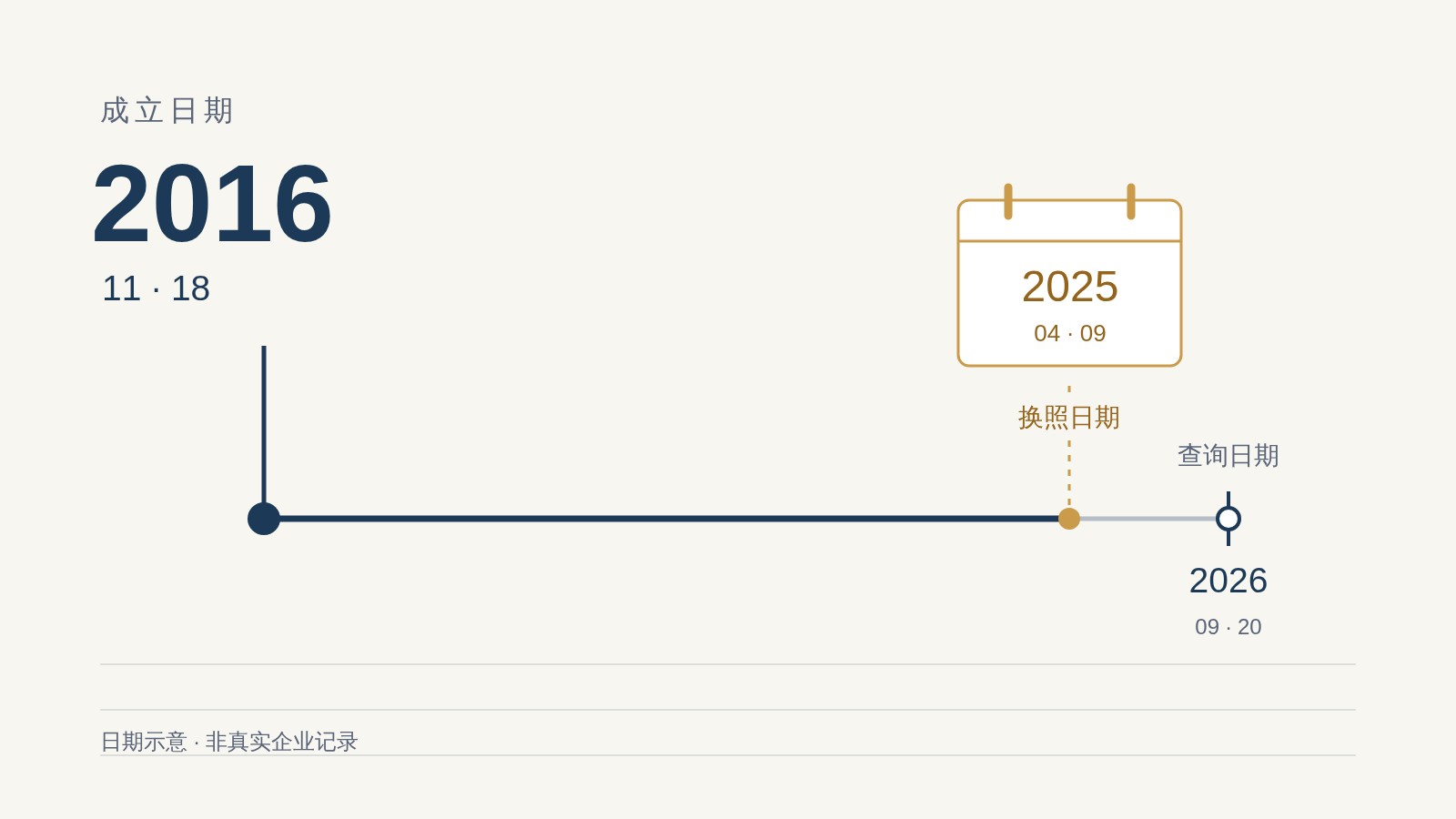
Consider a fictional Mainland company with the following information. These dates illustrate the reading method and do not describe a real supplier:
- The current company profile and the labelled licence field both show 成立日期: 2016-11-18.
- A later document bears 2025-04-09 beside the issuing authority. Supporting registration material connects that document with an address change.
- The profile is checked on 2026-09-20.
- The supplier's website advertises 20 years of experience, without identifying whose experience is being counted.
The incorporation date entered for this entity is 18 November 2016. The 2025 date belongs in the notes about the updated document, and the 2026 date records when the information was checked. The website claim remains a separate statement requiring clarification if it matters to the review.
As of 20 September 2026, the company has completed nine years since establishment; its tenth anniversary falls on 18 November 2026. Subtracting 2016 from 2026 and writing “10 years old” would overlook the month and day. In an onboarding form asking for whole completed years, compare the anniversary with the reference date before rounding anything.
For a fixed historical purchase date, calculate age at that date rather than at the day you write the report. An archived note saying “nine completed years as of 20 September 2026” remains interpretable later. An undated “nine-year-old company” becomes stale. Keeping the full establishment date is usually more useful than maintaining an age that needs to be updated.
Write dates unambiguously when working across languages. The source 2016年11月18日 can be retained as 2016-11-18 with a readable translation, 18 November 2016. A short numerical expression such as 04/09/2025 can be read as April 9 or September 4 in different countries. If only that ambiguous expression is available, ask for the original rather than choosing a convention silently.
If the source gives only a year, preserve that limited precision. “2016” does not justify entering 1 January 2016 to satisfy a required date box. Look for the full registration field or mark the date incomplete in your onboarding process. Similarly, a rounded age printed on a brochure cannot be converted back into an exact day of establishment. The calculation should start with a dated record, not create a date that the record never supplied.
Resolve a different claimed history
A mismatch between a brochure and the registry asks a different question from a mismatch between two establishment fields. “Established in 2006” on a group website may refer to a brand, predecessor, factory or another company. “Twenty years of experience” may describe a person's career. Neither wording identifies the incorporation date of your exact counterparty on its own.
Ask a focused question: “Which Chinese registered entity does this founding year refer to, and what record connects it with the company named on our documents?” A useful answer identifies the relevant company and distinguishes its date from any earlier operation. A reply that only repeats the marketing slogan leaves the relationship unexplained.
Do not automatically join the histories. An older company and a newly established affiliate can share a brand or staff while remaining separate records. Conversely, a changed name does not by itself demonstrate a newly formed company. When continuity depends on a rename or restructuring, follow the identifiers and dated registration evidence; the change-history guide handles that wider investigation.
The English-language EU SME Centre guide to knowing a Chinese partner explains why checking a Chinese legal name and registration identity matters. Its older system screenshots are not current navigation instructions, but the underlying identity check remains useful here: the date must belong to the entity being reviewed, not merely to a related name in a presentation.
A genuine younger incorporation date does not determine whether to buy from the company. Once the date is established, questions about team experience, facilities and a first order belong in the separate new-company supplier assessment. Keep those judgments out of the date field itself.
Save the dated result
A useful final note contains the Chinese company name, complete identifier, original date label and value, source address, and lookup date. Keep other date fields separately. If an image was supplied, retain the complete file and when you received it, so the document can be compared again without losing its context.
For the fictional example, the note could read: “Company establishment date: 2016-11-18, labelled 成立日期 in the company profile checked on 2026-09-20. The later licence document is dated 2025-04-09 and is supported by address-change material. Nine completed years as of the lookup date. The website's earlier experience claim is recorded separately.”
If two sources explicitly labelled 成立日期 disagree for the same company code, leave the conflict visible. Check the original characters, date format, record date and selected entity; then request current official evidence or clarification from the registration authority. Do not average the dates, choose the older one to support a sales claim, or treat the newer one as automatically more authoritative.
You can use ChinaValidate Company Search to locate the Mainland business and review available registration information. When a date's meaning is uncertain, return to its source label. The useful outcome is a specific establishment date tied to the right company and a dated source, with any unresolved difference clearly identified.