
China Tax Registration Certificate
Choose the right tax document for a Mainland supplier: a business license for identity, separate VAT status evidence, or a tax residency certificate.
Start with the Chinese legal name or USCC. Confirm the matching company before opening its profile.
Your supplier sends a Chinese business license when your onboarding checklist asks for a tax registration certificate. That can be the right response. For a Mainland company using a business license with a Unified Social Credit Code, the license also performs the tax registration certificate function. A separate certificate headed 税务登记证 is generally an older document, not the standard document to request from such a company today.
The next step depends on what your form actually needs: the company's identity, its tax identification number, its VAT registration status, or proof of tax residence. These are different requests. This guide helps overseas buyers choose the appropriate evidence and connect it to the Mainland company they intend to trade with.
- One license, several functions
- Match the tax document
- Read an older certificate
- Request and check the evidence
1. One license, several functions
The historical “three-in-one” reform combined the business license, organization code certificate and tax registration certificate into a business license carrying a Unified Social Credit Code, usually abbreviated to USCC. An overseas checklist written before that change can therefore ask for three separate documents where a current company supplies one.
The State Taxation Administration's July 2026 explanation confirms that tax registration has been integrated into business licensing. The relevant question for your supplier file is whether the document identifies the company correctly, rather than whether it has the old certificate title.
English names can obscure this change. “Tax certificate,” “tax registration certificate” and “tax identification document” are often used loosely in purchasing correspondence. Ask the person reviewing the file which fact they need to establish before asking the supplier to obtain a different document.
The current business license
Look for 营业执照, the Chinese heading for a business license, and 统一社会信用代码, the label for its 18-character USCC. Keep the company's Chinese legal name and the complete code together in your supplier record. The English trading name alone is a weaker way to connect documents that may use different translations.
For an enterprise covered by the merged registration system, receiving this license instead of a separate tax registration certificate is not, by itself, a warning sign. Equally, receiving a clear license scan does not establish that every tax-related claim made by the supplier is correct.
Registration and later tax procedures
A combined document does not mean that every subsequent tax procedure happens automatically. Jiangsu's tax authority guidance describes confirmation of shared registration information when an enterprise first handles tax business. It treats information confirmation, invoice-related matters and general VAT taxpayer registration as distinct items.
The same guidance explains that, after information confirmation, the USCC business license replaces the tax registration certificate for enterprises and farmer cooperatives covered by that procedure. Its local service instructions should not be treated as a nationwide checklist for every taxpayer or every tax matter.
For a buyer, the useful distinction is straightforward: the license connects the business to its registered identity. It does not show its latest filing record, unpaid tax position, invoice entitlement or entitlement to a treaty benefit. Request additional evidence only when one of those separate questions matters to the transaction.
2. Match the tax document
Start with the field you need to complete. A form labelled “VAT number” may be asking for an identification number, while a tax team may actually need confirmation of general VAT taxpayer status. Copying a number into the box will not resolve that difference.
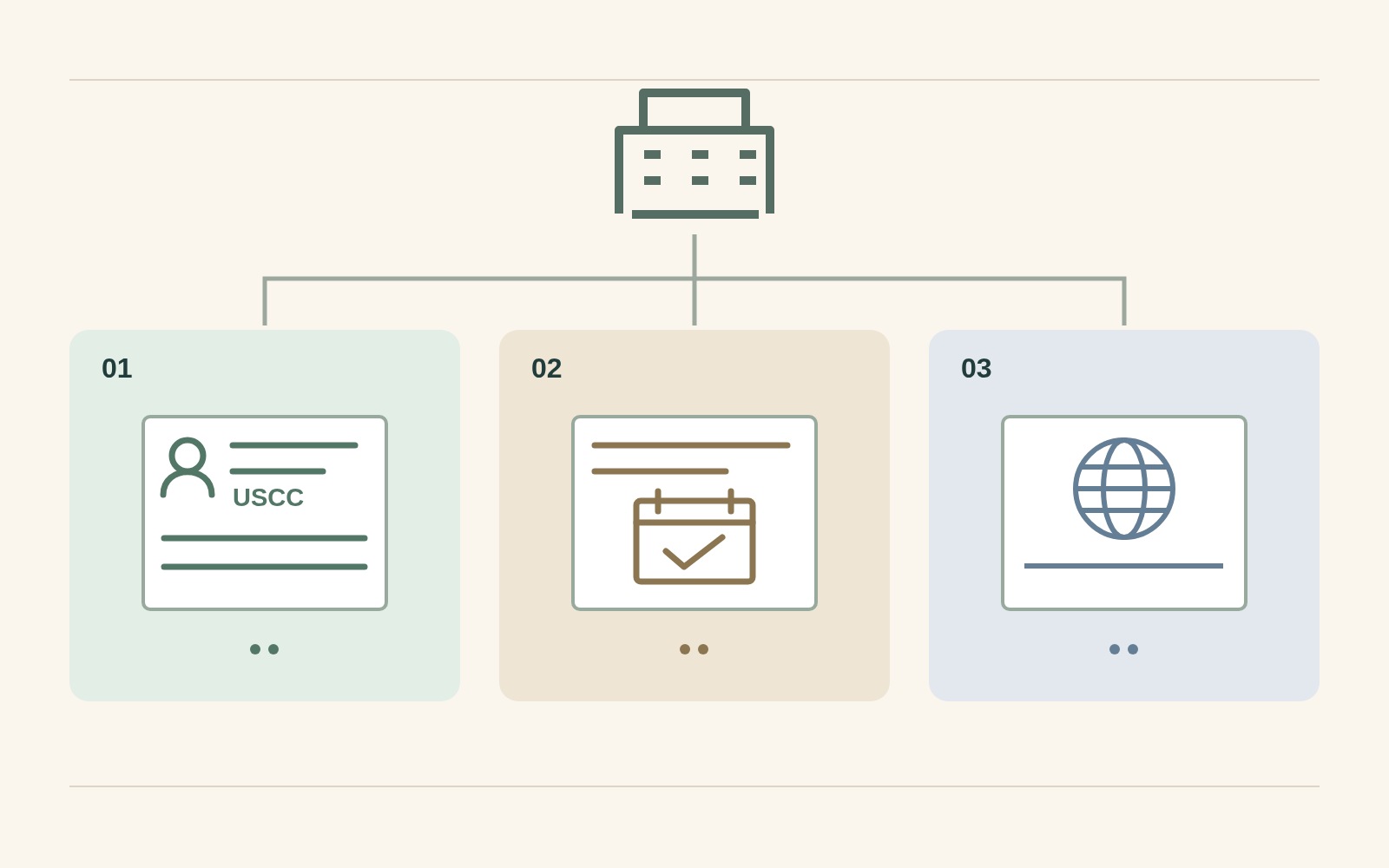
| Your requirement | Evidence to request | What remains separate |
|---|---|---|
| Company identity and tax identifier | Current business license with the Chinese legal name and USCC | Current company status and consistency with other supplier records |
| General VAT taxpayer status | Evidence of the company's current general VAT taxpayer registration, with the relevant date | Whether a particular invoice or transaction has the required tax treatment |
| Chinese tax residence | Chinese Tax Residency Certificate for the relevant year and purpose | Whether the specific payment qualifies for a treaty benefit or other relief |
| Explanation of an older tax record | Old certificate plus current license and evidence connecting any changed identifiers or names | Current registration information and the receiving party's document requirements |
A tax identification number
If the request is simply for the supplier's tax identifier, begin with the USCC on the current license for a company using the merged system. Copy all 18 characters, including letters. Do not shorten it to the organization-code segment or replace it with an English company name.
Ask the receiving party whether it needs the number alone or supporting documentation. A portal may provide separate upload fields for “business registration” and “tax registration” even when the same license is relevant to both. Explain the merged document and obtain confirmation about what that portal accepts.
If an old invoice or archived certificate contains a different number, use our Chinese company tax number guide to work through the identifier mismatch. A different historical format needs explanation; it is not sufficient evidence that the company is fraudulent.
General VAT taxpayer status
General VAT taxpayer status, 增值税一般纳税人, is a separate registration question. The 2026 tax authority announcement on general VAT taxpayer registration sets out registration and effective-date rules and replaces the earlier 2018 announcement on the subject. An old web article describing the previous procedure may no longer be a reliable guide.
If this status matters, request current evidence for the named company and the period relevant to your transaction. A business license alone does not answer it. Follow the separate general VAT taxpayer status guide for that check rather than treating “tax registered” and “general VAT taxpayer” as equivalent labels.
A tax residency certificate
A Chinese Tax Residency Certificate, 中国税收居民身份证明, serves a different purpose again. The State Taxation Administration's 2025 residency certificate rules, effective from April 2025, provide for certificates relating to a calendar year and cover both treaty and specified non-treaty uses.
If a payment reviewer needs evidence of Chinese tax residence, sending a business license does not answer that request. Identify the required year and purpose, then ask for the appropriate certificate. The certificate and any claim to a particular treaty benefit still need to be considered in the context of that payment.
3. Read an older certificate
An established supplier may send a tax certificate from its archives because an overseas buyer explicitly requested one. Older certificates exist; their presence does not, on its own, establish either a problem or current compliance. Treat the document as historical evidence until you can connect it to the company's current identity.
China Checkup's 2016 explanation illustrates the older certificate format and its Chinese field labels. It is useful for reading an archive document, not for determining today's registration procedure. Similarly, China Briefing's contemporary account of the reform helps explain why a longstanding supplier's document folder can contain both old certificates and a later combined license.
Fields that connect the record
- Taxpayer name: locate 纳税人名称 and retain the Chinese text. Compare it with the current license, allowing for a documented company name change.
- Identifier: record the full tax registration or taxpayer number under its original label. Do not assume that an older number must have the same length as today's USCC.
- Address and responsible person: use these as supporting comparison points. Both can change, so a difference should lead to a request for an explanation and relevant records.
- Issuing authority and date: preserve these when reviewing the document. They help place it in time; their appearance in a scan does not independently authenticate it.
Do not turn visual similarity into a verification result. A stamp, familiar layout or apparently official heading can help you recognize a document type. None proves that the copy belongs to the seller, remains applicable, or has not been altered.
A supplier with an old name
Illustrative example: a supplier sends an archived tax certificate under a former Chinese company name and a current business license under a new name. The English sales name has stayed the same, so the sales contact sees no inconsistency.
For the buyer, the useful evidence is the connection between the two Chinese legal names. Request the current license and the relevant company name-change record or explanation supported by registration information. Keep the earlier document in the history section of the file rather than presenting it as current evidence under the new name.
If the supplier cannot connect the records, leave the identity issue open. Do not resolve it merely because the contact person says that both documents belong to “our group.” Separate companies in the same group remain separate subjects for registration checks.
4. Request and check the evidence
A useful document request states the purpose, identifies the company and names any period that matters. It avoids requiring the supplier to guess which meaning of “tax certificate” your team has in mind.
A focused supplier request
For identity and tax-number onboarding, you can adapt this wording:
Please send your current Mainland business license showing the Chinese legal company name and Unified Social Credit Code. Our onboarding form requests a tax registration document. If your business license performs that function under the merged registration system, please confirm this. Please also explain any different company name or tax number in the documents already supplied.
If you need VAT status or tax residence, add that as a separate request with the relevant date or year. Avoid asking for every tax-related document by default. A smaller set of clearly identified records is easier to review than a folder of unrelated scans.
Connect the license to the company
- Read the source document. Use a clear, complete business license. Preserve its Chinese legal name and USCC exactly; keep an English translation alongside the original rather than replacing it.
- Compare registration information. Use ChinaValidate's business license verification tool to extract supported license fields and compare them with available company registration information.
- Review the comparison. Follow up on a mismatch or a field for which comparison data is unavailable. Missing information is not the same result as a matching field.
- Check the intended seller. Search the Chinese name or full USCC through company search. Compare the identified company with the party named in your supplier file and transaction documents.
Use the license tool for the business license itself. An older tax certificate, VAT registration evidence and a tax residency certificate answer different questions; a successful business license comparison does not authenticate those documents or establish tax clearance.
A portal with two upload fields
Illustrative example: a buyer's onboarding portal requires both “business registration certificate” and “tax registration certificate.” The supplier provides one current USCC business license. The buyer should explain the combined registration system to the portal reviewer and ask whether that document can support both fields.
The combined-document principle is reflected in official practice: a People's Bank of China announcement issued in 2015 explains the replacement of separate organization-code and tax-registration certificates for covered enterprises and cooperatives in its relevant business procedures. That is useful background, but it does not decide what an overseas bank, marketplace or buyer must accept.
If the reviewer instead asks for tax residence, the duplicate upload is not the answer. Change the document request to the appropriate certificate. If the reviewer needs a certified translation, confirm its translation requirements separately from the question of which Chinese document establishes the fact.
Keep the final record specific: the company identified, the license reviewed, the code recorded, and any separate tax evidence still needed. Start with the current business license when your purpose is supplier identity; follow the additional tax-document route only when your transaction calls for it.