
Chinese Invoice Translation
Prepare an English working translation of a Chinese invoice while preserving company names, tax fields, quantities and the original document.
Start with the Chinese legal name or USCC. Confirm the matching company before opening its profile.
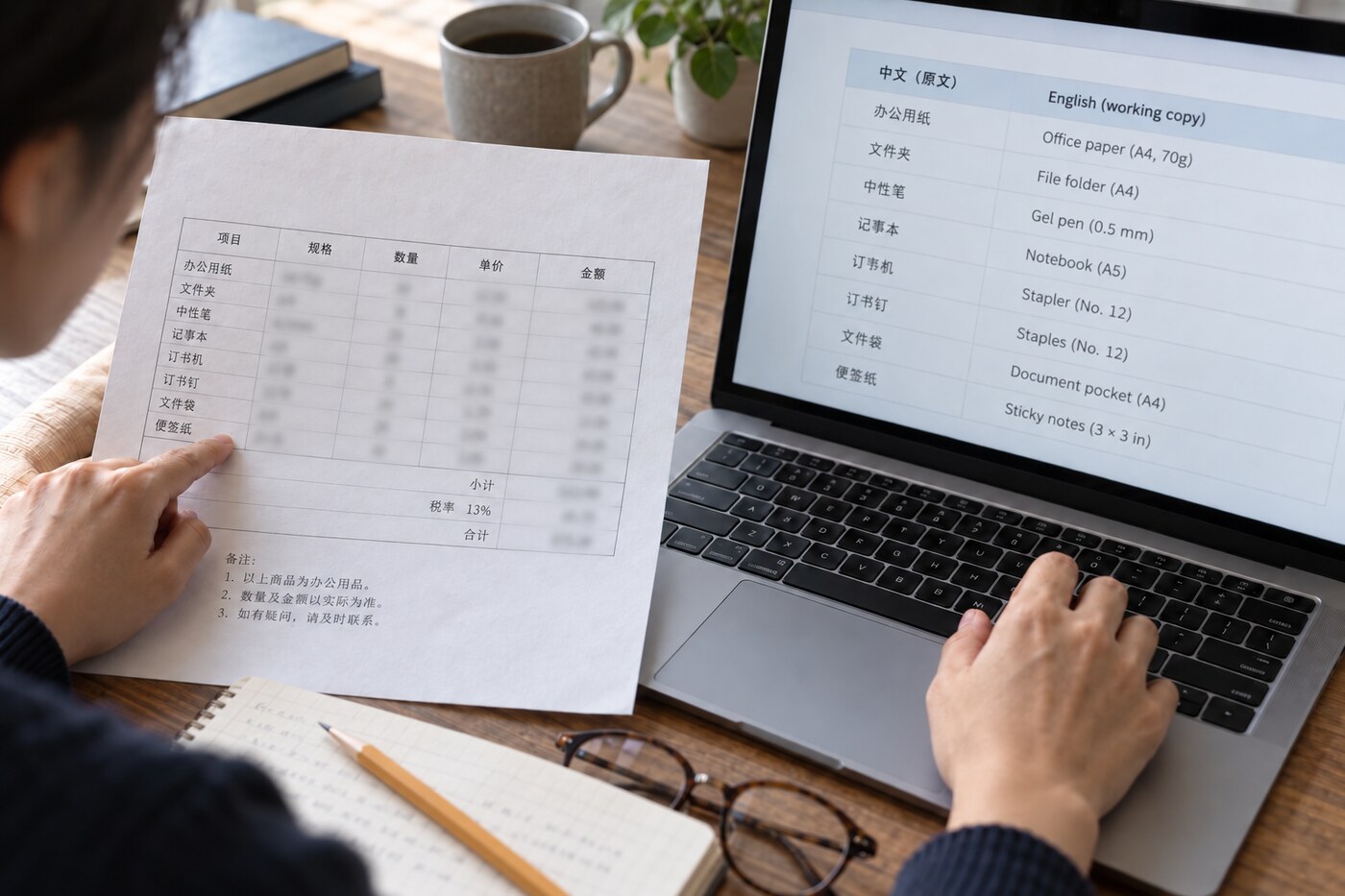
AI-generated cover illustration; the pictured paperwork is not an actual invoice.
Your supplier sends a Chinese invoice. A colleague needs it in English before reviewing the purchase. Translating the document sounds straightforward until the English copy changes a company name, drops a minus sign or calls the tax-inclusive total the amount before tax.
A useful translation lets another person trace every important entry back to the original. It should make the document easier to read without creating a new invoice or hiding uncertainty. Keep the original file, prepare a clearly identified working translation and verify the invoice separately when that check is needed.
This guide concerns invoices issued by mainland Chinese businesses, especially Chinese tax invoices known as fapiao. It follows one small teaching example through the translation process. The goal is a readable handover to an overseas buyer or finance colleague, not a substitute tax document or a promise of acceptance by an accountant, marketplace or authority.
The original and the translation
Start by identifying what you received. A Chinese fapiao, an English commercial invoice and a supplier quotation serve different purposes. An English file headed “Invoice” is not necessarily a translation of the Chinese attachment. It may be a separate document for the same order, with a different issuer, currency or scope.
China's invoice implementing rules require invoices to be issued in Chinese. The Invoice Administrative Measures also allow Chinese and foreign-language printing where there is a practical need. Neither provision makes a buyer's translated copy an invoice newly issued by the supplier.
Save the complete attachment as received. Request the original downloadable electronic file if a screenshot cuts off the seller, totals or remarks. Put annotations and translated text in a separate file. A bilingual working note is usually easier to compare than an edited PDF that conceals which words came from the issuer.
Name that copy plainly, for example “English working translation of [original filename].” Include the invoice reference and date as shown on the source. If a supplier provides its own English version, ask whether it is a translation or a separate commercial invoice before deciding that two totals should match.
Keep each company identifiable
Preserve the original Chinese legal name beside its English rendering. A familiar storefront name may be useful for communication, but it should not replace the company named in the seller field. The buyer's name belongs to the buyer block, even when that company is the one your team recognizes.
For an illustrative source entry, 销售方:示例甲公司(虚构) can be explained as “Seller: Example Company A (fictional).” The Chinese wording remains available for comparison. In a real file, label a name you translated yourself as a translation rather than presenting it as the company's confirmed English trading name.
Copy taxpayer identifiers and invoice numbers exactly. They are identifiers, not phrases to translate. Keep letters, leading zeros and the association with the correct party. A spreadsheet may shorten a long number or show it in scientific notation; store the field as text and compare the saved output with the original.
If you need to establish the seller's registered identity, use its Chinese name or company identifier in Company Search. Do not search the invoice number as though it were a company code. A registration result can help resolve an identity question; it cannot confirm that every detail in your translation is correct.
A worked translation
Consider a fictional purchase of metal clips. The teaching extract below has no usable invoice identifier, seal or real company details. Its purpose is to show how a short translation preserves the relationship between description, unit, quantity, price and total.

| Chinese source entry | English working translation | What to preserve |
|---|---|---|
| 金属夹;规格:每盒20个 | Metal clips; 20 clips per box | The pack description belongs with the item. |
| 单位:盒;数量:10 | Unit: box; quantity: 10 | The invoice quantity is boxes, not individual clips. |
| 单价:40;金额:400 | Unit price: CNY 40; amount excluding tax: CNY 400 | The assumed price is per box, before tax. |
| 税率:13%;税额:52 | Tax rate: 13%; tax amount: CNY 52 | This is the example's assumed rate, not advice on the applicable rate. |
| 价税合计:452 | Total including tax: CNY 452 | The total already includes the stated tax. |
The item quantity is 10 boxes. Because the description says 20 clips per box, a reviewer can separately calculate 200 clips. That calculation is an explanatory note, not a reason to replace the original quantity with 200. Changing the unit while leaving the unit price unchanged would change the meaning of the invoice.
The amounts also stay in their original currency. The example has CNY 400 before tax, CNY 52 in tax and CNY 452 including tax. An overseas finance team may later convert the amount for its accounts, but the translated invoice should not quietly replace CNY 452 with a dollar or euro value.
In a real document, the meaning of the price must come from the actual labels and layout. Do not assume every supplier's commercial invoice follows this tax-invoice example. Use the Chinese invoice reading guide when the fields themselves are unfamiliar.
Translate the description that is present, not the more detailed product name you remember from the order. If the source says only “metal clips,” adding a material grade, brand or intended use would introduce information the invoice does not state. Put an order-to-invoice explanation in a separate note, with the order reference that supports it. This keeps useful purchasing context without making it appear that the issuer supplied those details.
Details that change the meaning
Review the translation against the source in small connected groups. A correct dictionary translation is not enough if a value has moved into the wrong row or been attached to the wrong company. Pay particular attention to entries that software can read confidently but interpret incorrectly.
- Tax and total. Keep 金额, 税额 and 价税合计 distinct. In the example, CNY 52 is the tax component, not an additional charge on top of CNY 452.
- Signs and adjustments. Preserve a minus sign, a discount row and references to red-letter invoices. Do not turn an adjustment into a new positive sale merely because a translation tool normalizes the number.
- Dates. Retain the source date and use an unambiguous English form. The issue date is not automatically the order date, payment date or delivery date.
- Units and specifications. Boxes, pieces, sets and weight units are not interchangeable. Keep a model reference or pack size attached to the item it describes.
- Blank and unreadable fields. A blank entry means no value is shown. An unreadable character means the source cannot be read reliably. Do not turn either into a guessed value.

Machine translation or OCR can help produce a first draft. It still needs comparison with the source, especially where text is faint, a table wraps across pages or the same label appears under both parties. If a character remains uncertain, ask for a clearer file instead of selecting the most plausible company name.
Keep remarks and attachments in view. A main page may refer to an item list or contain a note about the transaction. Translating only the visible first page can leave out the information that explains the purchase. Record which pages and attachments the working translation covers.
A wrapped description is another common trap. A second visual line may continue the item above it rather than start a new sale. Follow the table boundaries, quantities and amounts together before splitting it into separate English rows. Preserve an empty numeric cell where the original has one; do not repeat the previous row's price simply to make the translated table look complete.
Translation and verification
A translation answers what the document says. Invoice verification checks the relevant invoice record. Reviewing the underlying purchase asks whether the document belongs to the goods or services actually obtained. These are connected tasks, but a successful result in one does not finish the others.
For a supported Chinese VAT invoice, use the original fields in ChinaValidate Invoice Verification. Compare the returned details with the source file. Keep that result separate from the translation; do not add “verified” to the translated document merely because its text looks complete.
A practical Covington review of fapiao compliance explains that genuine invoice records can still be misused or concern a different transaction. This is why the purchase context matters even after a record matches. The example's arithmetic alone would not establish that any clips were bought or delivered.
If the Chinese original is correct but the English copy swaps the buyer and seller, correct the translation. If the original names the wrong purchaser or contains the wrong amount, ask the issuer to address the invoice through the appropriate process. Editing your English copy cannot repair an incorrectly issued source document.
The recipient's requirements
Ask who will use the translation and for what purpose. An internal purchase review, an expense claim, a marketplace request and a formal submission may require different supporting material. A clear working translation should not be described as certified or officially accepted unless the relevant requirements have actually been met.
For example, Australian government record-keeping guidance says business records must be in English or easily translated into English. It also calls for digital copies to reproduce original paper records clearly and truthfully. That is a specific jurisdiction's record-keeping guidance, not a rule that translating a Chinese invoice makes an expense deductible everywhere.
When someone requests a certified translation, obtain their requirements before commissioning the work. Confirm the required language, completeness, translator declaration and treatment of the original. Do not assume that a supplier's bilingual email, an automatic translation or a company-search report satisfies that request.
Likewise, a request for an English commercial invoice may call for a separately issued trade document rather than a translation of a fapiao. Clarify this with the recipient and supplier. The fapiao and commercial-invoice comparison explains the document distinction.
A usable handover
Send the original invoice, the working translation and the purchase reference together. Add relevant attachments and the verification result if you performed that check. Keep a short note identifying the source file, the pages translated and any unresolved text. A colleague should be able to open the original and find the corresponding entry without reconstructing your work.
Before handing it over, compare the party names and identifiers, item rows, units, dates, signs and totals once more. Check the exported file rather than only the translation editor: wrapped cells, missing pages and shortened numbers can appear during export. Keep an uncertain entry marked instead of silently filling the gap.
The finished translation should read naturally in English while remaining anchored to the Chinese source. It helps the next person understand the purchase, choose the appropriate check and ask a precise question. The original remains the document issued by the supplier; the translation makes that document accessible.