
Fapiao vs Receipt in China
A hotel bill, a payment record and a fapiao can describe the same expense. Learn to tell them apart and request the document you need.
Start with the Chinese legal name or USCC. Confirm the matching company before opening its profile.
Cover: an illustrative scene of travel paperwork and a payment screen.
You leave a hotel in China with a printed bill and a payment confirmation on your phone. Both show the amount you expected. Back at the office, someone asks for the fapiao. It is a familiar source of confusion: you have records of the expense, but perhaps not the document they need.
A fapiao is a Chinese tax invoice. An ordinary receipt, hotel bill or payment record does not automatically qualify as one. The reverse matters too: a narrow strip of paper can be a genuine fapiao. Start with the document’s purpose and title, rather than its shape.
This guide covers Mainland China. It helps you identify what you have, request a missing invoice and choose an appropriate check. Whether your employer accepts a document for reimbursement is a separate question for its finance team.
Receipts, payments and fapiao
In English, “receipt” can mean almost any record you receive after paying. That flexibility causes trouble when discussing Chinese paperwork. A colleague may say “receipt” while asking for a tax invoice; a hotel receptionist may understand the same word as a request for an itemized bill.
The Chinese labels help narrow the meaning. 收据 usually means a receipt, while 小票 is commonly used for a till slip. 发票, pronounced fapiao, identifies the tax-invoice concept. Those words are useful starting points, although a label alone cannot authenticate a document.
| Record | Look for | Purpose |
|---|---|---|
| Payment record | Bank, card or payment-app transaction reference and status. | The payment activity recorded by that channel. It is not an invoice verification result. |
| Ordinary receipt or bill | 收据, 小票, an itemized hotel folio or a merchant’s own receipt number. | What the merchant recorded about the purchase, charge or payment. |
| Fapiao | An invoice title, invoice identifiers and the seller’s invoicing details. | The invoiced transaction. An appropriate lookup can check the invoice information. |
The distinctions explain why the same expense can produce several useful records. A hotel folio may itemize room charges and meals. A card transaction may identify a charge processed on a particular day. The fapiao has its own invoice identity. One document need not replace all the others.
For example, a payment screenshot marked “successful” tells you what that screen reports. It should not be stretched into a claim that a particular supplier received settled funds, delivered the goods or issued a valid invoice. If payment itself is disputed, go back to the payment provider’s transaction details and the merchant’s records.
Likewise, an ordinary receipt is not automatically worthless or fraudulent. It may be useful for reconciling a purchase, querying a charge or finding an order. The narrower point is that it does not become a tax invoice simply because it records a real payment.
That distinction also appears in official guidance. Shanghai’s tax authority says that an ordinary till slip, receipt or order number cannot substitute for a required invoice in its July 2026 invoicing guidance. This concerns the invoicing obligation; it does not settle every foreign employer’s expense policy.
A related trap is treating the invoice date as a payment confirmation. A fapiao and a bank record answer different questions. Professional guidance from Covington on Chinese fapiao discusses this separation, including invoices issued before or after payment. When dates differ, compare the underlying transaction instead of assuming the difference proves a false invoice.
For an import order, you may also receive a commercial invoice or proforma invoice. Those documents introduce another distinction, covered in Fapiao vs Commercial Invoice. Here, the immediate task is simpler: work out whether the document in your hand is a bill, a payment record or a tax invoice.
Appearances can mislead
The quickest rule often suggested to visitors is also a misleading one: “Small paper receipt, not fapiao.” China has an ordinary VAT invoice in roll form, called 增值税普通发票(卷票). The national VAT invoice verification platform includes it in its invoice classification guide.
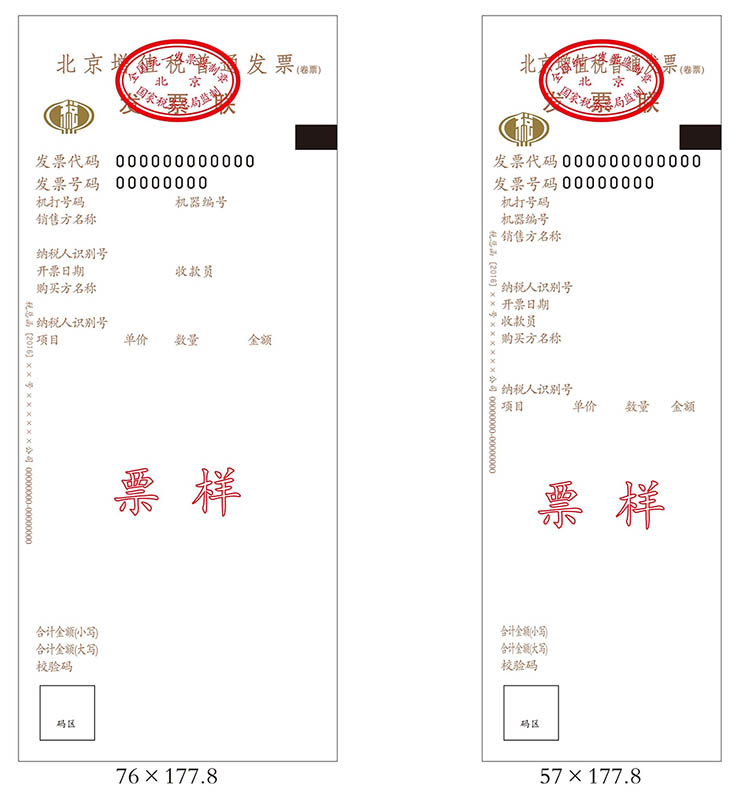
Notice the invoice heading near the top, followed by fields such as 发票代码, the invoice code, and 发票号码, the invoice number. The two examples have different widths, yet both are invoice specimens. Their paper format is the reason to look more carefully, not a reason to dismiss them.
These are historical specimens showing a recognized format, not a promise that every invoice issued today looks like them. Nor does a similar-looking slip prove authenticity. The image helps you identify a possible invoice category; an actual document still needs its own details checked.
At the other end of the spectrum, a polished PDF can still be an ordinary bill. A hotel logo, tax-inclusive total or prominent “PAID” marking may be useful information, but none turns the file into a Chinese tax invoice. Read the heading and identifiers before choosing a verification route.
A QR code is similarly inconclusive. It might open a payment page, a request form or a download. If it opens a form asking for your invoice title and email address, you may be at the invoice-request stage. If it opens an invoice file, save that file and read it. Our invoice QR code guide explains these different destinations.
Paper is not a requirement for validity. China’s Invoice Administration Measures recognize both paper and electronic invoices and give them equal legal effect. Asking for an electronic original can therefore be more useful than asking someone to photograph a printed copy.
A workable first inspection is short:
- Read the document title. Identify an invoice, bill, receipt or payment confirmation before interpreting its numbers.
- Find the invoice identifiers. A merchant order number or card transaction reference belongs to a different system.
- Read the issuer. Keep the actual invoicing name separate from the hotel brand, storefront or payment-app label.
If those parts are unreadable, ask for the original file or a complete, clear copy. Guessing a missing digit makes a subsequent lookup less useful. For a field-by-field explanation once you have identified a fapiao, use Read a Chinese Invoice.
From receipt to fapiao
Consider a hypothetical business trip. You pay for a hotel stay and leave with a folio showing the room charges. The payment app records the same total. Your finance team later asks for a fapiao made out to your employer.
The folio may be perfectly accurate. The missing piece is a particular document, not necessarily a suspicious transaction. Sending the same payment screenshot again will not answer the request. Contact the hotel with enough information to locate the stay and ask specifically for 发票.
First confirm the buyer name your finance team wants on the invoice. Do not assume it should be your personal name simply because you stayed in the room, or use a Chinese affiliate’s name merely because its tax number is available. The requested buyer details should reflect the actual transaction and the requirements of the party handling the expense.
Request the invoice
Send the booking or order reference, transaction date and relevant amount so the merchant can identify the purchase. Then supply the agreed invoice title, called 发票抬头, and an email address for delivery. Share payment evidence only as needed to locate the transaction, rather than sending a full account statement.
Please issue a fapiao for booking [reference], for the stay from [arrival date] to [departure date]. The invoice title should be [buyer name]. Please send the original electronic invoice to [email]. Let me know if you need any further buyer details.
请为订单[订单号]开具发票,入住日期为[入住日期]至[离店日期]。发票抬头为[购买方名称],请将电子发票原文件发送至[邮箱]。如需其他购买方信息,请告知。
The Chinese wording is a message you can adapt for the hotel, not a separate invoice template. For a supplier purchase, replace the booking and stay dates with the relevant order details. Ask for an invoice for the actual goods or services; do not request an unrelated description merely to fit an expense category.
Foreign buyers sometimes get stuck at a tax-number field. Shanghai’s 2024 invoice guidance says that foreign customers are among those for whom the buyer tax identification number or USCC may be omitted on an ordinary invoice. Do not invent an 18-character Chinese code or borrow another company’s number to make an online form submit.
If the merchant’s form insists on a number, explain that the buyer is overseas and ask the issuer how to complete its process. The form’s validation rule is not, by itself, a determination that your foreign business needs a Chinese USCC. Keep the exact buyer name agreed with finance while resolving the missing field.
When a booking platform is involved, also establish who is responsible for issuing the invoice for that transaction. Start with the booking terms and the hotel or platform’s support channel. A brand name on the reservation is not enough to identify the legal entity that will appear on the invoice.
The next check
Once the invoice arrives, compare the buyer, seller, description and amount with the expense you are documenting. If the invoice combines charges or separates items differently from the folio, ask for a reconciliation. Do not alter the file to make it agree with your records.
For supported ordinary, special and fully digital VAT invoices, ChinaValidate’s invoice verification tool provides a way to check the invoice information. Choose the appropriate input method and use the fields requested for that invoice type. The number printed on a card slip is not a substitute for an invoice number.

The roll-form specimen above illustrates a distinction worth preserving: a genuine invoice category is not necessarily supported by every verification tool. ChinaValidate does not currently check roll-form VAT invoices. For that type, use the applicable official verification route or ask the issuer for assistance; do not select a different invoice type to force it through.
There is also a separate company question. If the seller name differs from the hotel brand or supplier name you know, ask how the entities are connected. You can use a company search to look up the invoicing entity’s Chinese legal name or USCC. Registration information helps identify that business; it does not authenticate the invoice or establish the contractual relationship by itself.
Keep the result of each check with the question it answers. An invoice match concerns the invoice information checked. The folio explains the hotel charges. The payment record concerns the payment. Your finance team decides what it needs for the expense claim.
For the traveller in our example, the task ends when the missing fapiao has been obtained, its details reviewed and any discrepancy resolved. The original folio and payment record still belong with the expense. They were useful documents all along; they simply were not the whole set.