
Find a Chinese Company from a Product Barcode
Use a product barcode to find its associated company, then check the Mainland registration. Keep the brand owner, manufacturer and seller separate.
Start with the Chinese legal name or USCC. Confirm the matching company before opening its profile.
A product barcode can lead you to a company, but it does not necessarily lead you to the factory. The business associated with the number may be a brand owner, importer or another party responsible for the product identity. Your supplier may be a different business again.
Start with the complete product number, look up the company associated with it, then check that company’s Mainland registration separately. This gives you a useful identity trail without turning a barcode scan into a claim about origin, authenticity or the seller’s authority.
This guide follows that trail from a number on packaging to a company name you can investigate. It covers ordinary retail-product identifiers, not specialist medical-device identification or a full product-traceability investigation.
Start with the number
The digits beneath a familiar retail barcode commonly represent a Global Trade Item Number, or GTIN. EAN and UPC are terms you may see beside the number or in lookup services. The black bars are a machine-readable representation; you can usually start a manual search from the printed digits without scanning the package.
Use the actual selling unit in front of you. A bottle, a multipack and an outer carton can have different identifiers. Photograph the number together with the product name, size and packaging level. A sharply cropped barcode may be readable while leaving you unable to establish which item it identifies.
For a real published example, 6921168509256 appears beside Nongfu Spring 550 ml water in China Post’s public product list, item 88. That makes it a usable reference for recognizing a product number. The list is not a current GS1 company result, a factory record or evidence that a particular bottle is genuine.
The next two rows list 6921168520015 for 1.5 litres and 6921168593545 for 5 litres. The shared brand does not make those numbers interchangeable. Use the complete reference for the size you are checking, rather than removing digits until several products appear to share one code. A historical catalogue is also a reference to compare with current packaging, not a reason to disregard what is printed on the actual sample.
For example, a quotation might offer 24 bottles per carton while displaying the individual bottle’s number. Clarify whether the listed quantity means bottles or cartons and request the relevant packaging reference. Otherwise, a correct product lookup can still be attached to the wrong unit in your purchasing records.
Copy all the digits, including leading zeros. Keep a supplier’s internal SKU, a courier tracking number and the company’s Unified Social Credit Code in separate fields. The USCC identifies a registered business; a GTIN identifies a trade item. Putting a product barcode into a company-registration search does not convert one identifier into the other.
A check digit helps detect some transcription errors. It does not establish that a number was assigned to the product you received. Shenzhen’s standards institute explains both the check digit’s mathematical role and the limits of ordinary barcodes as authenticity evidence in its barcode guidance. If your copied number fails a format check, return to the label rather than generating a replacement number that passes.
Two useful lookup routes
Verified by GS1
Open Verified by GS1 and choose the product search when your starting point is a GTIN. The page also offers searches for other identifiers and for companies. Those options serve different inputs; choose the one matching the number you have.

GS1’s service explanation says a lookup returns information about the party that assigned the identifier and, where available, corresponding product information. Read the actual result instead of assuming every number will produce a product photograph and a complete specification.
Follow the current access conditions and usage terms. The public service is intended for limited individual searches; larger recurring checks have separate service options. A supplier catalogue containing thousands of rows is a different task from looking up one sample’s barcode.
When company information appears, preserve its wording and the field label in your own permitted records. Then compare any available product description with the item you photographed. A company name alone cannot resolve whether the number describes a 550 ml bottle, a larger bottle or a case of smaller bottles.
China’s product-information platform
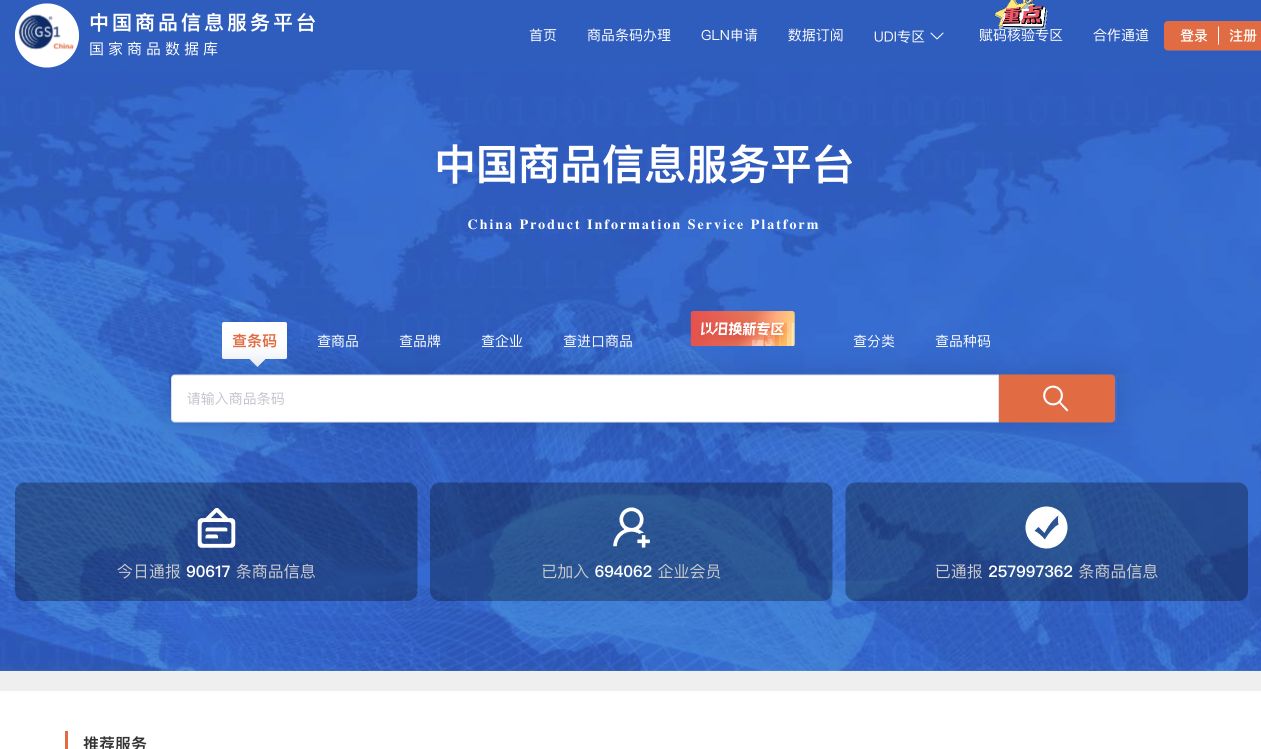
The China Product Information Service Platform, operated by the Article Numbering Center of China, provides a Chinese-language route. Its homepage separates 查条码 (barcode search), 查商品 (product search) and 查企业 (company search). With a complete barcode number, begin with the barcode option.
Access requirements matter. In the session shown below, submitting the published water-product number led to a login prompt. The message concerns access to search results. It is not a finding that the barcode is invalid, that no product exists or that a company has failed a check.

If your session requires an account, use the platform’s normal access route or another appropriate GS1 service. Do not borrow a supplier’s account or describe the empty area behind a login dialog as a completed “not found” result. Keep an access problem separate from a substantive response about the number.
Product information is supplied and maintained through these systems. Shenzhen’s product-data guidance distinguishes company and product information and discusses changes to registered details. A listing should therefore be read with its available dates and scope, not treated as an inspection of goods sitting in your warehouse.
The company behind the code
The most important question comes after the lookup: which role does the returned organization have? GS1 explains that the brand owner normally allocates the GTIN, regardless of where or by whom the item is manufactured. That party can be a manufacturer, but it can also be an importer, wholesaler or retailer arranging its own branded product.
| Role | Useful evidence | Unanswered question |
|---|---|---|
| Party associated with the GTIN | The identifier lookup and its stated company information. | Which role that business has in your transaction. |
| Brand owner | Brand information and relevant ownership or authorization documents. | Who actually manufactures the goods. |
| Manufacturer | Product labels, production documents and identified factory information. | Whether this is also your contracted seller. |
| Seller | Your quotation, order, invoice and supplier’s registration details. | How the seller is connected to the product and brand. |
These roles may belong to one company, but do not merge them before checking. A distributor selling a brand owner’s product can legitimately have a different name from the company associated with the barcode. The difference gives you a relationship to establish, not an automatic fraud verdict.
Consider a hypothetical private-label order. A retailer commissions a product from a Mainland factory and uses its own product identifiers. A barcode lookup could lead to the retailer. It would not reveal the factory merely because the goods were manufactured in China. To identify the producer, request the relevant manufacturer details and production evidence.
Conversely, a supplier may send a catalogue containing goods from several brands. Looking up one item can identify the party behind that item’s number; it does not verify the entire catalogue or establish that the supplier is authorized to sell every brand shown. Ask for the relationship relevant to the particular purchase.
From company name to registration
Once the lookup gives you a Mainland company name, move to company identification. Copy the full Chinese name where available. If the result provides only an English name, ask the supplier for the Chinese registered name and USCC rather than translating the English words back into a guessed legal name.
Use ChinaValidate Company Search with that name or USCC. The product barcode remains in your product notes; it is not the search input for this step. The official registration-search guide explains the GSXT route if you prefer to consult public registration information directly.
- Match the entity. Compare the complete Chinese name and company identifier. A shared brand word or city is insufficient.
- Read the current record. Review the available status, registered address and other relevant fields, retaining the lookup date.
- Connect the business to your order. Establish whether this entity is the brand owner, manufacturer or seller, using the documents for that role.
If the name and code are only visible in a license image, the business-license check can help extract and compare available registration fields. It does not check GS1 allocations or prove who owns a bank account. Use each result for the specific identity question it answers.
A similar English name is especially easy to overread. A group may contain several Mainland companies, each with its own USCC. If the barcode-related name and the order seller identify different entities, retain both. Ask which company is responsible for supply and what connects it to the product.
Compare addresses by their labels too. A contact address in a product directory and a registered address in a company record can serve different purposes. Neither should automatically become the factory location in your supplier file. Ask for the production site separately when that is the information you need, keeping its operator’s name beside the location.
Read an incomplete result carefully
Company found, product details missing. You have company information associated with the identifier, but no complete product comparison. Request a specification or label that ties the exact number to the selling unit. Do not fill an absent product description with text from another online shop and present it as the registry’s answer.
The product description differs. Check size, model, quantity and packaging level first. A case and a single item are not interchangeable inputs. If the supplied number still conflicts with the actual goods, ask the supplier to identify the correct existing number and explain the discrepancy. Keep the original reference while resolving it.
The company name differs. First distinguish a translation difference from a different entity. Compare Chinese names and available identifiers. Then ask whether the seller is a distributor, an associated company or the actual producer. A supplier’s explanation is a starting point for supporting documents, not a reason to silently rename the returned company.
No usable result appears. Recheck the digits and selected search type, and read the service’s explanation. An access prompt, connection failure and completed no-record response mean different things. If the identifier remains unresolved, contact the supplier or appropriate GS1 organization rather than labelling the physical item counterfeit from that result alone.
Origin and authenticity need more
A barcode beginning with a China-associated prefix is not a “Made in China” certificate. GS1’s country-of-origin explanation states that the prefix identifies the GS1 member organization that allocated the number range, not the manufacturing country. A product may be made elsewhere.
The same distinction works in reverse: goods made by a Chinese factory can carry identifiers arranged through another GS1 organization. Use the actual origin evidence required for your transaction. If you receive a certificate, the certificate-of-origin guide addresses that separate document.
Nor is an ordinary GTIN a unique serial number for one physical item. GS1’s barcode explanation describes the same product number being printed on many units of that product. A copied genuine number can therefore appear on packaging without authenticating the contents.
Finish with a precise conclusion: which product number you examined, which company the available information identified, and how that company relates to the seller. Keep any missing link explicit. Once you have a Mainland legal name or USCC, you can check the company; establishing origin, brand authorization and the authenticity of the goods requires the evidence for those separate questions.