
How to Find a Chinese Company's Legal Representative
Find the legal representative named in a Mainland Chinese company's public registration, then reconcile that name with an older licence or supplier document.
Start with the Chinese legal name or USCC. Confirm the matching company before opening its profile.
To find a Mainland Chinese company's legal representative, search its full Chinese registered name or Unified Social Credit Code in the National Enterprise Credit Information Publicity System. Open the matching company, then read the name beside 法定代表人 in its registration information. Copy the Chinese characters, the company identifier, the source and the date you checked it together.
That is a usable answer to “who is named in the company record?” It is not a search for every person who can speak for the supplier. An older licence, a translated name and a current public result can each say something different. The task is to connect those observations to the same company and the right point in time.
Find the correct company
Start with a piece of source material that identifies the business: a clear business licence, a contract party block or a company code supplied for onboarding. The full Chinese legal name is more useful than a brand, an English sales name or a shortened factory name. If you have the 18-character Unified Social Credit Code (USCC), keep the complete value as your second identity anchor. Do not type a salesperson's name into a company-name box and treat any returned employer as established.
Beijing's official company-information FAQ describes a public lookup by enterprise name, USCC or registration number. Use the normal query function and follow any verification shown by the official service. Its appearance and access steps can vary by national or local channel, so the stable instruction is to search for the business and open its own registration profile. The broader company-registration search guide explains the entry points if you need help reaching that profile.
At the result list, pause before copying a person's name. Match the selected company's complete Chinese name and USCC against the source you started with. Similar trade names can belong to separate legal entities. A factory, a sales company and a group parent can share a brand without sharing a registered representative. Even when the displayed person's name seems familiar, that does not repair an entity mismatch. The first result you opened may simply be the wrong company.
If a search returns several plausible businesses, compare their Chinese names, codes, company types and other stable registration details, then follow the candidate comparison method. If all you have is an English brand, identify its Chinese company first. Choosing a person before choosing the company reverses the evidence: the same or similar personal name may occur in many unrelated records.
Check the company type while you are there. A registered branch may display 负责人, a responsible person, rather than the company's 法定代表人. The branch can have its own record and code while pointing to a head company. If your quotation names a branch, save the branch's responsible-person field as labelled and identify the head company's separate legal representative only from that company's own record. The branch-office explanation covers the relationship; relabelling one role as the other makes an apparently tidy result inaccurate.
Copy the registered field
Look in the selected company's basic registration information for the label 法定代表人 or 法定代表人姓名. Record the label itself, not only the characters that follow it. China's current Company Law lists the legal representative's name as a company registration item to be publicly disclosed; it also requires the name on the company's business licence. The company-registration implementation rules identify the same field among the items on a company licence.
A current company profile and a licence image are two sources, not two interchangeable copies of one screen. On a licence, read the full name and code before the person's field. On the public profile, keep the company heading in view when you save or transcribe the person. A cropped line reading only “legal representative: Chen” loses the legal entity and often the Chinese characters needed to check the record again. The business-licence field guide deals with the rest of the document; this lookup only needs the identity anchors and the representative's labelled name.
Copy Chinese characters from the source where possible. If the value comes from a scan, inspect the actual image instead of accepting an OCR guess about a similar-looking character. Mark an unreadable character as unreadable and request a clearer file. A pinyin spelling or English rendering can help an overseas team pronounce or search a name, but place it beside the Chinese value as an alias, not over it. This is particularly useful when the supplier's English correspondence uses a name that does not transliterate directly from the registered Chinese name.
Take care with translated interfaces. A browser may translate 法定代表人 as “legal person,” “person in charge” or another broad expression, depending on context. The field label in Chinese and the company's registered type decide which role you actually found. A director, a manager, a shareholder, an ordinary sales contact and a legal representative can overlap in one person, but none of those other titles alone supplies the missing registered name. The legal-representative definition explains the legal role; this page stays with finding and recording the public field.
Save the source URL or service name and the day you viewed it. If the interface supplies a separate update, filing or change date for that item, save that too. The day you opened a page proves when you saw a value; it does not prove when the company appointed that person. Shanghai Customs gives a useful, narrower official example: when one registration service rejects company details, it asks users to check the public company information and match the entered details exactly. That is a reminder to retain original strings, not evidence that every public interface provides the same personal-data fields.
Compare records in time
The representative on an older business-licence scan may differ from the name now shown on the company's public profile. Preserve both. Company Law requires changes to registration matters to be registered and a licence carrying changed matters to be replaced after the change registration. A different name can therefore arise from a real change, an outdated document, a transcription mistake or a different company. The mismatch alone does not tell you which explanation applies.
Use the USCC and Chinese legal name to keep the entity fixed, then place each observation on its own line: the licence as received and any visible issue information; the public profile as checked today; and a relevant representative-change entry, if the service displays one. Do not put a change date into your note unless the record actually provides it. A public search timestamp, a licence print date, a corporate decision date and a change-registration date have different jobs. The general company change-history guide handles multi-field continuity; here you need only enough history to explain this person's name.
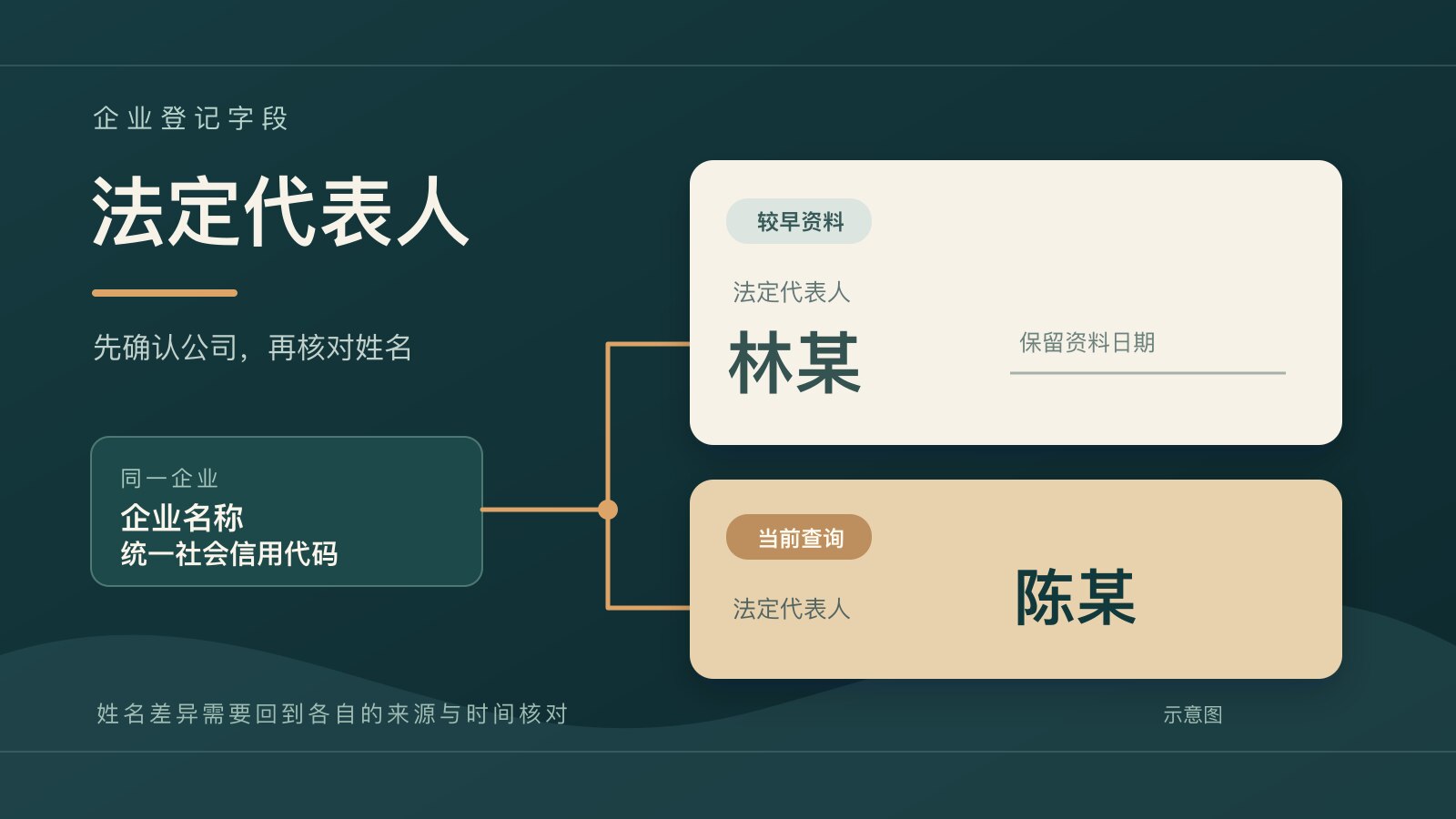
Consider an explicitly fictional supplier, 清禾部件有限公司. Its older licence copy names 林某; a later public registration result for the same masked company code names 陈某. If a displayed change entry connects those names and dates, the buyer can record a representative change. If no change entry is accessible, the buyer can say only that the two observed sources differ. The company should supply a current document or explanation before the buyer selects one value for a live onboarding form.
“Company: 清禾部件有限公司 (fictional). Code: masked in this example. Earlier licence copy received on [date]: 法定代表人 林某. Public registration profile viewed on [date]: 法定代表人 陈某. Change entry: [source and date if found, otherwise unavailable]. Current-name field: 陈某 as displayed by the public profile; document difference remains explained / unresolved.”
This note deliberately distinguishes the observed current display from a conclusion about the person's appointment or authority. If the supplier sends a newer licence naming Chen and its company code matches, that helps reconcile the file. If the code or company name on the licence belongs to another entity, stop treating it as a simple personnel change. Verify that second entity independently. The same approach works when a report is generated from a data source with a different retrieval time: keep both retrieval times visible rather than silently replacing one value.
An English sales signature saying “Mr. Lin, Managing Director” does not by itself disprove a current registry result naming Chen. Lin may hold another role, may have moved roles, or may be using a name the buyer cannot connect to either Chinese entry. Equally, a result naming Chen does not show whether Chen saw a quotation or approved a purchase order. Those are separate questions about a contact and the transaction. Use the personnel guide or transaction-specific authority review if those questions matter.
Resolve an incomplete result
Sometimes the task ends with a precise gap rather than a name. First identify which kind of gap you have. A blank search page, a returned entity without the field, a scan with an unreadable character and a different person in a supplier email require different follow-up. Treating every one as “no legal representative” erases the facts you actually have.
No matching company: preserve the query, access result and search date. Recheck the full Chinese name or code from the original source. A CAPTCHA failure, temporary access problem or English-only company name is not evidence about who represents the company. The company-not-found guide addresses identity and search failures.
Company found, field not displayed: record that the selected page did not show the field. Confirm the entity type and whether you opened a summary, an annual-report panel or the registration details. Try the proper public basic-information view or a clearer, current company document. Do not infer a representative's absence, resignation or formal removal from a missing line. Specific public records can carry their own explanations, but a blank display cannot supply one.
Name appears, characters or identity uncertain: save the exact visible text and request a better source. The same Chinese personal name can refer to different people; a matching pinyin spelling can refer to several Chinese spellings. Ordinary public company information is not a private identity dossier. This lookup does not require obtaining an identity number, home address or personal telephone to fill a supplier master record. If a transaction needs to establish that a particular contact is the person named, obtain appropriate confirmation through the company.
Another person sends the contract: keep the registered name and the signer's name as separate entries. The representative does not need to be the only employee communicating with customers, and a signature by someone else cannot be judged from the public name alone. Ask which entity the signer represents and what transaction-specific authority supports that person's act. The existing pre-contract guide covers that next decision; this article does not turn a name lookup into a legal opinion about a signature.
Keep the answer usable
A useful output fits in a few lines: “Searched [full Chinese legal name or USCC] in [service] on [date]. The selected company's Chinese name and USCC matched [source document]. The field labelled 法定代表人 displayed [Chinese name]. A separate [licence or earlier result] displayed [other name], dated [date or unknown]. The difference was [linked to a recorded change / awaiting explanation].” Keep the page URL, complete record capture or report alongside the note where your team's retention policy allows.
This wording lets a colleague distinguish three outcomes: a current public name tied to the correct entity; a historical difference with a documented explanation; or an unresolved conflict that still needs a document or company response. A record with an empty or unavailable field should say exactly that. It should not be completed from a website biography or a familiar English nickname because that makes a guess look like registered data.
If you need help reading the Mainland company profile across languages, ChinaValidate Company Search can locate company candidates and display available registration details, including a legal-representative field when the underlying data provides one. Keep the original Chinese name and source date with any translation. A compiled report helps organise the observation; it does not certify that a person can sign a particular contract or guarantee that every company has a complete field.
The registered-name lookup is finished when you can point to the exact company, the original field label and name, and the dated source. If the records disagree, leave the difference visible and ask for the one document or change entry that would resolve it. That is enough to move the company-information task forward without pretending that a public name answers every question about the people behind a supplier.