
Taobao vs Tmall: Know Your Seller
Understand Taobao and Tmall store types, find the business behind a shop, and separate company registration from brand authorization.
Start with the Chinese legal name or USCC. Confirm the matching company before opening its profile.
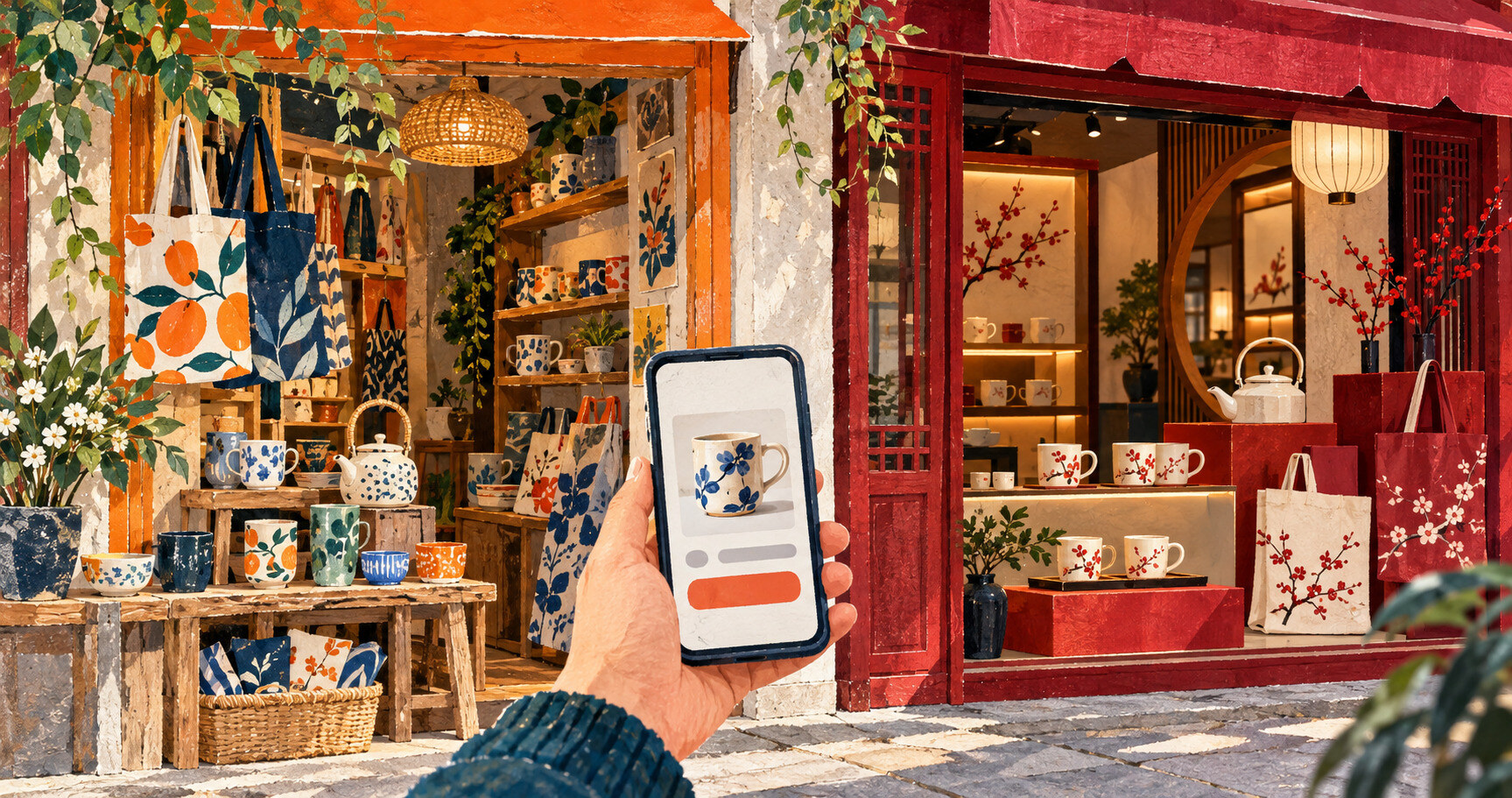
Cover: an AI-generated illustration of online shopping and contrasting storefronts, not actual Taobao or Tmall shops.
You find a ceramic mug in the Taobao app. One listing comes from a small homeware shop; another carries a Tmall label and a brand’s name. Open the second shop’s business details, however, and the registered company has a different name again.
That is where a useful Taobao vs Tmall comparison begins. The platform, the shop’s name, the business operating it and the brand on the product are different pieces of information. Understanding their relationship helps you choose a seller without mistaking a familiar logo for a company identity.
This guide focuses on sellers registered in mainland China. It explains store labels, the documents behind them and the short company check that connects a shop to its operator. Keep the original Chinese names when collecting details; a browser’s English translation is useful for reading, but the original text is more reliable for matching records.
One app, different sellers
Taobao and Tmall are part of the same shopping ecosystem. Alibaba’s description of Taobao explains that its app gives access to Taobao stores, Tmall flagship stores and other shopping channels. Opening the Taobao app therefore does not, by itself, tell you which kind of seller you are buying from.
Start with the individual shop attached to the product. Read its displayed type and business information together. A search result, a promotional banner and the shop’s qualification page serve different purposes; the qualification page is where you look for the operator’s identity.
| What you see | What to establish | Useful evidence |
|---|---|---|
| A Taobao shop | Whether the seller is a registered business or an individual operating under an applicable registration exception. | The shop’s business disclosure or exemption statement. |
| An enterprise-store label | Which registered business operates this particular shop. | The disclosed Chinese name, business license and company record. |
| A Tmall flagship store | The operator’s identity and its relationship with the named brand. | Business qualifications, plus the brand’s own store link or relevant authorization. |
| A specialty or multi-brand store | The operator and the brands or products its claim concerns. | Shop qualifications and evidence tied to the particular brand. |
Use this as a reading guide, not a ranking of honest and dishonest sellers. A small registered shop can have a clear identity. An impressive branded storefront still needs to be matched to its actual operator. Product condition, authenticity, delivery and after-sales service require their own evidence.
Read the store label
Three Chinese terms help when reading domestic Tmall shops:
- 旗舰店 — flagship store. The brand is central to the shop’s identity. Establish whether the operator owns the brand or operates under authorization.
- 专卖店 — authorized specialty store. The shop presents a relationship with a particular brand; identify the selling business as well as that relationship.
- 专营店 — multi-brand specialty store. Check the particular brand you intend to buy, rather than treating the shop’s overall presentation as evidence for every product.
TMO Group’s 2025 explanation of domestic Tmall store types describes flagship stores operated with an owned brand or exclusive authorization, alongside specialty and multi-brand formats. These are useful distinctions when reading a shop. Detailed admission requirements depend on the current platform rules and category.
The practical point is simple: a flagship-store name does not tell you, on its own, which company operates the store. A brand owner and an authorized operating company can have different legal names. A company-registration search checks the disclosed operator’s registration; it does not establish the terms of a brand authorization.
Look at where a claim appears. A platform-displayed store designation, wording drawn inside a seller’s banner and a brand’s own link to its shop are different forms of evidence. If the brand maintains an official website with a link to its Tmall store, follow that link and compare the destination with the shop you found. Similar-looking names are not a substitute for the same destination.
Keep the store URL with your notes. A translated word such as “official” can otherwise become detached from the page that actually made the claim. If the disclosure identifies a business outside mainland China, use the appropriate jurisdiction’s records instead of forcing that name into a mainland company search.
The company behind the shop
The Tmall Merchant Service Agreement, updated March 21, 2026, distinguishes the merchant from the companies providing the Tmall platform. Its admission section separately addresses business qualifications, brand authorization and other merchant information.

This distinction matters when you open a legal-information link. A license in a platform-wide footer may identify the website operator. It does not necessarily belong to the seller of the mug in your basket. Return to the particular shop and look for its own business details.
Look for labels such as 企业资质 (business qualifications), 资质证照 (licenses and qualifications) or 营业执照 (business license). These labels are more useful than memorizing a menu position that may differ between the app and desktop site.
The Shenzhen Lawyers Association’s 2024 platform-evidence guide, section 6.2.8, describes using qualification links on Taobao and Tmall to view a shop’s license. It is a historical walkthrough, not a guarantee of today’s button layout. If your session requires sign-in, use the platform’s normal access process; if the details remain unavailable, ask the seller for the qualification page or license through the shop’s messaging channel.
Collect only what you need for the check: the shop URL, the disclosed business name, its Unified Social Credit Code and the date you viewed the information. Keep a readable copy of the relevant disclosure. There is no need to collect someone’s private identity document to compare a registered company with its public record.
A different company name
Consider a fictional homeware brand, “Willow Cup.” Its Tmall flagship shop discloses an operator called “Hangzhou Harbor Homeware Co., Ltd.” The name difference is a question to resolve, not a conclusion about the shop.
Separate the two checks. First, match the disclosed operator to its mainland registration. Then establish why that business is entitled to operate the branded shop. The brand might be owned by that company, by a related company or by a separate business that granted authorization. Each explanation needs evidence appropriate to the relationship.
A document can make the distinction visible. The blank authorization template linked from Tmall’s older qualification documentation has separate spaces for the relevant parties. The small extract below is a reading aid, not an authorization for any actual shop.

For Willow Cup, a useful review would connect these records:
- The shop disclosure identifies Hangzhou Harbor Homeware as the operator of the exact store you visited.
- The company record matches the operator’s Chinese name and credit code.
- The brand evidence connects that operator to Willow Cup and the relevant store or sales activity.
If the seller sends an authorization document, read who granted it, who received it, what brand or activity it covers and its period of validity. If the named licensee is a different company, the document does not establish this operator’s authority. A document covering a different channel or an expired period leaves a different gap. Our brand-authorization guide covers that deeper review.
Keep the conclusion narrow and useful. You may be able to say that the company identity matches while the claimed brand relationship still needs confirmation. That is more informative than treating every completed company search as proof that all products are genuine.
Personal shops and public records
A personal shop needs a different starting point. China’s E-Commerce Law, Articles 10 and 15, provides specified exceptions to market-entity registration and requires disclosure of business-license information or the applicable exception. A missing license is therefore not, by itself, proof that a shop is fake.
The 2025-amended online-trading rules distinguish the information registered businesses disclose from the statements used by qualifying unregistered sellers. An individual business with a license, commonly called an 个体工商户, is also different from an individual relying on a registration exception.
For a buyer, the next action depends on the evidence shown. If there is a license, record the business name and type shown on it. If there is an exemption statement, read that statement rather than inventing a company name to search. The fact that a shop calls itself personal does not establish that every exemption condition is met.
You can still assess the product listing, order terms, seller communication and available platform protections. If your organization specifically requires a registered-company supplier or particular invoicing documents, confirm that requirement with the seller before ordering. A shop can be unsuitable for your purchasing process without that fact establishing misconduct.
A short registration check
Once a shop discloses a mainland registered company, use its full Chinese name or 18-character Unified Social Credit Code to find the record. Compare the returned identity with the shop’s disclosure, including the registration status and any relevant former name. For the detailed official lookup route, use our China company-registration search guide.
ChinaValidate company search can help you look up the disclosed business. If the seller provides a license image, business-license verification can help read and compare its company fields. Keep the shop’s original disclosure alongside the result: the company search does not independently establish who controls a particular Taobao account.
If the result is missing or unexpected, revisit the source before making a judgment. A cropped code, translated company name or wrong jurisdiction can send the search in the wrong direction. Request a clearer document or the original Chinese text, then repeat the specific check. Do not choose a similar company simply because its name sounds plausible.
Choose the seller, keep the evidence
Return to the two mug listings. The useful comparison is now more specific than “Taobao or Tmall.” For the first shop, you know what kind of seller is disclosed and what evidence is available. For the branded shop, you have identified the operator and checked the basis of the brand relationship as far as your evidence allows.
The Taobao seller agreement effective June 2, 2026 identifies the buyer and seller as the parties to an order. It also provides a controlled process for changes of store operator. Keep the business disclosure with the relevant order and date, rather than assuming that an old screenshot always identifies the seller of a later purchase.
Save the product listing, exact store link and relevant seller replies with your order record. Where a brand claim matters, retain the brand’s own store link or the evidence you checked. Where you require an invoice, confirm the issuing business and requested document before payment; an order confirmation and a Chinese tax invoice serve different purposes.
You do not need a thick report for every small purchase. Start with the decision you need to make: identify the seller, understand a brand claim or meet a business-purchasing requirement. The store label helps you find the next piece of evidence. The disclosed operator tells you which mainland business to check.