
China Organization Code Lookup
Find the company behind a nine-character Chinese organization code. Read its position in the USCC and connect old documents to current company information.
Start with the Chinese legal name or USCC. Confirm the matching company before opening its profile.
A Chinese organization code is a nine-character identifier that you may find in an old supplier file or on an organization code certificate. In the modern 18-character Unified Social Credit Code (USCC), the organization-code component occupies positions 9–17. It is not the last nine characters.
For a current company lookup, start with the supplier's Chinese legal name or full USCC. If you have only an old organization code, use it to compare documents while obtaining those current search details. Adding guessed characters to a nine-character code does not establish a registered company identity.
1. Recognize the old code
Look for the field label before counting characters. The Chinese label 组织机构代码 means organization code. An older document headed 组织机构代码证 is an organization code certificate. A supplier spreadsheet may preserve this field long after the company has adopted a business license bearing its full USCC.
The State Council's 2015 unified-code scheme describes the organization code as eight identifying characters followed by one check character. The same document distinguishes it from the former 15-character business registration number. These labels matter when an overseas form uses a loose term such as “company registration ID.”
| Identifier | Length | Typical context | Useful next action |
|---|---|---|---|
| Organization code | 9 characters | Historical certificate or supplier record | Obtain the current name and full USCC, then compare the embedded component |
| Former business registration number | 15 characters | Older business license | Read the field label; do not treat its final nine characters as the organization code |
| Unified Social Credit Code | 18 characters | Current business license and company record | Use the complete identifier for the company lookup |
A printed hyphen before the final character is a separator, not an additional identity character. Preserve the original document, but compare the nine letters or numbers without counting that separator. Do not remove a character simply because an accounting form expects digits: the word “code” does not mean that every position must be numeric.
Similar lengths can conceal different identifiers. Older taxpayer numbers can also contain 15 characters, so length alone cannot tell you whether a field is a tax number or a former business registration number. The USCC and tax-number comparison explains that separate distinction.
Historical terminology still appears in English supplier paperwork. China Checkup's 2014 introduction to organization codes shows the older certificate context. Use that context to understand an archived document; use current official information for today's registration and lookup procedures.
2. Locate it in the USCC
Count the USCC from left to right, beginning with position 1. The Beijing market regulator's explanation places the nine-character subject identifier at positions 9–17 and the full USCC's check character at position 18. This is the key distinction when comparing an old organization code with a newer license.
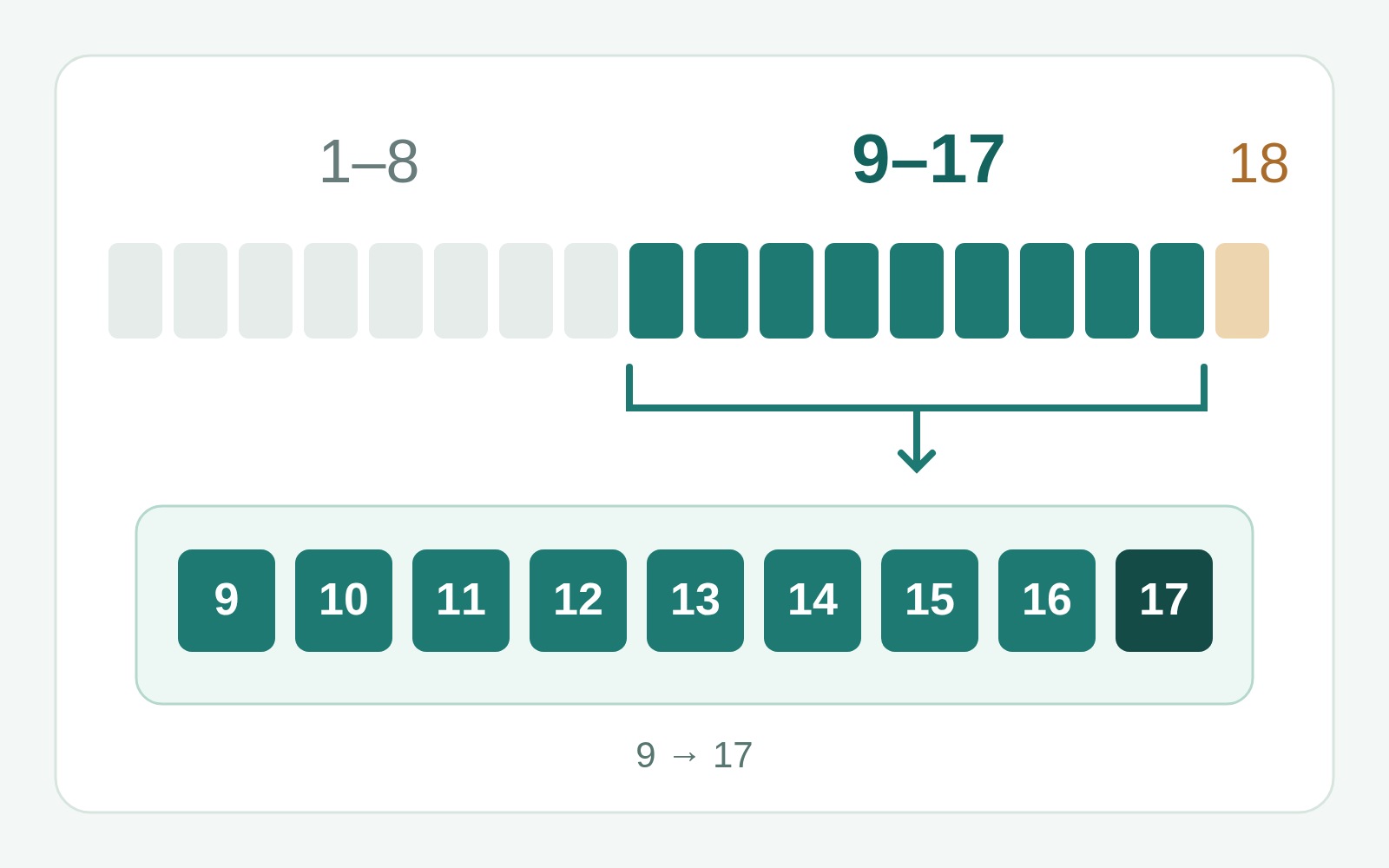
- Copy the full USCC. Start from a readable current license or a company record you have identified. Keep all 18 characters in their original order.
- Select positions 9–17. Count nine characters, including position 17. Do not take the last nine, which would start one character too late.
- Compare with the old field. Ignore a display hyphen, but compare every actual character. Keep the original values visible if they disagree.
The two check characters belong to different structures. The ninth character of the organization code falls at position 17 of the USCC. Position 18 checks the complete USCC. Replacing one with the other changes the identifier you are comparing, even if the result still looks like a plausible code.
An extraction example
Schematic example, not a registered company code: in ........ABCDEFGHX., the dots mask the first eight positions and position 18. The highlighted component would read ABCDEFGHX, sometimes displayed separately as ABCDEFGH-X. The last dot does not belong to that nine-character component.
Extraction works in one direction because the complete code already contains the component. A bare organization code does not supply every part of the full USCC. Do not fill the missing prefix from a supplier's present address or calculate a final character and call the result its official code. A mathematically plausible string still needs a corresponding registration record.
If the full USCC appears mistyped, the USCC validator can check its format and checksum. A pass is an input check, not proof that a company exists or is active. The separate USCC validation guide covers that calculation without confusing it with the old code's check character.
3. Find the current company
The next step depends on the material you actually hold. The quickest useful request is often for the supplier's current Chinese legal name and full USCC, rather than another English-language certificate bearing a trading name. Ask for the text as well as a readable document so that a blurred character does not become a search error.
A current business license
Read the Chinese company name and the complete USCC from the license. Search with that name or full identifier, then compare the selected company's name and code with the document. Extract the nine-character component only if you also need to reconcile an older supplier field.
If you received an image, business-license verification can help read and compare the available license fields. Inspect the extracted text before interpreting a mismatch. This route concerns the current business license; an old organization code certificate is a different document and should not be treated as the same upload.
An old certificate or supplier file
Keep the old Chinese name, organization code and document date together. Request the latest license from the supplier, then look up its current name or full USCC. Compare the embedded component with the old code and check any available name-change information if the company names differ.
Illustrative example: a procurement team finds a nine-character code in an archived supplier file. The supplier now sends a license under a different Chinese name. If the organization-code component agrees, that gives the team a specific connection to investigate. It should still confirm the current record and the name-change explanation before replacing the supplier name in its purchasing system.
Do not discard the old name as soon as a likely current match appears. It may be the name printed on earlier contracts or invoices. Keeping both names with their dates helps a colleague understand why historical documents and current orders use different wording.
Only a nine-character code
Ask for the company's Chinese legal name or current license. The National Organization Code Management Center's current lookup help describes searches using an organization name or complete 18-character USCC. Do not assume a bare nine-character input is accepted by every modern search service.
An exact web search for the old code may reveal a historical notice or document containing a name. Treat that name as a lead, then confirm it through current company information. A search-engine snippet, copied directory entry or old attachment does not establish the company's present registration status.
Once you have suitable input, use ChinaValidate company search. The company registration search guide also explains the official registry route. Keep the full identifier in the search; shortening an available USCC to nine characters throws away useful identifying information.
4. Resolve different results
A comparison is useful when it tells you exactly what needs clarification. “The codes do not match” is too broad if one document uses a full USCC and another shows only its organization-code component. First compare equivalent fields, then separate a copying error from a difference in company identity.
| What you see | First check | Next step |
|---|---|---|
| One code has a hyphen | Whether the actual nine characters agree | Retain the original display and use a consistent comparison format |
| The last character seems different | Whether you included USCC position 18 by mistake | Extract positions 9–17 again from the original document |
| The component agrees but the name differs | Old and current names, dates and available change records | Confirm the explanation before updating the supplier record |
| The nine-character components differ | Transcription and the entity named on each document | Identify each company separately and ask which one is your counterparty |
| The search returns no result | Input type, spelling and the service's response | Request current details and retry with a supported name or full code |
Compare the image with the typed value before changing a letter or number. An unclear scan may suggest more than one reading. Obtain a clearer copy instead of silently substituting a character to make a checksum pass. That would resolve a calculation while leaving the underlying identity uncertain.
Different entities should remain separate even when the supplier describes them as part of one group. A factory, sales company and contracting company may play different roles. Ask which named business will sign the contract and supply the relevant documents; an explanation of their relationship is not a reason to combine their codes.
A name change also needs a more precise explanation than “the company has a new number now.” The USCC management rules effective from February 2026 provide for a unique, lifelong code. Use the actual registration history to resolve a proposed change of identity rather than inventing a new code from the current name.
No result has several possible meanings. The code-center help describes login and access limits, as well as newly registered or changed information that has not yet been returned to its system. Record whether the service rejected the input, limited access or completed a search without a match. Those outcomes do not all support the same conclusion, and none alone proves forgery.
5. Keep the confirmed identity
Use the confirmed current Chinese legal name and full USCC for the supplier's main company record. Keep the old organization code in a separate historical field with its source. This lets you recognize older documents without using an incomplete identifier for each new lookup.
- Current identity: retain the Chinese legal name and complete USCC from the company record you checked.
- Historical reference: retain the old code, old name if relevant, and the document date.
- Comparison result: state whether positions 9–17 agreed and identify any unresolved character or name difference.
- Current status: record what the company lookup returned and when you checked it, separately from the code comparison.
If a form asks for “organization code,” confirm whether its owner means the legacy nine-character field or today's full company identifier. Entering 18 characters into a nine-character field, or truncating a USCC to fit an outdated form, can create a new discrepancy. Provide both labeled values when clarification is needed.
The useful endpoint is a current company identity connected to the old material, with any remaining difference made explicit. When you have the Chinese legal name or full USCC, look up the company and read its available registration information. A matched code connects identifiers; the current record supplies the context for using that identity today.