
China Export License: A Buyer’s Guide
Read a Chinese supplier’s export documents: distinguish an application from a license, check dates and goods, and connect the named exporter to a company record.
Start with the Chinese legal name or USCC. Confirm the matching company before opening its profile.
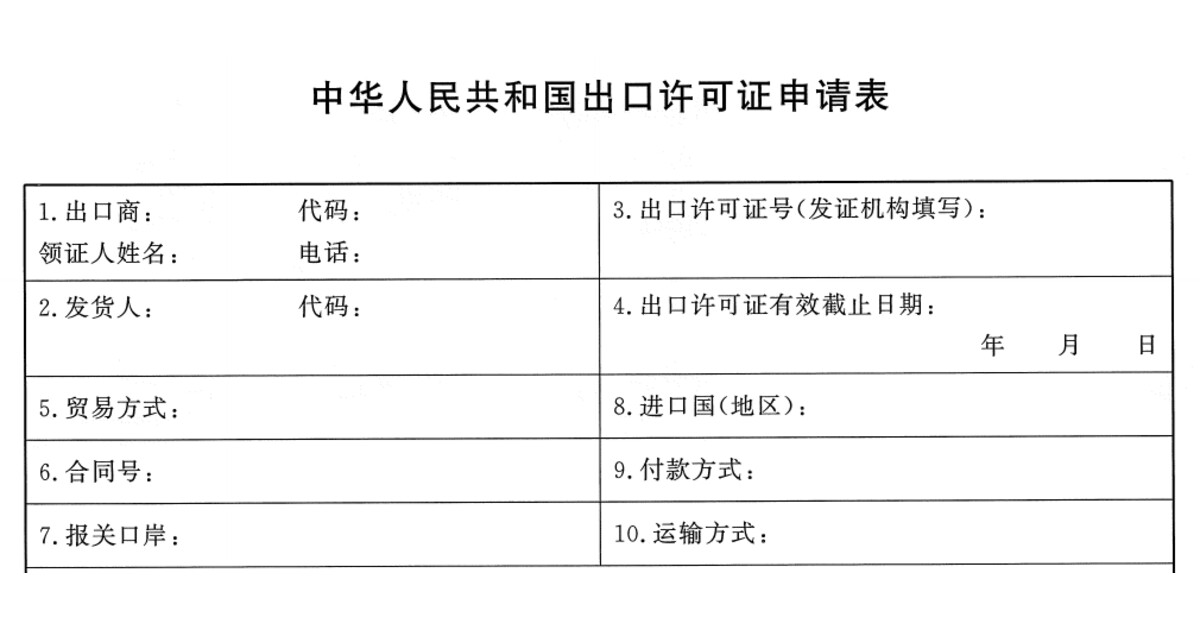
A supplier sends an attachment called “China export license.” Before looking for a stamp or a company number, read the document’s actual title. The attachment could be a license for particular goods, an application awaiting approval, or an old registration record. Each answers a different question.
For an overseas buyer, the useful task is to connect three things: the document, the goods in your order, and the company named on it. A genuine document can still be expired, belong to another company, or concern a different product.
This guide uses public Chinese government materials to show what to read. The cover is a detail from a blank application form; the issued license below is a historical specimen, not evidence for a current supplier.
Identify the Document
The Chinese title is often more precise than an English filename. Look for the words below on the document itself. You do not need to translate every box before deciding which kind of evidence you have.
| Words on the document | What they identify |
|---|---|
| 出口许可证 | An export license. Read its goods, parties and dates. |
| 出口许可证申请表 | An export-license application form. The last three characters mean “application form.” |
| 对外贸易经营者备案登记表 | A foreign-trade operator filing form, associated with a former registration requirement. |
On MOFCOM’s public application form, there is already a box for an export-license number. Its presence does not make the form an issued license: the box says the issuing authority fills it in. The notes also reserve the authority’s review fields for official completion.
The lower part contains a space for the applicant’s stamp. A supplier could therefore show a stamped application without having shown a granted license. Ask for the issued document when the transaction requires one.

Older filing forms need a different response. China stopped foreign-trade operator filing registration from 30 December 2022, following an amendment to the Foreign Trade Law. MOFCOM’s January 2023 explanation confirms the change. A missing old filing form is not, by itself, a reason to reject a present-day supplier; possessing one is not current permission for every export.
A customs-registration record is another document again. It concerns the enterprise’s customs registration, rather than a particular goods license. If that is what your supplier has sent, use the separate customs-registration guide. A certificate of origin likewise addresses origin, rather than granting export permission.
Keep the original file alongside any translation. A short English summary that calls all these documents “export licenses” removes the distinction you need to make.
Names, Dates and Goods
The historical specimen below was published through Shenzhen’s government service portal. Its exporter and consignor names are obscured in the source image. The dates remain visible: it was issued on 3 July 2008 and expired on 2 October 2008.

This gives you two firm observations without judging the seal or guessing the hidden names. The document’s validity ended years ago, and the redacted copy cannot identify its exporter. It may be useful as a specimen, but it cannot establish which company is licensed for an order today.
The two company fields
The first box identifies the exporter; the second identifies the consignor. MOFCOM’s form rules associate the exporter with the enterprise signing the export contract. Do not automatically treat both boxes as the manufacturer’s identity.
The official application guide calls for an agency agreement when the exporter and consignor differ. A difference can therefore have an explanation, but it needs documentation. It is not a blanket rule that any two companies can be substituted; requirements depend on the goods and arrangement.
For your file, copy each full Chinese name separately. If the English quotation uses a brand name, ask which Chinese legal entity it represents. If a name is blurred or cropped out, request a readable copy before attempting a company match. Guessing from the city or a few remaining characters is unreliable.
The transaction fields
Next, compare the license with the order documents in front of you. Work through the following pairs rather than checking boxes in isolation:
- License number and company identifier. They identify different things. An 18-character Unified Social Credit Code identifies an entity; it is not a license number.
- Issue date and expiry date. Both matter. A recent email forwarding an old scan does not renew the document.
- Goods description and commodity code. Compare the specified product with the contract, including relevant specifications and units.
- Contract and destination. A readable license for an unrelated contract or destination needs an explanation before it belongs in your order file.
Some English labels on older documents can mislead. The historical specimen calls one field “Terms of trade,” but its Chinese label refers to a trade category, such as general trade—not the FOB or CIF delivery term in your quotation. Its payment field identifies a payment method, not the beneficiary’s bank account. MOFCOM’s form-filling rules provide the underlying meanings.
Read these labels together with their entries. A document can look familiar while answering a narrower question than you expected. In the specimen, the goods are zinc-coated iron or non-alloy steel wire; the example illustrates document reading, not the current licensing treatment of steel.
Finally, separate a legibility check from authentication. Chinese rules recognize electronic and paper export licenses. The appearance of a red stamp alone is not a reliable approval test. Request the complete issued file and use the relevant issuing authority’s published contact or verification procedure when confirmation is needed.
The Product Boundary
“We have an export license” is incomplete without identifying the goods concerned. The 2026 export-license catalogue notice, effective 1 January 2026, covers 43 categories. The catalogue groups entries by commodity descriptions and codes; it is not a list of approved suppliers.
For a concrete example, page 37 lists citric acid, code 2918140000, followed by salts and esters of citric acid, code 2918150000. These are separate entries. The extract below shows the original code and description columns.

The distinction matters when an attachment describes a related substance rather than the material being purchased. A seller’s broad marketing description does not resolve that difference. Give the person handling customs the product specifications and ask them to identify the applicable entry and licensing requirement.
Use the catalogue as a question to resolve, not a shortcut around classification. You can point to a code and ask, “Is this the classification being used for our goods?” You cannot establish the answer just because a similar phrase appears on a website or an invoice.
The annual notice also addresses exceptions and other controls. In particular, dual-use licensing has its own requirements; a generic export license does not replace an applicable dual-use permit. Conversely, failing to find a product in this catalogue does not prove that its export is unrestricted.
Save the catalogue version and the written explanation used for the order. If the product, specifications or shipment timing changes, ask the exporter or qualified customs adviser to revisit that explanation. Your useful buying record is the link between the actual goods and the applicable requirement—not a folder containing a plausible-looking permit for something else.
The Company Behind It
Once the document is readable and its purpose is clear, connect the named exporter to a registered Chinese company. This is where a company search helps. It answers an identity question that the permit image, especially a translated or redacted copy, may leave unresolved.
Use the full Chinese legal name or USCC in ChinaValidate’s company search. Compare the returned legal name, identifier and current registration status with the supplier’s documents. Retain the Chinese name as the reference: English trading names and translations can vary between a quotation, website and email signature.
A business-license copy provides another place to check the name and USCC. If that is the document you have, business-license verification can help compare its company information with registry data. It is a separate check from establishing that an export license was issued and applies to your goods.
Consider a clearly hypothetical order: the quotation names “Harbor Tools,” but the export document names a different legal company. There are two immediate possibilities to investigate: Harbor Tools could be a brand of that company, or another company could be handling the export. A translated name that sounds similar does not settle which explanation is correct.
Ask the seller to identify its contracting entity and explain the named exporter’s role. Then check the company it identifies. Where an agency arrangement is claimed, obtain the relevant supporting agreement or transaction documentation instead of simply replacing one name with another in your records.
A successful registry match means you have connected the stated name and identifier to a company record. It does not establish that the company manufactured the goods, holds every necessary permit, or will fulfil the order. Nor does it authenticate the export-license image. Keep those conclusions separate in your purchasing file.
For the broader relationship between the seller, exporter and other parties, continue with verifying a Chinese export trading company. The narrower task here is to record exactly which entity appears on the license and how that entity relates to this transaction.
An Incomplete File
The next request should depend on what is missing. Repeating “send your export license” can produce the same ambiguous attachment again. These two hypothetical replies show a more useful way to continue.
The supplier sends an old foreign-trade filing form. Acknowledge it as a historical company document, then ask which current licensing requirements apply to the goods and who will be the exporter. If a goods license is required, request the issued document relevant to the transaction. Do not ask the supplier to renew a filing requirement that was abolished.
The supplier sends a stamped application. Record it as application material. Ask whether the license has been issued and, if so, request the complete issued file showing the parties, goods and validity dates. A submission receipt or an applicant’s stamp does not fill that gap.
Please send the complete issued document, including the exporter, consignor, goods and validity dates. Please also identify the Chinese legal entity named in our contract and explain any difference from the exporter shown on the license.
Keep the answer with the original attachment and your company-search result. Record what each item actually establishes: the file’s type, the named entity, the relevant goods and the dates. If one of those remains unclear, the purchasing decision still needs that specific piece of evidence.