
China Company Credit Reports
Compare Chinese company disclosures, public credit reports, banking credit files and commercial reports, then choose the right evidence for your supplier review.
Start with the Chinese legal name or USCC. Confirm the matching company before opening its profile.
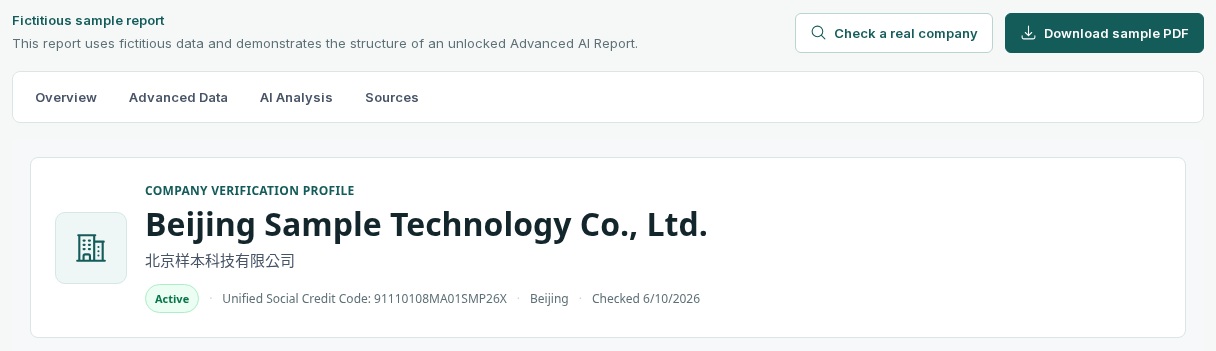
Cover: ChinaValidate’s public sample report. The company and records shown are fictitious.
You ask a Chinese supplier for a company credit report. They send a government-branded PDF. An English-language service offers another report under almost the same name. Your finance colleague expects something showing bank borrowing. All three may be talking about different documents.
“China company credit report” is a broad search term, not a guarantee of a particular set of records. Start with who issued the report, what information it contains and how it was obtained. A company-registration extract, a public credit report and a bank credit file answer different questions.
This guide compares the main options for Mainland Chinese companies. It also shows how to read a report’s identifying fields and an individual finding, so you can request a useful document rather than simply a longer PDF.
Four reports, different jobs
The word credit appears in several Chinese public-information systems as well as commercial products. It does not always mean a lender’s assessment of a borrower. Use the following distinctions when discussing a report with a supplier or research provider.
| Report or source | What to look for | Suitable use |
|---|---|---|
| GSXT company disclosures | Registration details, filings and available public company records. | Identify the registered business and inspect its disclosures. |
| Public credit information report | Public administrative and other credit-related records, with the issuing platform’s scope. | Review the public records covered by that report. |
| PBOC corporate credit report | Enterprise credit information, including reported lending information, through an authorized access route. | Examine the company’s financial credit record where access is permitted. |
| Commercial company report | The provider’s stated sources, modules, research and any analysis. | Obtain a readable company review, often in English, matched to a defined task. |
These categories can overlap in their underlying information. A commercial report might reproduce registration facts and summarize public legal records. That does not make the commercial provider the original issuing authority, or give the report access to every government and banking database.
Public company information
Registration and disclosures
The National Enterprise Credit Information Publicity System, commonly called GSXT, is the starting point for official company disclosures. Its Chinese name is 国家企业信用信息公示系统. Registration and filing information sits alongside other disclosures; the system’s name should not be read as a promise of a bank credit score.
China’s enterprise-information disclosure regulation distinguishes information published by authorities from information companies submit themselves. Its annual-report provisions also allow enterprises to choose whether certain financial figures are publicly disclosed. Consequently, a public annual filing is not automatically an audited financial statement.
For a buyer, this source is useful when the immediate task is to establish which company exists behind a trading name and read its available disclosures. Our company-registration search guide covers that lookup process. If the recipient specifically requires registration-file copies or certified records, follow the separate registration-file route rather than substituting a commercial summary.
Authentication is another distinction. SAMR’s 2021 introduction of real-name access describes report-sending and printing functions for authenticated users. It is evidence of the service’s purpose, not a promise that a historical button path will work on every overseas device today. Use the current official interface and its access requirements.
Public credit reports
Credit China and local credit portals provide a different view of public information. A 公共信用信息报告, or public credit information report, can bring together administrative and other public records. Read its contents and source notes instead of assuming it includes every category you have seen in another region’s report.
Access also varies by information type. For example, Jiangsu’s rules effective from February 2026 distinguish publicly available information, a subject’s own information and authorized inquiries. This is a provincial example of why “public credit” should not be interpreted as unrestricted access to every complete company file.
When a supplier sends one of these reports, ask which platform issued it and keep the original file. A screenshot of the cover may identify the report, but it leaves out the source explanations, record details and verification instructions needed to interpret it.
The banking credit file
A corporate credit report from the People’s Bank of China credit reference system belongs to a separate access regime. It concerns enterprise credit information, including lending information reported to that system. You cannot obtain a supplier’s full banking credit file simply by entering its name in an ordinary public company search.
The PBOC’s enterprise self-service inquiry guidance identifies legal-representative and authorized-agent routes. Identity verification and the relevant authorization matter. The precise process depends on the permitted channel; do not send someone your supplier’s login credentials or assume rules for personal credit reports apply to enterprises.
If your organization genuinely needs this document, specify the required report and ask the company to obtain it through an appropriate official or participating-bank channel. Agree on a secure way to provide the necessary information. A registry-only report cannot fill that gap, even when its cover uses the English term “credit report.”
Keep the reason for the request specific. Confirming a supplier’s registered identity and examining its borrowing history are separate tasks. Asking for the latter when you only need the former can produce unnecessary delay and an exchange of sensitive information that does not answer the original question.
Commercial reports in English
Commercial providers decide which sources and services their reports include. Some mainly organize public company information; others offer additional investigation, interviews or financial analysis. The report title alone does not tell you which service you are buying.
For example, System Day’s product description advertises investigation and credit recommendations, with financial information where available. Those are that provider’s stated services. They illustrate why two products called a China company credit report may differ substantially; they are not a description of every provider’s coverage.
Before ordering, inspect a sample and the actual deliverables. Separate three layers: the original record, its translation or summary, and the provider’s interpretation. A score or recommended credit limit belongs to the last layer. It needs an explanation of its methodology and inputs; a polished chart does not supply one.
For an English report, retain the Chinese legal name and Unified Social Credit Code alongside the translated wording. An English trading name can make the document easier to read, but it is not a substitute for the identifiers used to match the company. Ask whether the English name is supplied by the company, translated by the provider or taken from a specific record.
ChinaValidate’s public sample company report shows registry fields, groups of available company records and separate AI-assisted interpretation. Its fictitious data demonstrates the format. For a real company, review the returned modules and their availability; the sample is not a promise that every company has the same records. This company-information report is not a PBOC banking credit report or a credit rating.
Read the cover first
A useful report establishes its own identity before presenting findings. The official blank cover below makes that visible: it separates the subject, the company code, the report number, the generation date and the issuing organization.

When reading a Chinese cover, these labels are particularly useful:
- 主体名称 — subject name. Identify the entity covered, not the parent company or an English brand with a similar name.
- 统一社会信用代码 — USCC. Compare the company identifier with the supplier’s business license and the company you searched.
- 报告编号 — report number. This identifies a report; it is not the company’s registration number.
- 生成日期 — generation date. Distinguish the date the file was produced from the dates of its underlying records.
- 出具单位 — issuing organization. Identify who produced the document and follow its stated verification method.
For example, a PDF generated this week may include a previous year’s annual filing. Calling it a “current report” does not turn every figure into a current-year figure. Read the period beside a revenue number and the event date beside a legal record before comparing two reports.
If the supplier supplied the document, compare its identity fields with an independent company lookup. If you only have an image of the license, business-license verification can help extract and compare the available company fields. Keep the distinction clear: matching the company helps establish which entity the report concerns; it does not authenticate every page in that PDF.
A finding needs its context
The following screenshot comes from ChinaValidate’s fictitious sample. Its operating-exception entry includes a reason, an authority, a date of inclusion and a date of removal. Those details tell a more precise story than a colored warning label alone.

The sample says the registered address could not be contacted and later records removal after an address update. Describing that only as “an operating exception” loses the later development. Describing it as “no issues” loses the earlier record. A useful reading keeps both events and asks whether the actual supplier’s current documents resolve the relevant concern.
Apply the same care to empty sections. These results have different meanings:
| What the report says | What it supports | Useful follow-up |
|---|---|---|
| No matching record returned | The stated search found no matching result within its scope. | Check the searched identity, source and observation date. |
| Data unavailable | The report could not provide that information. | Determine whether another source or supplier document is needed. |
| Category not included | The report does not examine that subject. | Choose additional evidence if the subject matters to your decision. |
A useful question to the provider is therefore narrower than “Is this company safe?” Ask which source was checked, which entity and period were covered, and whether a result is missing or genuinely absent from that search. This makes it possible to close a specific information gap.
Request the report you need
Choose the document by the task. The following examples are hypothetical purchasing situations, not customer case studies.
A new supplier has sent a quotation. You need to identify the proposed seller and compare it with the license. Begin with company registration and the exact Chinese identity. A readable company report may then help you examine available ownership and public records. A banking credit file is not automatically necessary for this first identity check.
Your team is assessing a financial exposure. First agree which financial statements, borrowing information or independent analysis the decision requires. Then identify a provider or authorized source that actually supplies those items. A report with many registry pages may still omit the one category your finance team needs.
A tender names a particular public credit report. Request the specified issuer, subject, scope and date requirements. Do not substitute a translated commercial company report simply because it looks more detailed. Check the recipient’s instructions before purchasing or asking the supplier to produce a different document.
A precise request can be short:
Please provide a report covering [Chinese legal name] and [USCC]. We need [specific records or report type] for [purpose]. Please identify the issuing organization, data sources, generation date and periods covered. If you provide an English version, retain the Chinese company identifiers and explain any categories that are unavailable or outside the report’s scope.
To begin with the supplier’s identity, search the company using its Chinese name or USCC. Once you have the right report and have read its findings, the separate internal-approval guide explains how to turn that evidence into a decision. The useful starting point is a report that answers your actual question, with sources and limits you can understand.