
Chinese VAT Registration Proof
Read a Chinese supplier’s VAT qualification documents. Use the official registration form to identify the taxpayer, effective date and evidence of a completed procedure.
Start with the Chinese legal name or USCC. Confirm the matching company before opening its profile.
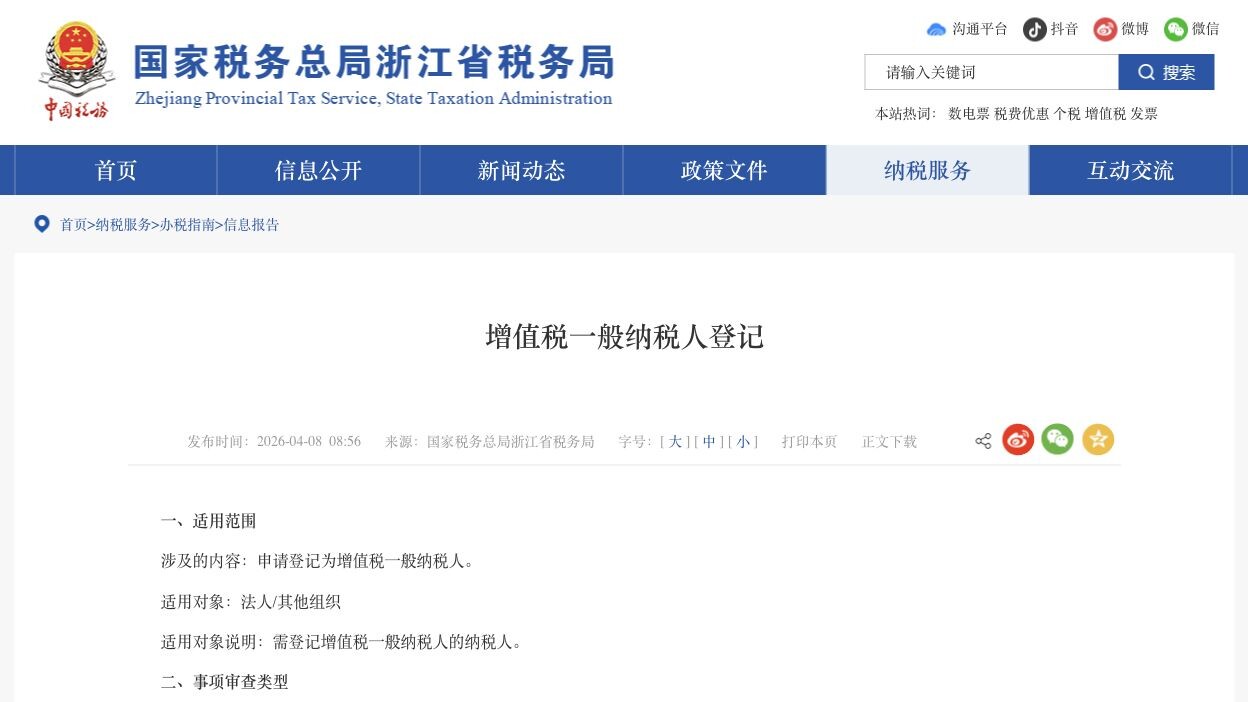
For a Chinese supplier’s general VAT taxpayer status, ask for evidence of the qualification itself. A business licence identifies the company; an invoice records a transaction; a general VAT taxpayer registration record addresses a different question. Before requesting a “VAT certificate,” decide which of those facts your purchasing or finance team needs.
This guide is for reading the documents a Mainland Chinese supplier sends back. It uses the tax authority’s actual registration form to show where to look, what the labels mean and which parts need supporting context. You do not need to understand every box to identify the taxpayer and recognize whether the material answers your request.
Identify the document
“VAT registration proof” is an English description of your evidence requirement, rather than a reliable prediction of the heading on a Chinese document. Ask the supplier to retain the original Chinese title. Translating every tax-related file as “VAT certificate” makes materially different records look interchangeable.
| Material received | Its useful starting point | What to establish next |
|---|---|---|
| Business licence — 营业执照 | The registered company and its Unified Social Credit Code (USCC). | Whether your request concerns identity or a separate VAT qualification. |
| General VAT taxpayer registration form — 增值税一般纳税人登记表 | The taxpayer’s registration information and the fields associated with the procedure. | Whether this is a blank template, a submitted form or a retained record of a completed registration. |
| Taxpayer qualification information — 资格信息 | The qualification shown by the relevant tax service. | The named entity, exact qualification, applicable dates and source of the result. |
The combined business licence and tax-registration system explains why a supplier may provide a licence when asked for a tax registration certificate. Grant Thornton’s China indirect-tax guide describes that integration. It does not make the licence evidence of every subsequent tax qualification. Our tax registration certificate guide covers the older certificate and the combined document in more detail.
If your form only needs the company’s identifier, resolve that request first. If it expressly asks whether the supplier is a general VAT taxpayer, keep that as a separate evidence field. A complete-looking onboarding file is not useful when its attachments answer a different question.
Read the registration form
The State Taxation Administration publishes the current form as an attachment to Announcement No. 2 of 2026. The extracts below come from that official blank form. They show the document’s labels, not a registration granted to a particular supplier.
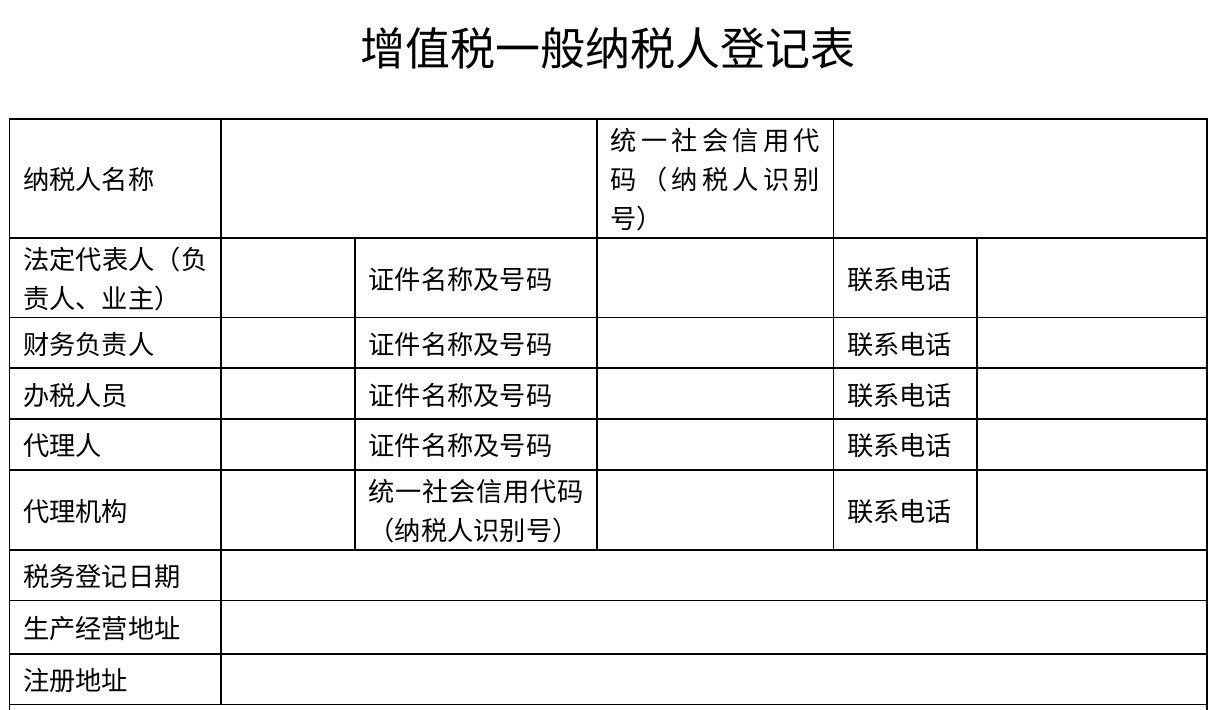
The taxpayer’s identity
Start with the first row: 纳税人名称 is the taxpayer name, and 统一社会信用代码(纳税人识别号) identifies the USCC or taxpayer number. Read the complete Chinese name and identifier together. A recognizable English brand is not a substitute for those fields.
There is another identifier field farther down, next to 代理机构, the agency handling the procedure. That code belongs to the agency named in that row. Do not copy it into your supplier record. The form also lists representatives and people responsible for finance or tax matters; their names do not identify additional supplier companies.
For a buyer’s qualification check, concentrate on the taxpayer, not the personal identity numbers collected for the filing procedure. Ask the supplier to avoid sharing unnecessary personal details while retaining the company identity and the material needed to understand the result.
Dates and categories
Several labels can look relevant without answering the same question. Use this short reading key alongside the original, rather than replacing the Chinese document with an English recreation.
| Label on the form | English meaning | Reading point |
|---|---|---|
| 税务登记日期 | Tax registration date | Keep it separate from the general taxpayer effective date. |
| 生产经营地址 | Production or business address | This is labelled separately from the registered address. |
| 注册地址 | Registered address | Compare like-for-like when checking the company record. |
| 纳税人类别 | Taxpayer category | Here the choices concern entity categories, including enterprise and individual business. |
| 一般纳税人生效之日 | General taxpayer effective date | This is the specifically labelled date relevant to the qualification taking effect. |
A tick beside 企业, meaning enterprise, should therefore not be translated as “general VAT taxpayer confirmed.” It answers the entity-category question in that row. Likewise, the main-business choices elsewhere in the form describe the business activity category, not an approval of the supplier’s products.
Preserve the date labels in your English note. Writing simply “registered on” beside two different dates conceals the distinction the form makes. If you are reviewing an earlier transaction, specify its period when asking for clarification; a document collected today may need additional context to answer a historical question.
The authority’s section
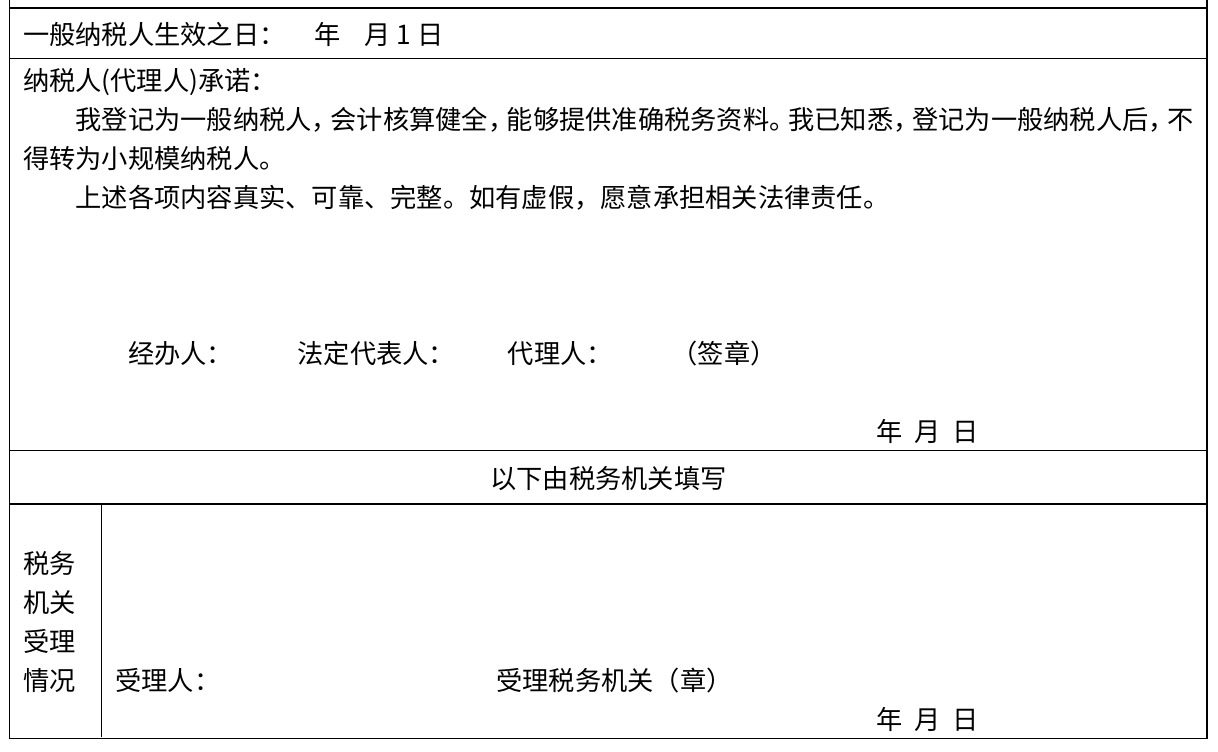
Below the taxpayer’s undertaking, the form introduces a section for the tax authority to complete. A supplier’s signature or company stamp in its own part should not be confused with an authority’s entry. When reviewing a copy, retain enough of the page to tell which section you are looking at.
This is also why a filled-in form deserves a more precise description than “certificate verified.” Establish how the supplier obtained the copy and what stage it represents. Visual recognition helps you read the document; it does not independently authenticate a stamp, prove that a filing was completed or establish the latest status.
The form’s official instructions say that the competent tax authority and the taxpayer each retain a copy. If the supplier sends its retained copy, ask it to identify that provenance. If it sends a fresh download of an empty template, the next request is for the actual company-specific information, not for an English translation of the template.
A filing and its result
Zhejiang’s 2026 general taxpayer registration service guide distinguishes submission, acceptance, review, completion and delivery. It also describes paper and electronic handling. Those stages explain why the existence of a submitted document is not the whole answer.
When the material is a screenshot or an electronic record, read the result wording and the surrounding context. A page containing editable fields tells you something different from a record showing the outcome. If the crop removes the taxpayer identity or the qualification, request the missing context rather than interpreting the page from its colour, logo or a single status word.
Ask for the current qualification information or the relevant completed-registration record from the supplier’s authorised tax contact. You do not need to enter their account yourself. Keep the source, the taxpayer and the date information connected in the material you receive.
Regional tax services may present the information differently. Do not insist on a particular menu label or a paper stamp just because another supplier’s file had one. Zhejiang’s guide expressly includes electronic delivery, but it does not establish that every region uses one identical screen or document layout.
A historical document can still help explain how a qualification arose. It should be described with its own date and purpose. For a current purchasing decision, decide whether you also need a recent qualification result. For an earlier invoice, ask for information relevant to that invoice’s date instead of assuming a current result settles the earlier period.
The 2026 announcement contains effective-date rules and transitional provisions, and replaces the 2018 announcement on registration administration. If a supplier or an old checklist cites an earlier rule, check which period is being discussed. Do not reject a historical record merely because a newer form now exists, or treat an old procedural explanation as the current rule.
Match the company
Once the document is understandable, connect it to the entity you are buying from. The useful comparison is between the taxpayer named in the qualification material and the Chinese legal entity in your supplier file. A group name, shop name or sales contact can help you locate the records, but does not replace the legal entity.
- Take the identity from the taxpayer fields. Retain the Chinese name and full identifier. Keep the agency’s information separate.
- Compare the business record. Use the supplier’s business licence and available company-registration information to establish which entity the document concerns.
- Resolve differences specifically. For a name change, ask for the record connecting the names. For a different identifier, establish which company each record belongs to before drawing a conclusion.
ChinaValidate’s business licence verification tool and Company Search support the company-identity side of this work. They should not be described as authenticating the tax authority’s qualification document. For the qualification lookup itself, follow the VAT taxpayer status guide.
An address difference also needs the right comparison. The registration form has separate registered-address and business-address fields. First establish which one the supplier has sent and which one appears in your company record. If the same labelled field differs, request an explanation and current evidence rather than silently choosing the version that looks more familiar.
Broader overseas-company due diligence guides, including the EU SME Centre’s partner-checking guide, treat tax qualification as one part of a company review. Its older procedural links should not be used as current instructions. The useful principle is to connect each specific claim to evidence about the correct company, rather than turning one tax document into overall supplier approval.
Request the missing evidence
A focused request is easier to answer than “send all tax certificates.” State the company you intend to check, the qualification you need and whether the request concerns the present or an earlier transaction. Ask for the original Chinese material with a short explanation if needed.
The following is suggested correspondence, not a prescribed official request:
Please provide the general VAT taxpayer qualification information for [Chinese company name and USCC], including the effective date shown and the source of the record. If you send a registration form, please confirm whether it is your retained copy following completion of the procedure. Please omit personal identification numbers and other information unrelated to this company-status check.
A Chinese version you can send to the supplier:
请提供[企业中文名称及统一社会信用代码]的增值税一般纳税人资格信息,并保留资料中显示的生效日期和来源。如提供登记表,请说明是否为办理完成后留存的材料。个人证件号码等与本次企业资格核对无关的信息可予以遮盖。
If the issue is a historical invoice, add its date and explain that you need the qualification applicable to that period. If only the entity is unclear, ask for that identity clarification first. Avoid turning a missing date into an unnecessary request for the supplier’s full tax returns.
Record the conclusion
Make your note match the strength of the evidence. “Supplier-provided registration copy received” and “qualification viewed through the relevant official service” describe different work. Record which occurred, along with the Chinese company identity, the date checked and any relevant effective date shown.
For an unresolved point, name the missing fact: the taxpayer is not visible, the record concerns another entity, the procedure’s outcome is unclear, or the applicable date has not been established. That gives the next reviewer a useful action instead of an unexplained yes/no box.
Keep invoice verification separate. If you also need to compare a particular fapiao with its recorded information, use the invoice verification guide. It addresses the invoice; this review addresses the company’s claimed qualification. Neither alone answers every question about tax compliance, a purchase’s treatment or the supplier’s ability to fulfil an order.
The practical result is a supplier file in which each attachment has a clear purpose: company identity, the qualification evidence received, the source and dates, and any remaining question. A precise record is more useful than a folder of differently named “certificates” whose contents nobody has distinguished.