
Chinese VAT Invoices After a Supplier Name Change
Compare invoice dates, registered names and seller identifiers when a Chinese supplier changes its name, and decide what evidence or correction to request.
Start with the Chinese legal name or USCC. Confirm the matching company before opening its profile.

A Chinese supplier's current name may differ from the seller name on a VAT invoice because the company changed its registered name after the invoice was issued. The difference alone does not make an earlier invoice wrong. Compare the invoice's issue date with the name-change registration date, establish that both names refer to the same entity, and verify the invoice itself.
A later invoice still using the former name calls for a different follow-up. If the date or identity cannot be established, keep the question open until the supplier provides the missing evidence. The invoice's match to an official record, the company's identity and any entitlement to deduct input VAT are separate matters.
A name-change timeline
In this illustrative example, the same supplier issued an invoice under its old registered Chinese name on April 8. Its name change was registered on April 18. A second invoice issued on April 25 still shows the old name. Assume the seller identifier is the same on both invoices and the registration evidence connects the names.
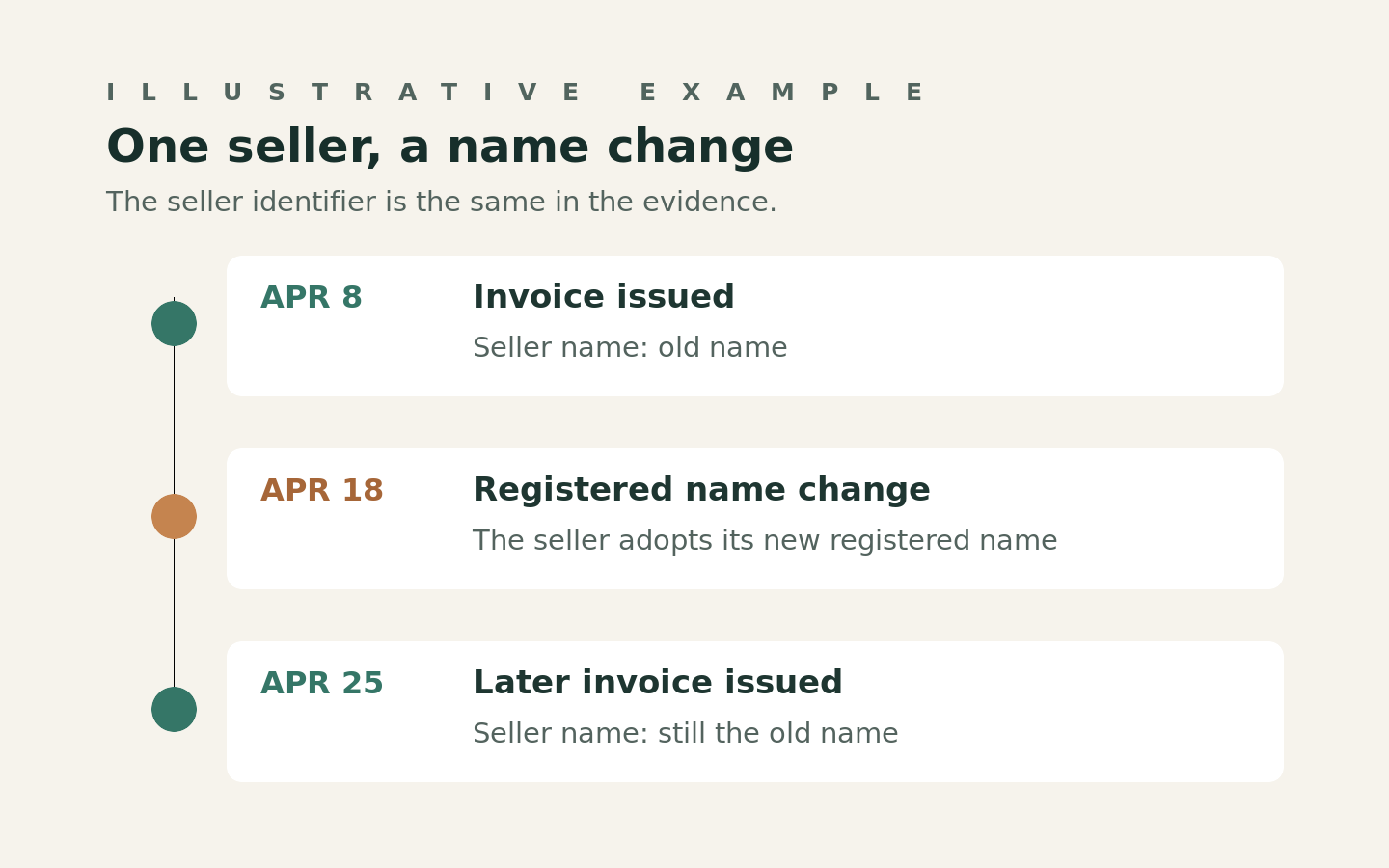
The April 8 invoice should be assessed as a document issued before the change. A new company name in today's registry does not require rewriting the historical seller name on that basis alone. The April 25 invoice needs the supplier's tax team to investigate why it still used the former information and determine the appropriate correction. Neither conclusion settles whether either document matches the tax record or qualifies for a particular tax treatment.
In a 2021 Shunde tax consultation response, the question concerned a material invoice issued in an earlier month, followed by a supplier name change while its tax number and other details stayed the same. The response said an invoice issued with old information before the business registration change was valid, and that new information should be used for invoicing after the change. It was a reply to those facts, stated to be for reference and subject to current tax rules. It is not a blanket decision on every invoice or on the recipient's input VAT deduction.
The invoice and its date
First confirm that the document is a Chinese tax invoice, often called a fapiao. A pro forma or commercial invoice may serve a different purpose and should not automatically be evaluated under the same tax-invoice procedure. Obtain the complete electronic file or a legible copy, including its issue date, number and seller and purchaser sections.
Record the seller's full Chinese name and taxpayer identifier from the seller block, along with the buyer's details, invoice type, issue date, amount and tax. Copy the invoice number separately: it identifies the document, not the company. The person named as the invoice preparer is not necessarily the seller. For fully digital electronic invoices, State Taxation Administration Announcement No. 11 of 2024 lists the issue date, seller and buyer information, items, amounts and tax among the basic fields.
Use the issue date printed on the invoice for the initial comparison. The date on a purchase order, shipment, email or payment may be useful transaction evidence, but it does not replace the invoice's issue date. Equally, a date on a supplier's announcement may say when it told customers, not when the registration authority approved the change. Label each date by the event it records.
Connecting the two names
Compare the old Chinese name on the invoice with the former name in a registration change record. Then compare the current Chinese name and Unified Social Credit Code (USCC) on the current business licence or company record. Ask for the dated registration approval or change notice that links the old and new names. A supplier's letter can explain the change, but a letter alone should not stand in for the registration evidence when the date is material.
China's USCC management measures, SAMR Order No. 112, effective February 1, 2026, describe the code as an organisation's unique, lifelong identity identifier. A matching USCC is therefore a useful anchor for a company record across a name change. Compare the name history as well, and check that the identifier was copied from the seller's field. A code printed on a document does not on its own establish that the document was issued as shown.
When the seller block uses a USCC, compare the full code with the registration record. If the formats differ, ask the supplier to identify each number and provide evidence connecting the invoicing taxpayer to the registered entity. The invoice issuer lookup guide explains how to locate the seller details without confusing them with the purchaser's.
Use ChinaValidate company search to find the company record, or compare a supplied licence with available records using business licence verification. The former-names guide explains the change-history entries. Check what a result actually contains: a current licence can identify the current company but may not itself show the former name or the date of change.
Dated registration evidence
A useful change record identifies the company, the name before and after the change, and the registration or approval date. Keep its source and the date you obtained it. If the record gives only a list of former names without dates, it may support an identity link but does not establish which name was registered on the invoice date.
The Shanghai online change-registration instructions describe an applicant downloading a registration notice after approval in the relevant online process. This is an example of evidence a supplier may be able to obtain, not a statement that every locality issues an identical document or that an application alone proves approval. Ask for the applicable record from the supplier's registration process if the notice or public history is incomplete.
Invoice issued before registration
Where the old name was registered when the invoice was issued, and the dated change record connects it to the current company, retain the historical invoice under the name actually shown. The later name change explains why a present-day licence displays a different name. Keep the invoice with the change record so a colleague reviewing the file later can see the sequence.
Do not request a replacement solely because the current name differs. Check the invoice result and transaction details first. An independently verified invoice can still contain a separate issue with the buyer, amount or transaction, and the historical-name explanation does not resolve it. Conversely, a genuine difference in registered names over time should not be erased by altering a PDF or replacing the seller name in a transcription.
Old name after registration
For the April 25 invoice, the old name appears after the hypothetical April 18 change. Ask the issuer's finance or tax team to compare its registration and invoicing records and confirm whether the seller information is wrong. A supplier may have sent a template or an outdated copy; the correct response depends on what was actually issued. Do not assume that a matching tax number makes the old name appropriate for a later issue date.
If the issuer confirms an error, ask it to handle the correction through the applicable tax-invoice process and provide the resulting documents. For a fully digital electronic invoice, Announcement No. 11 addresses a red-letter invoice when an invoice was issued in error. Its procedure differs according to whether the original invoice has been confirmed for use or accounting, with a separate rule for an invoice confirmed for export tax refund. The issuer and recipient should establish the original invoice's type and use status before selecting the procedure. See Section 8 of the announcement.
Keep the original, the issuer's explanation and any red-letter or replacement documents together. Check the replacement independently and reconcile its number and amount with the original and the order. Do not create a replacement yourself or assume that the same procedure applies to every kind of invoice.
Unclear dates or different identifiers
If the invoice and registration change carry the same calendar date, the date comparison alone does not establish their sequence or the correct treatment. Ask the supplier for the registration evidence and its tax team's explanation for that specific invoice; consult the competent tax authority or a qualified tax adviser where the treatment remains unclear. Use the same approach if the invoice date or registration date is missing, unreadable or contradicted by another source. Do not invent an ordering from the date of an email or assume a transitional period.
If the issuer's identifier and the current company's USCC differ, first check for a copying error, a different type of historical tax identifier, or a buyer number mistakenly taken from the invoice. Ask for the source records and an explanation of the link. If they identify two separate companies, a name change has not been established merely because the names, owners or brand look similar. Identify the actual seller and its role in the order; the supplier and invoice mismatch guide covers separate-entity arrangements.
Until the missing date or identity evidence is supplied, describe the result as unresolved. That is more useful than marking the document valid or invalid based on a guess. Specify exactly what would resolve it, such as a dated name-change notice or an explanation supported by the issuer's tax registration information.
Invoice and transaction checks
Verify the individual invoice through an applicable service, using the details required for its type. ChinaValidate invoice verification can be used for supported invoice checks. Announcement No. 11 also identifies the electronic invoice service platform and the national VAT invoice verification platform as free channels for verifying fully digital electronic invoice information. Compare the returned information and status with the document received; record the date and result of the check.
A matching result supports the invoice information returned by that service. It does not establish that goods were delivered, that the issuer was the actual seller, or that the current and former names belong to one company. A failed, unavailable or incomplete check needs the exact result preserved and investigated; it should not be described as a confirmed fake merely because no match was obtained.
Reconcile the invoice with the real transaction: who supplied the goods or service, who purchased it, what was supplied, the amount and the supporting contract, order, delivery and payment records. If those records show another entity, obtain an explanation tied to the transaction. A name-change notice cannot convert a separate company's sale into the invoicing company's sale.
Input VAT and follow-up
For a recipient considering an input VAT deduction, the historical-name explanation is only one part of the review. Invoice type, the recipient's circumstances, the actual purchase and applicable VAT rules also matter. A successful invoice check or a matching company code does not by itself establish deduction eligibility. If the invoice has already been used or accounted for, tell the supplier and your tax adviser before a correction is initiated, because its status can affect the procedure.
Send the supplier a focused request: identify the invoice number and issue date, quote the seller name and identifier as printed, and ask for the dated name-change record. For a later old-name invoice, also ask whether the issued seller information was correct and, if not, what documents will be provided through the applicable correction process. Preserve the response alongside the invoice, verification result and transaction records so the decision can be traced to the facts available.