
How to Find a Chinese Company's Former Names
Find a Mainland Chinese company's former registered names, read name-change dates and connect older documents to the current company record.
Start with the Chinese legal name or USCC. Confirm the matching company before opening its profile.
To find a Mainland Chinese company's former names, locate its company record and read the entries for changes to the registered company name. Save the name before each change, the name after it and that entry's date. A list labelled 曾用名, meaning former names, is a useful starting point; the dated change entries explain how those names connect to the company you see today.
This is particularly useful when an older quotation, certificate or supplier file uses an unfamiliar Chinese name. You need to establish whether it is an earlier name of the same company, a different English rendering or another business altogether. The result should let someone follow the names through time without guessing which company a document belongs to.
Find the registered change
Begin with the company's current full Chinese name or Unified Social Credit Code (USCC). Search the National Enterprise Credit Information Publicity System and open the matching company. If you need help locating the official entry point or distinguishing its functions, use the company registration search guide. Once inside the company record, the relevant task is finding name changes, rather than reading every registration field.
Record the current name and code before opening the history. China's USCC management measures, effective from 1 February 2026, describe the code as a nationwide unique, lifelong identity marker. It is therefore a useful anchor while names change. Compare it with a reliable company source, rather than accepting a code typed beside an old name in an email as sufficient evidence.
Look for registration-change information, commonly headed 变更信息. The arrangement varies between public services and commercial reports. One may show a separate former-name list; another may require you to inspect a longer list of changes. A company profile that shows only today's name has not necessarily answered the historical question.
Read the change category before copying anything. A change to a shareholder's name, legal representative or address is not a change to the company's own registered name. Look for entries identifying the enterprise name, then open any truncated details. If records are paginated, inspect the remaining pages or state which part you could retrieve. The first screen may contain only recent changes to entirely different fields.
For example, a publicly accessible Shenzhen enterprise-information page separates basic registration details from a change table and paginates the latter. Its columns identify the matter changed, before and after content, and change date. This is an observed presentation, not a promise that every provincial page has identical controls or a complete historical record.
Read the name-change entry
The useful information usually sits across a row. Read 变更事项 as the matter changed, 变更前内容 as the previous content, 变更后内容 as the new content, and 变更日期 as the date attached to that change. Preserve the labels from your source if its wording differs. Do not reverse the names merely because a translated page lists the newest record first.
Copy each Chinese name in full. A changed location element, an added industry word or a different company ending can be precisely what the entry records. Keep brackets and the organisation form. If the source shows a shortened preview, expand it before treating the visible text as the full former name. Where selectable text and an image disagree, resolve the transcription against the clearer source.
Attach the date from the name-change entry itself. A basic profile's 核准日期, or approval date, may concern another registration update. The day you downloaded a report is a retrieval date. Neither automatically tells you when the company changed its name. If your source supplies only a year or month, retain that precision rather than inventing a day to complete a spreadsheet.
Also distinguish a registered Chinese name from the names used to sell products overseas. Article 7 of the enterprise-name implementation measures addresses standard Chinese characters and foreign-language translation separately. A revised English translation, new logo or shortened email signature does not, by itself, establish a registered name change. The guide to different supplier names explains these other labels.
Two changes, three names
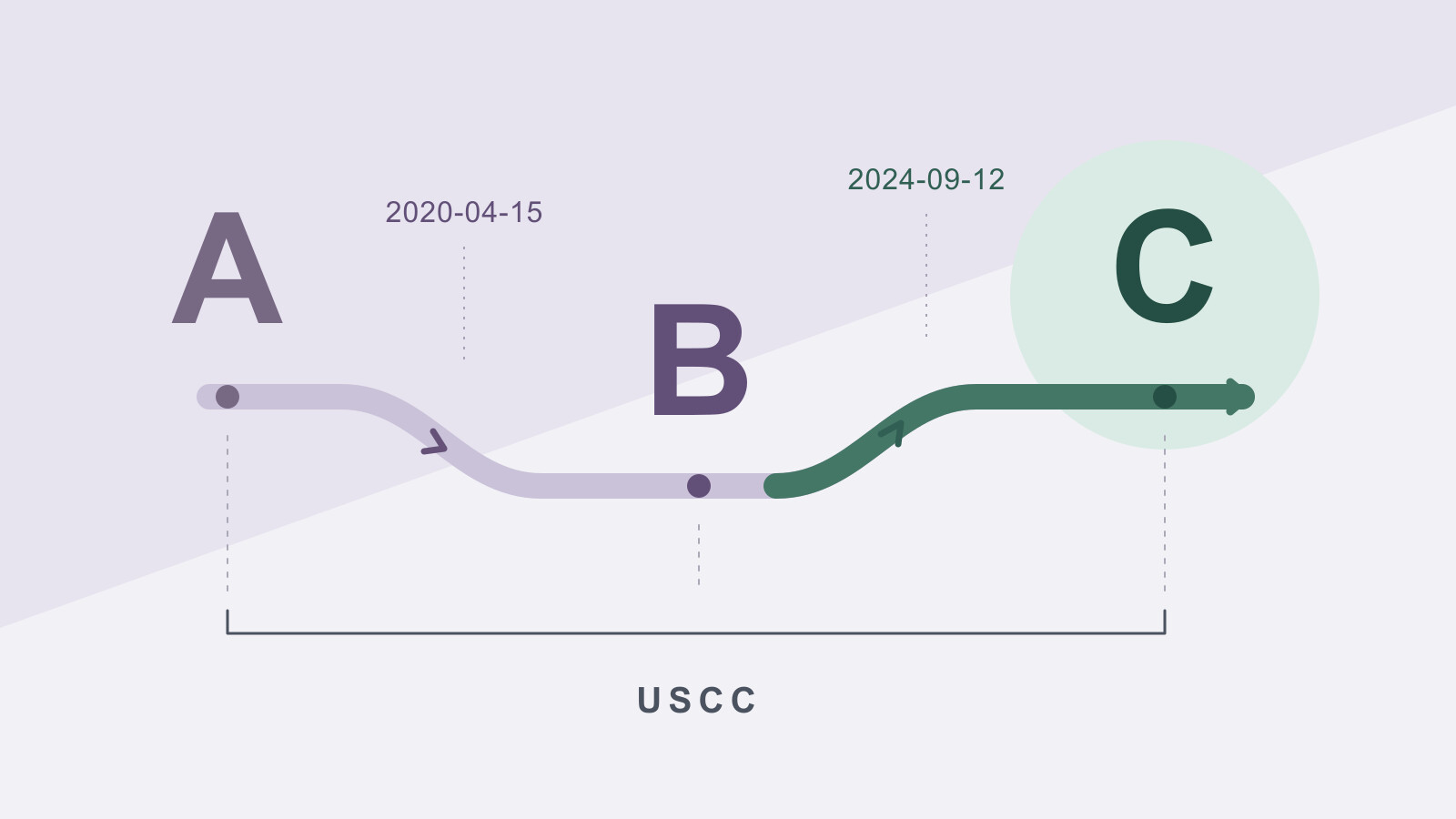
Consider a hypothetical company whose present registered name is C. Here, A, B and C stand for complete Chinese company names; they are not real businesses or three different entities. Its code is omitted. The example shows what to extract from two name-change entries, without reproducing an official screen.
| Change recorded | Names in that entry |
|---|---|
| 2020-04-15 | Before: A. After: B. |
| 2024-09-12 | Before: B. After: C. |
The repeated B is the connection between the two entries. Read chronologically, they support A changing to B and B later changing to C. If the service displays the newest event first, reverse the event order in your own reading note, while preserving what the source actually said. Compare the resulting C with the current profile you captured at the start.
Now add a separate address change dated 2026-03-06. That later date belongs to the address entry. It does not move the B-to-C name change forward to 2026. Keeping the change category beside each date prevents the newest date on a crowded profile from becoming the answer to every historical question.
Suppose an older certificate names B and is dated 2023. The name fits between the two changes in this example. That gives you a reason to investigate the certificate under B, rather than rejecting it because today's name is C. You would still check its issuer, scope and status separately. The name history connects an identity; it does not authenticate the certificate or establish that it remains usable.
There is a second limit to the timeline. The first entry tells you that A preceded B on the recorded change date. It does not, without more evidence, tell you when A first became the company's name. Do not automatically assign A to the company's establishment date. There may have been an earlier change outside the retrieved information.
Finally, imagine you can see A-to-B but the current profile says C, with no B-to-C entry available. Keep the missing connection visible. Ask for the relevant registration-change record or another authoritative record identifying both names. Do not join B to C solely because a salesperson says the company rebranded. A useful note can contain a gap; it should not manufacture an uninterrupted history.
Starting from an old name
If you have only an old document, copy the Chinese company name exactly as it appears and note the document's date. Look for a USCC on the same material. Where a reliable code is available, use it to retrieve the current company identity, then work back through the name-change entries. Preserve the old document so the connection can be checked later.
A service may return a current company when you search a former name, but do not assume all search boxes support historical-name matching. Read which name actually matched. If several candidates appear, compare the identity evidence before choosing one; the candidate-comparison guide covers that task. A matching word in a brand or group name is not enough.
The national code centre's query guidance supports searching by organisation name or the 18-character code. It also describes delayed data transmission after registration changes and access restrictions. These explain possible limits of that service, not a guarantee that an old-name search will succeed. A login challenge or timeout is an unfinished lookup, not a finding about the company's history.
When no reliable code is available, request the supplier's current full Chinese name, current business licence and the record connecting it to the old name. An English sales name is another starting clue, not a substitute for that connection. Avoid asking the supplier simply to confirm that two English spellings are equivalent when the unresolved issue is a formal Chinese name change.
Do not merge another company into the history because it now uses familiar wording. The State Council's English explanation of business-name rules discusses name transfers and authorised use, alongside registration. Names and legal entities are related but distinct records. A proposed transfer to an affiliate or newly formed company needs its own explanation; it is not resolved by calling that company a former name.
Gaps in the name history
A former-name list has no dates. Save the names as the list presents them, with its source and retrieval date. Do not infer chronology from their display order. Look for dated registration-change entries to establish the sequence. If those cannot be obtained, report that the names are listed but their order or change dates remain unverified.
Two sources disagree. Compare the full Chinese strings, identities, event dates and publication or retrieval dates. One source may show a different stage of the history, or a summary may omit an entry. Prefer the underlying registration evidence for the specific change. Keep the disagreement open if neither source provides it; copying the longer list does not make that list complete.
No former name appears. Describe the scope of the search: for example, no former names returned in the profile retrieved today, or no company-name changes found in the accessible entries. Those findings are narrower than “this company has never changed its name.” An unavailable section, incomplete pagination or unreturned field cannot establish the whole history.
The current name still does not fit. Recheck that the record belongs to the intended company and that the entry changes the enterprise name itself. If codes conflict, resolve the source or transcription discrepancy before joining records. If the explanation involves a merger, a new company or transferred operations, move beyond a simple name lookup. The broader company change-history guide covers related changes without treating every difference as a rename.
Use the names with dates
Keep the current Chinese name and USCC as the primary identity in your supplier record. Attach each confirmed former name to its supporting change entry and date. Preserve the original Chinese spelling beside any translation so a colleague can repeat the search. Do not overwrite the names printed on older documents to make the folder look consistent.
Historical names are useful search terms for older certificates, public notices or other records. Search a confirmed old name when the period warrants it, then verify that a returned result refers to the same entity. A date-compatible name is a lead; names can still be similar across companies. Record which version of the name produced the result instead of silently attributing everything to today's label.
You can use the confirmed current name or USCC in ChinaValidate Company Search to find the corresponding Mainland company and review available information. Where a report returns former names, keep them alongside their Chinese originals and check the dated evidence needed for your task. A returned name list is not a promise of a complete sequence or a date for every change.
The final answer may be brief: the current company uses C; the retrieved entries connect A to B and B to C on the recorded dates; earlier history was not established. That is enough to explain the old name on a supplier document and identify any remaining question. It is more useful than either discarding the old wording or asserting a history the available records cannot show.