
Chinese Company Chop vs Invoice Stamp
Recognize Chinese company and invoice stamps, compare the names on contracts and fapiao, and understand why some electronic invoices have no visible seal.
Start with the Chinese legal name or USCC. Confirm the matching company before opening its profile.

A supplier sends you a stamped contract and an invoice. Both carry red marks, but the shapes and Chinese wording differ. That can be entirely normal: a company chop and an invoice stamp have different jobs. The useful comparison is the company identity and the document's purpose, not whether the two red impressions look identical.
A company chop is the business's general seal. An invoice stamp, or fapiao chop, is the invoice-specific seal identified by the words 发票专用章. Neither should be confused with a stamp saying “PAID,” a supplier's English logo, or the tax authority's invoice supervision mark.
This visual guide covers mainland Chinese supplier paperwork. Start with the wording below, then follow the relevant document example. You do not need to translate every line of a contract to work out which name and identifier deserve a closer look.
The four labels to recognize
“Chop,” “seal” and “stamp” are often used interchangeably in English business correspondence. The Chinese wording is more useful because it can identify a specific function. A supplier who says “our company stamp” may mean a general company seal or simply a stamp belonging to the company.
| English term | Chinese term | Usual context |
|---|---|---|
| Company chop | 公章 | Company correspondence and formal business documents, including contracts. |
| Contract chop | 合同专用章 | Commercial agreements and contract execution. |
| Finance chop | 财务专用章 | Banking and financial administration. |
| Invoice stamp | 发票专用章 | Tax-invoice issuance, subject to the rules for the invoice format. |
The specialist functions are also described in Hawksford's guide to Chinese company chops. Use the table to identify what you have received, rather than to decide whether an entire contract or transaction is legally valid.
The general company chop may display the company name without literally including the word 公章. In contrast, wording such as 合同专用章 or 发票专用章 expressly describes a specialized seal. Ask for the Chinese term if the impression is too faint to read; an English description alone can conceal this distinction.
Read an invoice stamp
The national invoice-stamp specification describes a red oval impression measuring 40 by 30 millimetres. It places the taxpayer's name around the outside, the taxpayer identification number in the centre, and the invoice-specific wording below. A business using several invoice stamps can also have a sequence number beneath that wording.
Those features help locate information. They do not authenticate a scan. A resized PDF changes apparent dimensions, a photocopy loses colour, and a genuine-looking oval can be copied. Reading the name and identifier is more productive than measuring an image on your screen.
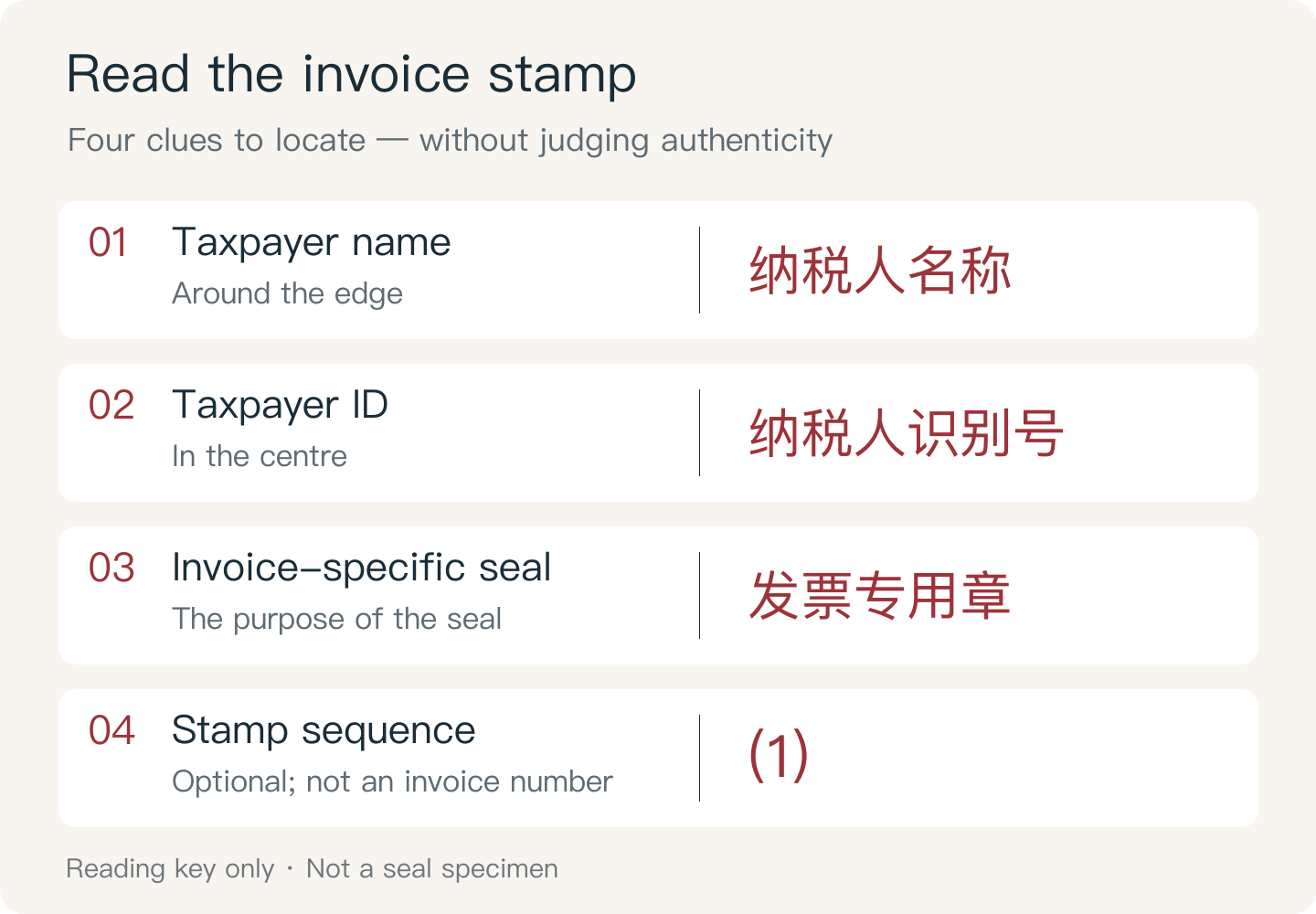
Read the pieces in this order:
- Name. Copy the taxpayer's Chinese name, keeping the order of characters and any brackets. If part of the ring is illegible, request a clearer image and the name as typed text.
- Identifier. Compare the central taxpayer identifier with the seller's identifier printed on the invoice. Keep letters, digits and leading zeros exactly as supplied.
- Purpose. Look for the invoice-specific wording. The same company name on a finance seal does not turn that seal into an invoice stamp.
- Sequence. A small number such as “(1)” identifies a particular stamp in the national specification. Do not copy it into the company tax number or invoice number field.
The specification permits a standardized abbreviation where the taxpayer's name is too long. Therefore, a shortened name needs an explanation and comparison with the full issuer identity; it is not, by itself, proof of a false invoice. Preserve the full seller name from the invoice and the business record when recording your conclusion.
Keep another red mark separate: 发票监制章 means the invoice supervision seal. It relates to invoice administration, rather than being the seller's own invoice stamp. If you ask a supplier about “the missing red seal,” identify which of these two marks you mean.
Match the stamp to the document
A supply contract
On a contract, begin with the named seller and the execution section. A company chop or contract chop is relevant to that context. The invoice stamp is designed for a different function, so its presence should prompt a specific question about who executed the agreement and under what authority.
Do not turn that observation into the blanket rule “wrong stamp, invalid contract.” Article 22 of the Supreme People's Court's 2023 contract interpretation considers the person acting for the company, their authority and the circumstances of execution. A seal image alone cannot settle those questions. For a material contract, resolve unclear authority with the supplier and obtain appropriate legal advice before relying on the document.
Our company-chop verification guide covers that fuller contract review. Here, the immediate task is simpler: identify the type of seal and the business named on it.
A paper tax invoice
A mainland Chinese tax invoice is a fapiao. Article 21 of the Invoice Administrative Measures requires paper invoices to bear an invoice-specific seal. A general company chop or finance chop should not be treated as an interchangeable substitute for that requirement.
If you receive an originally issued paper tax invoice and can see only a different type of seal, ask the issuer to explain or correct the document. Request the complete invoice, not just a photograph of the stamp. You need the title, seller, number, date and amounts to identify the document and check its record.
A printout of an electronic invoice is a different situation, discussed below. The fact that a document is now on paper does not establish that it was originally issued as a paper invoice.
A commercial or pro forma invoice
International trade paperwork may use the word “invoice” for a commercial invoice or a pro forma quotation. Do not apply the paper-fapiao stamp requirement simply because an English heading says “INVOICE.” First establish which document the supplier has sent.
For example, a pro forma invoice can set out a proposed order, deposit and delivery terms. A stamp on it may help identify the business presenting those terms, but it does not make the document a tax-system fapiao. Nor does a Chinese invoice stamp, by itself, establish that a deposit has been paid. Keep the order, payment record and tax invoice distinct.
Compare the purposes in our fapiao and commercial invoice guide if your supplier uses the same English label for several files.
Compare the company identities
Once you have identified the seals, put the company information beside the document information. Avoid comparing an English brand on one page with a Chinese legal name on another and treating a rough translation as an exact match.
Use three places as your starting point:
- The contract: the Chinese name of the company accepting the contractual obligations.
- The invoice: the seller's name and taxpayer identification number, not the buyer's details.
- The business record: the registered name and Unified Social Credit Code, where that is the identifier used by the company.
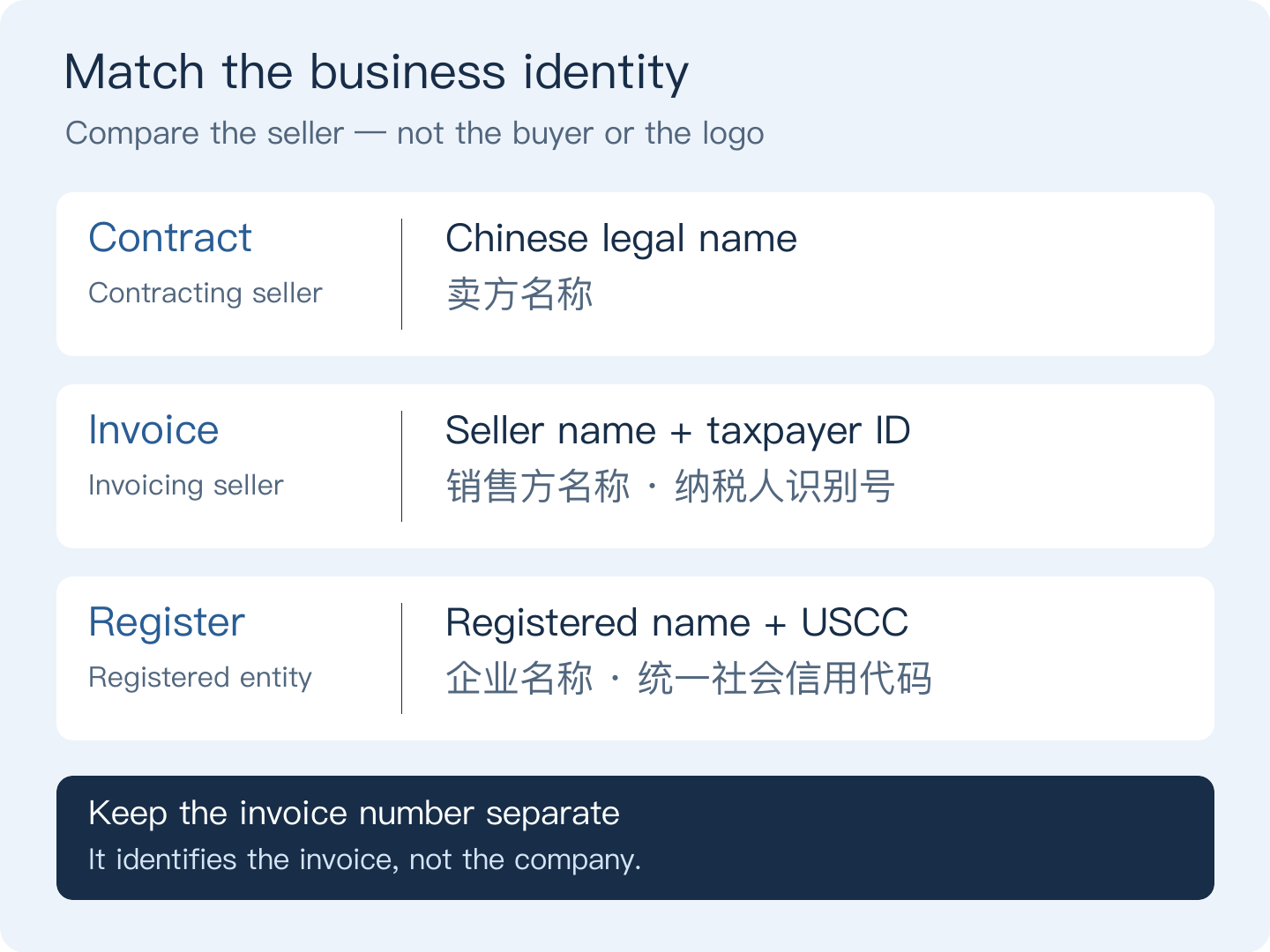
Here is a hypothetical purchasing example. A contract names Company A, its stamp carries Company A's Chinese name, and the fapiao seller is also Company A. The invoice stamp is oval while the contract stamp is round. The difference in shape has not created an entity mismatch: the names and identifiers are the fields to compare.
Now change one fact. The invoice seller is Company B, which the salesperson describes as “our finance company.” That explanation identifies a question, not its answer. Ask for Company B's full registered name and identifier, its role in this order, and the documents connecting that role to Company A. A second company's genuine invoice does not explain the commercial arrangement on its own.
A similar name can be especially misleading. A manufacturer and a trading company may share a brand or some Chinese characters while being separate registered businesses. Compare the complete names, including the ending that describes the organization, and use the identifiers to avoid choosing a lookalike search result.
You can search the Chinese company using its name or USCC. If the name is available only on a license image, the business-license check provides a separate way to review the license information. These checks help establish the entity behind the paperwork; they do not certify that a particular stamp impression is genuine or that its user had authority.
If a historical document shows an earlier name, compare its date with the company's former-name information. Do not silently replace the old wording in your copy. Keep the original and the explanation connecting it to the current business.
Electronic invoices without a stamp
A fully digitalized Chinese invoice can be issued without a visible seller's invoice stamp. The State Taxation Administration's digital-invoice explanation says invoices downloaded through the tax digital account include a digital signature and do not need an invoice-specific seal for accounting and archiving. The nationwide rollout announcement, effective from 1 December 2024, also gives fully digitalized invoices the same legal effect as paper invoices.
An actual issuer provides a useful illustration: AWS China's fapiao guide explains that its digitalized invoice removes the seller-seal column. It also confirms that printing the file does not create a need to add that seal, and tells recipients to retain the electronic version.
This is why asking a supplier to paste a red stamp onto an unstamped PDF can be the wrong request. Ask for the original issued electronic file and identify its format first. A scan of a paper invoice, an original digital invoice and a spreadsheet exported as PDF may look similar in your inbox but require different checks.
Use the invoice details for a record check through the national VAT invoice verification platform or our invoice verification tool. The absence of a visible stamp is not a reason to skip verification. The unstamped electronic invoice guide explains the format distinctions in more detail.
Resolve the visible difference
Before requesting another document, name the precise discrepancy. A readable request gives the supplier something concrete to correct and avoids an exchange of increasingly cropped stamp photographs.
| What you see | Useful next step |
|---|---|
| Different shapes, the same issuer identity | Identify each seal's function. Compare the document fields rather than requiring identical artwork. |
| A company name is partly unreadable | Request the original file or a clearer scan, plus the name as Chinese text. |
| The invoice stamp and printed seller disagree | Ask the issuer to explain the exact name or identifier difference; verify the invoice record before accepting an explanation. |
| The invoice seller differs from the contract party | Identify both businesses and obtain the order-specific explanation connecting their roles. |
| No seller stamp on a digital invoice | Confirm the invoice format, retain the electronic original and check its recorded information. |
| A “PAID” mark or English logo only | Identify what the file actually is. Do not infer a Chinese tax invoice or a verified company seal from that mark. |
A clearer scan solves legibility. A company search addresses registered identity. An invoice lookup compares invoice information. None of these steps, alone, explains why a different company is accepting your order or receiving payment. Follow the unresolved question rather than collecting more versions of the same image.
A precise request to the supplier
If the documents are unclear, adapt this short message to the fields that actually differ:
Please confirm the full registered Chinese name and tax identifier of the seller for this order. The contract names [Company A], while the invoice shows [Company B]. Please explain each company's role and provide the original invoice file. Please also identify the seal used on the contract as the company chop, contract chop or another type.
Remove the mismatch sentence if the names agree. If the only issue is an unreadable impression, ask for a legible source instead of suggesting that the company identity is wrong. Refer to the order or invoice number in your message so the supplier answers about this transaction.
A useful completed check records the Chinese company identified, the type of document received and any remaining difference. The result should be more informative than “red stamp present”: you should know whose paperwork you hold and which verification step answers the remaining question.
Sources checked on 2 November 2026. The cover is an AI-generated illustration of stamp tools; the body graphics are explanatory reading aids, not official seals or authenticated documents.