
Chinese Business License: Original vs Duplicate
Distinguish an official Chinese business license duplicate from a photocopy or scan, recognize the paper formats, and match the document to the supplier.
Start with the Chinese legal name or USCC. Confirm the matching company before opening its profile.
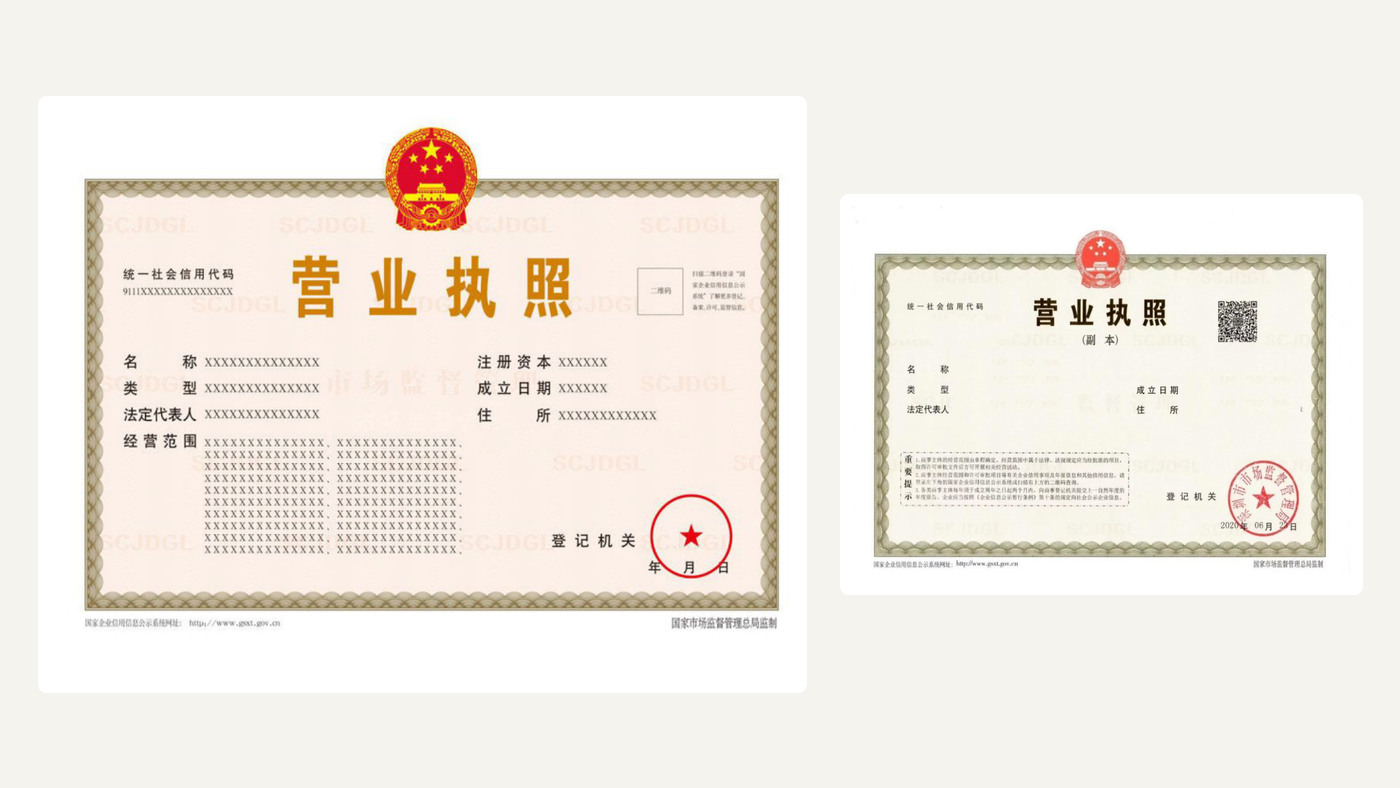
A Chinese business license marked 副本 is the officially issued duplicate version of the license. The word does not mean “photocopy,” and receiving this version is not, by itself, a reason to reject a supplier’s document. Chinese registration rules give the original and duplicate the same legal effect.
The distinction that matters is between the version of the license and the file you received. A supplier can photograph either version. That photograph lets you read the registration details, but it is still a photograph—not the physical certificate and not necessarily an official electronic business license.
This guide explains those distinctions for mainland Chinese business licenses. Keep the Chinese labels beside their English meanings: they help you recognize the document without translating every line.
Two official versions
The relevant terms are 正本, the original, and 副本, the duplicate. Article 22 of the Market Entity Registration Administration Regulation establishes their equal legal effect. It also gives electronic and paper business licenses equal legal effect.
“Duplicate” can sound less authoritative in an English document checklist. Here it names a recognized form of the credential. It does not describe an unofficial reproduction made on an office copier. A translation headed “Business License (Duplicate)” may simply be translating the Chinese title accurately.
The larger paper original is commonly associated with display at the business premises; the smaller duplicate is convenient to carry and present. Red Star’s English introduction to Chinese business licenses describes receiving copies of either format when checking a supplier. That practical distinction concerns how the documents are used, not a higher or lower grade of company registration.
For supplier identification, the useful information is the registered entity named on the document. Asking for the larger version just because its English name is “original” does not resolve a company-name discrepancy or establish who controls the business. First identify the file and the entity it describes.
A duplicate and a copy
The English word “copy” does several jobs. It can refer to an authority-issued duplicate, a photocopy of that duplicate, a PDF containing its scan, or a translated document. Use more precise descriptions when passing the file to another colleague.
| Term or file | What it describes | Useful wording in your records |
|---|---|---|
| 正本 | The officially issued original version | Paper original, or photograph of the paper original |
| 副本 | The officially issued duplicate version | Paper duplicate, or scan of the paper duplicate |
| 复印件 / 扫描件 | A photocopy or scan of a source document | Copy received from the supplier, with the source version noted |
| English translation | A rendering of the Chinese document | Translation linked to the accompanying Chinese source |
| 电子营业执照 | An official electronic business license | Electronic credential or display, with its source identified |
A scan of a duplicate has two layers: the underlying certificate is the official duplicate, while the attachment is an image of it. Both descriptions can be correct at once. Calling the attachment “the original” without explaining which layer you mean creates unnecessary uncertainty.
Similarly, an “original file” request usually concerns the attachment: the PDF or full-resolution photograph before it was compressed into a chat screenshot. It need not mean that the supplier should send its physical license overseas. Say which file you need and why.
If someone asks for a “certified copy,” clarify the receiving organization’s requirement. The word duplicate on the license does not establish that a particular photocopy has been certified. Nor does an English translation become an official English license because it reproduces the document’s layout. Our business license translation guide covers that separate task.
Recognize the paper format
The national notice introducing the 2019 format specifies landscape layouts. The original measures 420 × 297 mm, corresponding to A3; the duplicate’s inner sheet measures 297 × 210 mm, corresponding to A4. The duplicate also has a cover. These are physical dimensions, not the dimensions an emailed image must have.
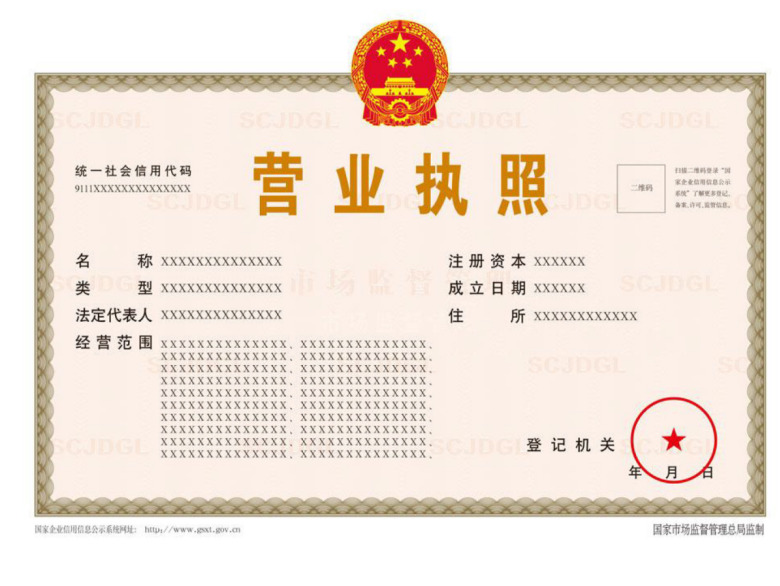
A full-screen A4 scan can look larger than a reduced photograph of an A3 certificate. Scaling, rotation and printer settings can also change the apparent size. Do not use screen width or a downloaded PDF’s page dimensions as an authenticity test.
The national format notice identifies the duplicate’s annual-report reminder as an additional printed feature. It also provides different formats for different kinds of market entity. A company, a partnership and an individual business should not be forced into one identical field map.
Look at the title, visible labels and issuing context together. The examples in this article come from two different government publications; they are not paired certificates for one company. Their purpose is to show the document forms and the duplicate label, not to create a template against which every supplier must match pixel for pixel.
Read the duplicate label
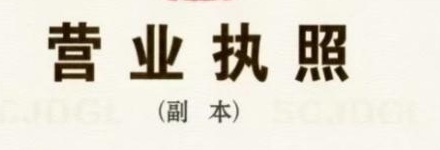
In this example, (副本) appears immediately beneath the main license title. That is the part translated as “Duplicate.” It describes the form of the license, rather than saying that the company is a branch, a subsidiary or a second business.
The company identity is elsewhere: read the name field and the Unified Social Credit Code. In a real supplier file, those values need to be legible. The blank identity fields in this government example make it useful for recognizing the layout, but unsuitable for demonstrating a company search.
A company stamp added to a scan is another separate feature. It may be relevant to a recipient’s document requirements, but it does not turn the scan into the physical license or establish the sender’s authority on its own. Preserve what was supplied and compare the registered identity independently.
Versions and dates
Differences between two license images are not always differences between an original and a duplicate. They can also reflect a change in the national layout or in the company’s registered particulars. Work out which explanation is relevant before requesting a replacement.
SAMR’s 2022 format-adjustment notice removed operating-term information from the face of licenses for companies and certain other entity types. It also changed some field names and positions. The notice allowed existing entities to continue using their earlier licenses or apply for the revised version.
Consequently, a missing operating-term field on the relevant newer format is not necessarily an omission. An earlier layout is not automatically invalid simply because you have found a more recent sample online. Read the document in its own context rather than treating the newest sample as the only possible appearance.
Keep the company’s establishment date separate from the date shown by the registration authority. A business can have existed for years before a replacement license was issued. The date you received the scan is different again: a newly received email may contain an older attachment.
Where the company has changed a registered name or address, compare the file with the current record. The registration regulation provides for replacement when a registered change affects license particulars. Ask for the relevant current document or an explanation of the change; do not silently edit the old scan to make it agree.
This is also why “the two versions have equal legal effect” is not a finding that a specific image is current. It explains the status of the document forms. Current company information and the history of the supplied file still need to be considered.
Match the company
Once you know what you received, use the license to identify the supplier. The distinction between original and duplicate should help you read the file—not become an extra hurdle before an ordinary company lookup.
- Keep the complete source. Retain the attachment as received. Use a readable, upright copy for review without replacing characters, numbers or seals.
- Take the identity from the Chinese document. Locate 名称 for the registered name and 统一社会信用代码 for the USCC. An English trading name can stay beside them as an alias.
- Compare a current record. Check that the name and code identify the same entity, then examine relevant differences in address, representative or other available particulars.
- Connect it to your purchase. Confirm whether that entity is the company named on the quotation, contract or invoice. A duplicate license is no explanation for a different legal entity.
ChinaValidate’s business license check reads a supported license file, retrieves company information using its identifiers and compares available fields. You can also enter the Chinese name or code in Company Search. The license-to-company walkthrough explains the upload and comparison process.
A matching company record is useful identity evidence. It does not authenticate every pixel in the attachment, prove that the sender represents the company, confirm a bank account or guarantee delivery. Keep those transaction questions separate from the narrower question of which license version was supplied.
Request the right document
For an initial supplier identity check, the practical need is a complete, readable file and enough information to find the correct company. Do not automatically request both paper versions merely because you now know that two forms exist.
- Unreadable scan: request a clearer copy of the same document, with the name and code visible.
- English translation only: request its Chinese source so the translated identity can be checked.
- Old registered details: ask which details changed and request the relevant current evidence.
- Formal submission: follow the bank, authority or other recipient’s stated requirements for originals, certified copies or translations.
An official electronic license is a separate option, not another name for any PDF. If the supplier offers one, clarify whether you are receiving the credential, an authorized display or a screenshot. The electronic business license guide explains the distinction without asking the supplier to share account credentials.
In your supplier record, describe the result plainly: for example, “scan of paper duplicate; Chinese name and USCC compared with the company record on [date].” It states what was received and checked without upgrading a scan into an authenticated original.
Keep that note with the Chinese attachment, any translation and the dated company-search result. A colleague can then see which document was supplied, which entity it identified and which details still need clarification.