
Chinese Business License Translation
Prepare a readable English version of a Chinese business license with a worked bilingual example, accurate amounts and a clear link to the registered company.
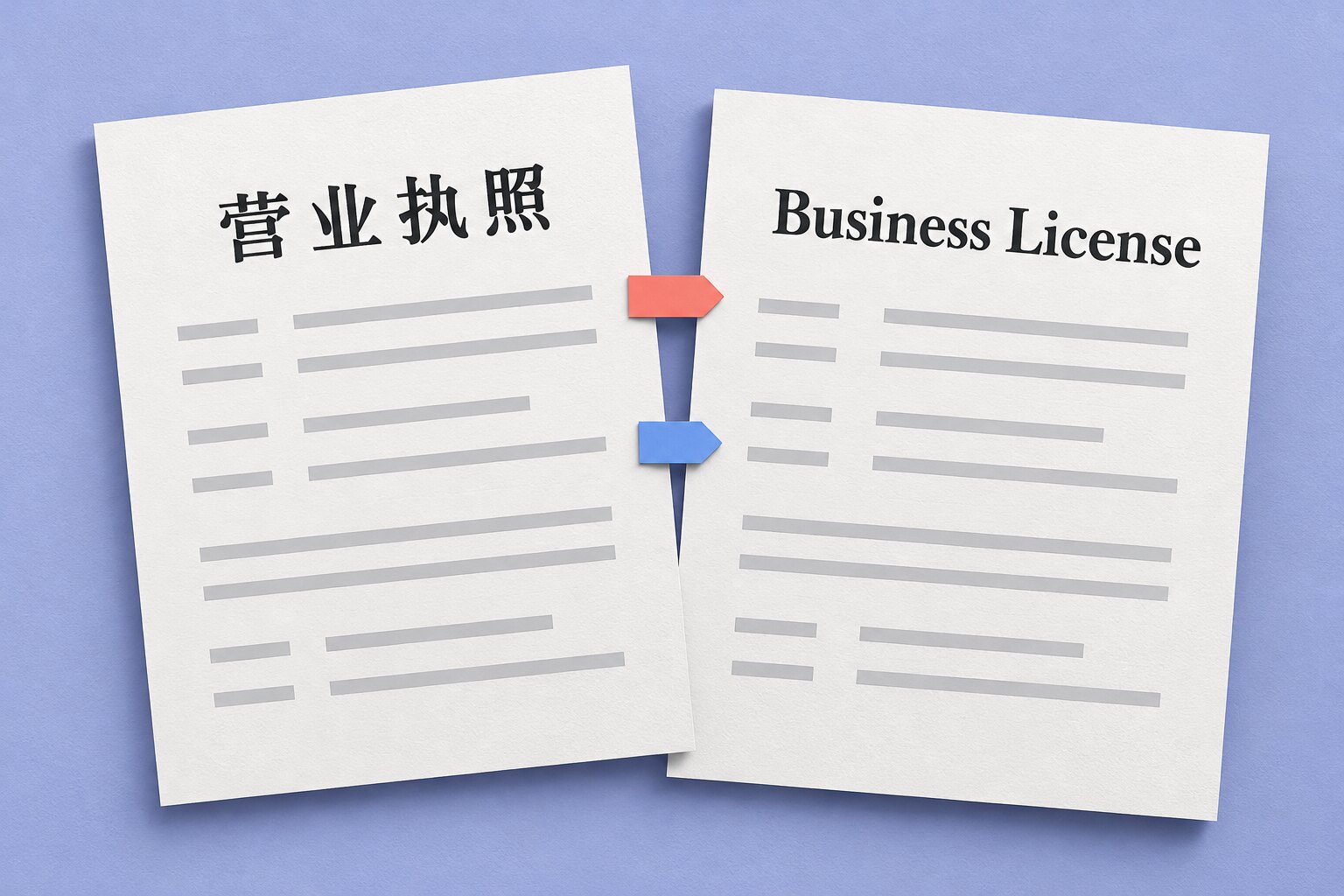
An overseas purchasing colleague opens a Chinese supplier's business license and asks for an English version. The supplier sends a neat translation, but the company name differs from the invoice and the capital looks unexpectedly small. Before requesting another document, separate three things: what the Chinese license actually says, how those words have been translated, and whether the underlying registration is current.
A useful Chinese business license translation keeps those questions separate. It makes the document readable while retaining enough Chinese text to identify the business. This guide builds a working translation for supplier onboarding. It does not turn the translation into a government-issued English license or establish that the person sending the file controls the company.
Start with the source document
Ask for a clear, complete copy, including the edges and any continuation material. A cropped image can hide a registration authority, date or qualifying sentence. If a character is unreadable, mark the uncertainty and request a better copy. Guessing a company name from a website creates an attractive document with an unreliable identity.
Paper formats and fields depend on the entity and document version. The market regulator's 2019 license-format notice describes several formats and distinguishes originals and duplicates. It also describes QR links to public registration information. Translate the document supplied, rather than forcing every business into a limited-company template.
Save the original file before editing or extracting text. In your working notes, record when it arrived and who supplied it. The original image, transcription and English translation serve different purposes. Keeping them together lets a colleague trace a translated amount or address back to a visible field without asking the supplier to resend everything.
A complete working example
The following is a fictional teaching worksheet, not a real license or a searchable company. It shows a company-style record and its English rendering. Bracketed entries tell the preparer what to copy; they are not values to submit in an actual vendor form. Different source documents may contain additional fields or notices.
| Chinese source field | English working translation |
|---|---|
| 营业执照(副本) | Business License (Duplicate) |
| 统一社会信用代码:[逐字复制原件的18位代码] | Unified Social Credit Code: [copy all 18 characters from the source] |
| 名称:示例贸易有限公司(虚构) | Name: 示例贸易有限公司 — Example Trading Co., Ltd. (fictional; working translation) |
| 类型:有限责任公司 | Type: Limited liability company |
| 法定代表人:张某(虚构) | Legal representative: Zhang [fictional placeholder] |
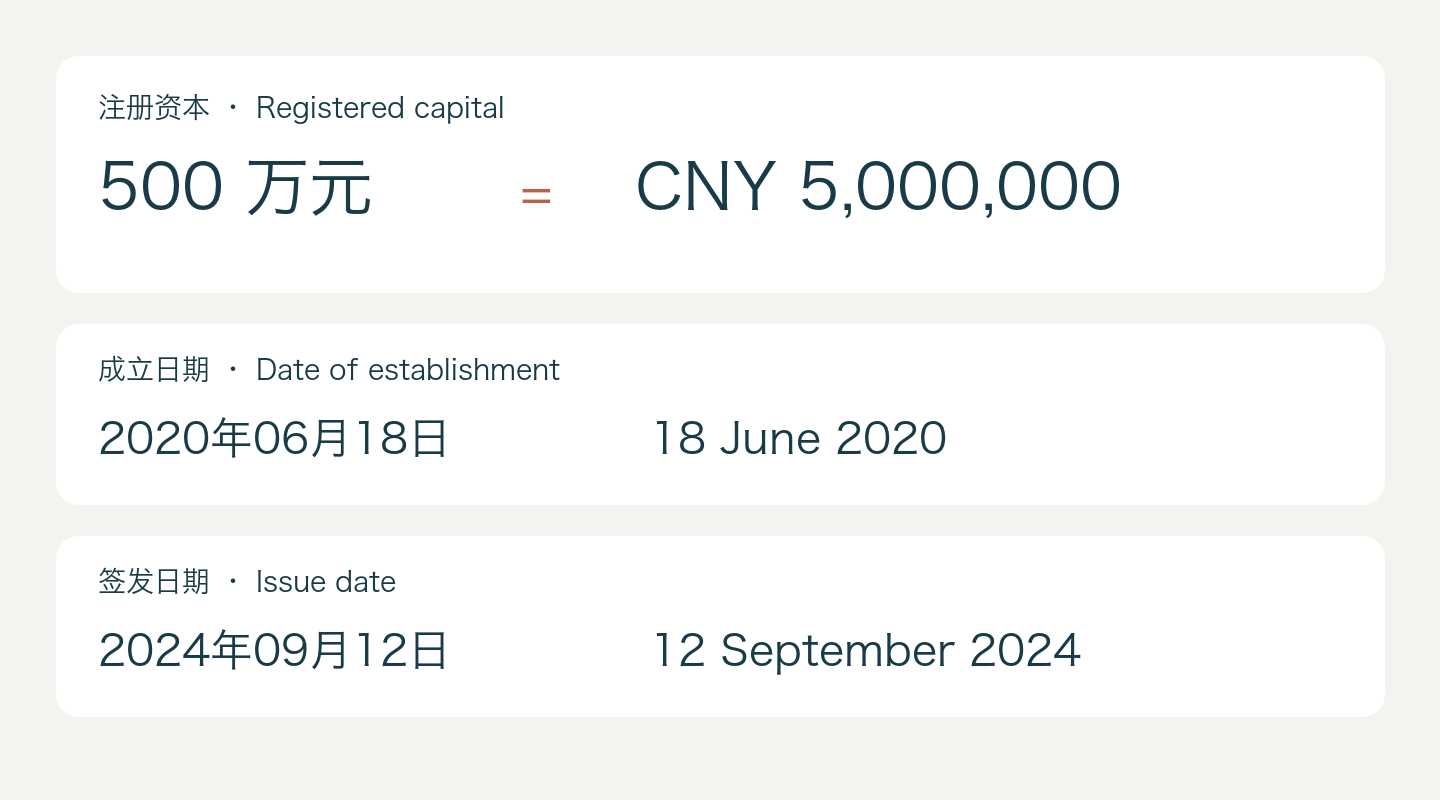
| 注册资本:人民币500万元 | Registered capital: CNY 5,000,000 |
| 成立日期:2020年06月18日 | Date of establishment: 18 June 2020 |
| 住所:示例市示例路88号(虚构) | Registered address: No. 88, Shili Road, Shili City [fictional address] |
| 经营范围:一般项目:日用百货销售;货物进出口。(除依法须经批准的项目外,凭营业执照依法自主开展经营活动) | Business scope: General activities: sale of daily-use goods; import and export of goods. Except for activities requiring approval under applicable law, business activities may be conducted independently on the basis of the business license. |
| 登记机关:示例市市场监督管理局(虚构) | Registration authority: Shili City Administration for Market Regulation [fictional authority] |
| 签发日期:2024年09月12日(示例标注) | Issue date: 12 September 2024 [illustrative label] |
For a real document, reproduce the complete entity type and all visible scope wording, not just the shorter examples above. Include legible annotations and explain unreadable areas. Describe a visible seal or QR notice in words where relevant; do not manufacture a new seal or substitute a different QR code to make the translation look official.
Professional translators also treat visible annotations and document completeness as part of the job. The Lingofish business-license translation page illustrates that approach. Its Australian certification service is a specific service context, not a universal requirement for every buyer's internal supplier file.
Keep names and roles distinct
The Chinese legal name is the identity anchor. Put it beside the English working translation, and record a supplier's preferred English name separately if it differs. A fluent English rendering is useful for communication, but it should not silently replace the name that appears in the Chinese registration record.
For example, a supplier may market itself under a short brand while its license carries a longer legal name. Preserve both with clear labels. Do not change the license translation to match a website logo, and do not conclude that two businesses are identical because their English names resemble one another. Our company-name translation guide explains that narrower naming task.
Translate 法定代表人 as “legal representative,” not automatically as owner, shareholder or chief executive. Those roles answer different questions. Likewise, “registered address” does not establish that manufacturing happens there. A translation can accurately reproduce the address without proving that the supplier operates the factory shown in its sales photographs.
Retain every part of the entity type, including text in parentheses. Do not turn an individual business into a limited company because your onboarding form prefers that category. If the source uses an operator or person-in-charge field instead of a legal-representative field, translate that actual role. The form should accommodate the evidence, rather than rewrite it.
Handle numbers without reinterpretation
Chinese monetary units are a frequent source of avoidable mistakes. In the example, 500万元 means 500 × 10,000 yuan, or CNY 5,000,000. It does not mean CNY 500,000. Write the currency and expanded amount clearly, and retain the Chinese source value so another reader can check the conversion.
Registered capital is the label being translated. Do not relabel the figure as cash available, annual sales, paid-in capital or purchasing capacity. Those are separate claims requiring separate evidence. Even a mathematically correct conversion becomes misleading when a spreadsheet places it under the wrong financial heading.
Dates need similar care. The example's establishment date is 18 June 2020, while its issue date is 12 September 2024. The later document date does not make the business newly established. Using written month names avoids the ambiguity of day-first and month-first numeric dates when the file moves between countries.
Copy the Unified Social Credit Code as text, preserving all 18 characters. Avoid automatic numeric formatting or character substitutions introduced by optical recognition. An apparently small difference can direct a later company lookup to the wrong record or produce no result. If the scan is unclear, resolve the character against a clearer source instead of guessing.
Preserve the scope and its limits
A business-scope translation should preserve the activities and their qualifications. “Sale of daily-use goods” is not “manufacture of household products.” A trading activity should not become a manufacturing capability merely because that wording suits a purchasing questionnaire. Keep the source's distinction between general activities and any separately listed licensed activities.
The final sentence in the example matters. Dropping the condition about legally required approval makes the English text broader than the Chinese. Translate the qualification even when it looks repetitive. Where the actual license refers to a separate permit, retain that relationship rather than presenting the business license as the permit itself.
Long scope text can remain readable through short clauses or a list that preserves the original relationships. Do not delete activities simply because they are irrelevant to the current order. If your team also needs a short supplier profile, create a clearly labelled summary alongside the complete translation. That summary should not replace the translated source.
Choose the right deliverable
For an internal purchasing review, a labelled working translation may be the appropriate reading aid. A bank, court or other recipient may specify a different standard, translator qualification or certification process. Ask that recipient for its requirements before paying for a particular format. A polished PDF alone does not establish acceptance.
Do not add phrases such as “certified true translation” unless an appropriately responsible translator has actually made that certification. Notarization and an apostille concern different procedures and should not be implied by decorative stamps. If those are requested, use our business-license apostille guide to distinguish the documents and confirm the receiving party's needs.
A concise handover note can say: “English working translation of the attached Chinese license, prepared for internal supplier review. Chinese source retained; unclear fields identified.” Add the preparer's actual identity and date where appropriate. Do not invent a reviewer, certification number or translation agency to make the file appear more authoritative.
Link the translation to the company
Before relying on the file, compare the Chinese name and code with a current company record. Keep any differences in a separate review note. If the registered address has changed, translating the old license accurately does not justify silently updating it. Request the relevant current document and preserve the history of what was supplied.
- Keep the complete Chinese source and English translation together.
- Check the legal name, code, amounts, dates and scope qualifications against the source.
- Record any separate trading name and explain its source.
- Compare the company identity and relevant current registration details.
- Send the recipient the document type it actually requested.
Use ChinaValidate's business-license verification tool for supported document checks and company search to examine the registered business. These checks support identity review; they do not certify an English translation or prove product quality, delivery ability or the sender's authority. The useful outcome is a readable document with a clear connection to its source and the company being considered.