
China Certificate of Good Standing
Understand the registration evidence available for a mainland Chinese company when a reviewer requests a Certificate of Good Standing.
Start with the Chinese legal name or USCC. Confirm the matching company before opening its profile.

For a mainland Chinese company, a request for a “Certificate of Good Standing” usually needs to be translated into a request for specific registration information. Start with the company’s current registered status and identify whether the recipient needs an official document, a public lookup, or evidence about a particular compliance matter.
There is no useful shortcut in simply giving a Chinese business license that English title. A license identifies the registered business. A current lookup shows the information returned at the time of the search. A certificate or report has the scope of its issuer. The documents can support the same review without becoming interchangeable.
This distinction comes up in real cross-border work. Cogency Global describes requests from US clients for good-standing certificates when checking Chinese companies. Its explanation points to company registration records as the relevant Chinese alternative, rather than a certificate issued in the US Secretary of State format.
The request behind the term
Before asking the supplier to obtain a document, read what the recipient actually wants to establish. “Good standing” may be shorthand in a checklist, but it can conceal several different requests:
- Continued existence: the identified company remains registered, rather than having completed cancellation.
- Official registration evidence: the recipient wants a result issued or certified through the registration authority, with the particulars it specifies.
- A separate compliance check: the request concerns filings, a particular restriction, or another defined public record.
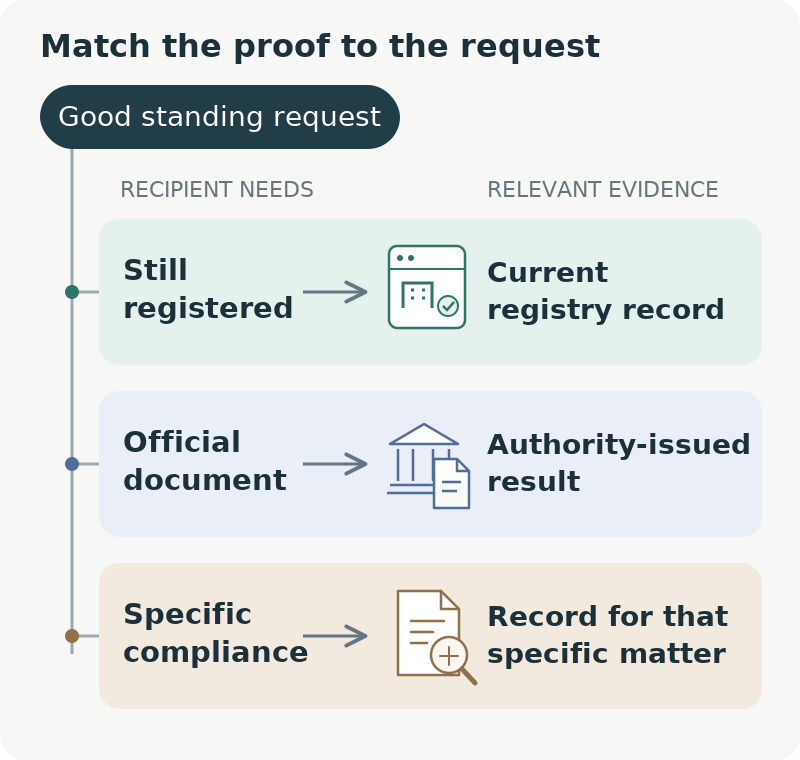
Those requests lead to different evidence. If the instruction specifies the issuer, the information to be shown and how recent the document must be, preserve those requirements when discussing the Chinese equivalent. If it only supplies an English document name, clarify the intended purpose before paying for a report or translation.
The distinction between an online status check and a certificate is not unique to China. Delaware’s Division of Corporations explicitly says its online status service does not generate an official good-standing certificate. That is a useful reminder: even where the named certificate exists, a search result and the certificate are different outputs.
For a mainland supplier, describe the proposed Chinese material by its actual name and ask whether it meets the stated requirement. A recipient may accept a current registry result for an internal supplier review while requiring an authority-issued result for another procedure. Acceptance belongs to that recipient; an English translation cannot settle it.
Read the current status
The official public starting point is the National Enterprise Credit Information Publicity System, often abbreviated to GSXT. Search with the complete Chinese registered name or Unified Social Credit Code. Beijing’s current published guidance directs users to the company’s detailed information for its continuing registration status.
Look for 登记状态, meaning registration status, or 企业状态, meaning company status. Common active-family wording includes 存续(在营、开业、在册). A service may render this as “active,” “existing” or “registered.” Retain the Chinese wording alongside the English explanation, especially when another person will decide whether the evidence satisfies a document request.
A matching result should identify the same legal entity as the supplier’s documents. Compare the Chinese name and full code before considering the status. An English trading name is helpful context, but a similarly named company, parent or affiliate cannot provide the requested proof for a different entity.
Then separate the current registration field from historical information. An establishment date answers when the company was formed. An annual report refers to a reporting period. Neither is the date on which you checked today’s status. A company record can contain all three without any contradiction.
If you encounter a different label, preserve it rather than translating everything into “inactive.” The company-status reference explains the differences between cancellation, license revocation and other stages. For this task, the immediate point is narrower: a record showing cancellation cannot support a statement that the same company remains actively registered.
An official registration result
Some requests require more than a readable screen. If the recipient wants registration information bearing the authority’s query stamp, there is a specific legal route to discuss with the registration authority.
Article 22 of the 2025 registration-archive measures provides for organizations and individuals to request information about registered particulars. It also provides for the registration authority to add its archive-query stamp according to the applicant’s needs. This is a route to an official registration-information result, not a rule creating a universal certificate of good standing.
Two useful terms for this request are 登记事项信息 (information about registered particulars) and 档案查询专用章 (the archive-query stamp). Use the source wording when discussing the available result with the authority.
When contacting the relevant service, ask for the registration-particulars result and the form of certification needed. Confirm the company identity, whether the requested current status appears in the output, and the available application or delivery route. Do not assume that every local portal uses the same English label or produces the same layout.
Keep this separate from requesting the entire registration archive. Access to underlying filed documents follows different eligibility and identity requirements. The registration-files guide covers that process. There is little benefit in requesting articles of association or historical applications when the recipient only needs current registered particulars.
Once you know which result is available, send its description to the recipient before arranging translation. If the recipient requires a particular certified translation, notarization or authentication, obtain its exact instructions. These are requirements about the form and use of the evidence; they do not expand what the underlying registration result says.
Active status and compliance
“Active” is a registration finding, not a general verdict on the business. It should not silently become “all taxes paid,” “no debts,” “all permits current” or “safe to trade with.” Each of those statements concerns information beyond the registration-status field.
China’s enterprise-information disclosure regulation treats registration information, administrative records and company disclosures as distinct information categories. It also distinguishes information supplied by authorities from information submitted by companies. Reading the origin and period of a record therefore matters as much as finding the company’s name on the page.
An annual filing is a useful example. The regulation normally requires the previous year’s report to be submitted between January 1 and June 30; a company established during the current year starts reporting the following year. A missing current-year annual report is consequently not, by itself, proof of noncompliance. Identify which reporting year is actually due before drawing a conclusion.
Where the request concerns an operating-abnormality entry or an administrative penalty, inspect that specific record and any subsequent change. Record dates and the stated reason may matter. A registration-status label cannot answer the separate question, and an unavailable section should not be described as a clean result.
Local services can provide more specialized evidence. For example, Beijing’s guidance describes a dedicated credit report used in place of certain market-regulation inquiries about violations. That is a defined local service, with its own scope. It should not be relabeled as a nationwide certificate covering every legal, financial and regulatory obligation.
The practical response is to match additional checks to the actual request. If the recipient asks only for confirmation that the company remains registered, provide evidence for that point. If it names a separate compliance matter, identify the relevant record or issuing service. Avoid asking the supplier for an undefined “clean company certificate.”
Read the dates and scope
A document can be authentic and still be too old for the question being asked. Conversely, a newly generated report can include older underlying records. Read the date attached to each item instead of treating the newest date anywhere on the cover as the date of every fact inside.
| Date | What it tells you |
|---|---|
| Establishment date | When the company was established, not when its present status was checked. |
| Registration event date | When the stated change or decision occurred. |
| Report or query date | When the output was generated or the record was retrieved. |
| Reporting period | The period covered by an annual filing or another dated disclosure. |
If a recipient requests evidence issued within a particular period, confirm which date it means. Re-saving an old PDF does not update its underlying result. A fresh company query may address current status, while an authority-issued document may still be needed to meet the recipient’s required format.
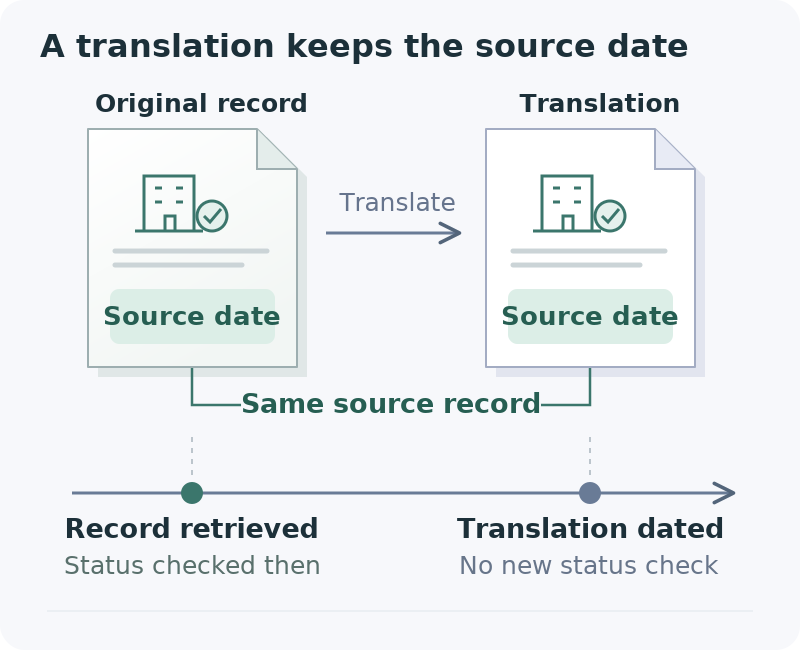
Translation adds another date without changing these facts. A translation completed today can faithfully describe a record obtained months ago. Keep the original with the translation and preserve the source’s dates and qualifiers. The English title should identify the actual material, such as a registration-information query result, rather than claim a broader certification.
Also distinguish the original issuer from a service that organizes or translates the information. A commercial company report can make public records easier to read, but its publisher is not thereby the registration authority. Our company credit report guide explains the different report types when the recipient’s request extends beyond registration.
Send a precise request
You can make the supplier’s task clear without prescribing a document it cannot identify. The following wording is a reusable request, with placeholders for the actual company and deadline:
Please provide current registration evidence for [full Chinese company name], Unified Social Credit Code [code], showing its registered status.
Our reviewer requires [public registry result / an authority-issued registration-particulars result with the applicable query stamp], dated within [required period]. Please confirm which official output is available before arranging any additional certification.
Please send the original Chinese document or complete result, identifying the issuing authority or platform and the query or issue date. We will confirm separately whether a certified English translation is required.
Select the applicable wording rather than sending both alternatives as simultaneous requirements. If the reviewer has not specified the output or date window, settle those points with the reviewer first. Do not impose an arbitrary thirty-day rule merely because another organization uses one.
If the checklist still says “Certificate of Good Standing,” attach a short explanation of the proposed Chinese evidence and what it establishes. Ask the recipient to confirm acceptance. This is more useful than changing the attachment’s filename and hoping that a familiar English title will be enough.
Check the received material
Once the supplier responds, work through the material in a practical order:
- Identify the company. Match the Chinese registered name and full USCC across the supplied document and the company record.
- Read the finding. Locate the exact status or requested information, its date, and the issuing source.
- Match the requirement. Confirm that the output has the agreed form and covers the requested subject and period.
If the identity is inside a license image, ChinaValidate’s business license check can help read the fields and compare available company information. If you already have the name or code, begin with Company Search. These tools help identify and examine the company; they do not issue an official good-standing certificate.
The result you send onward should be specific enough to stand on its own: the named company’s recorded status, the source and date of that finding, and the document supplied. That gives the recipient something it can assess against its requirement, without turning a registration check into a claim about the company’s entire business.