
1688 Invoices for Overseas Buyers
Identify the right invoice, the actual buyer and the issuing party when purchasing from 1688 directly or through an agent.
Start with the Chinese legal name or USCC. Confirm the matching company before opening its profile.

The goods have arrived at a consolidation warehouse, but the seller's “invoice” is a screenshot of the 1688 order. Your accountant wants a document addressed to your business. Your agent says the Chinese tax invoice belongs to its domestic purchase. These answers can describe different parts of the same transaction.
For overseas buyers, the first task is to identify which invoice is needed and which business actually bought the goods. A 1688 order record, a Chinese tax invoice and an export commercial invoice are not interchangeable. Sorting out their roles before payment is easier than trying to change the buyer's name after delivery.
Three documents, three jobs
| Document | What it helps establish | What it does not replace |
|---|---|---|
| 1688 order and payment record | The items, seller, account, amounts and transaction recorded on the platform | A tax invoice merely because it shows a paid total |
| Chinese tax invoice, or fapiao | The issuer, buyer, invoiced goods or services, amounts and tax information | Proof that the goods were exported or accepted by your country's customs |
| Commercial invoice for the overseas sale | The commercial shipment and seller-to-buyer billing details requested for that sale | The underlying Chinese domestic tax invoice where one is required |
An order confirmation may be useful evidence of what you bought without being the accounting document your business needs. Equally, a genuine fapiao for an agent's domestic purchase may not name your overseas company. Ask your accountant or customs broker which documents are needed for the particular transaction; do not assume one PDF serves every purpose.
Keep the original documents alongside a translation. The translation helps your team read names, item descriptions and amounts, but it should not silently rename the parties or turn a platform receipt into a tax invoice. Our fapiao and receipt comparison explains the basic distinction if these document types are new to you.
Identify the actual buyer
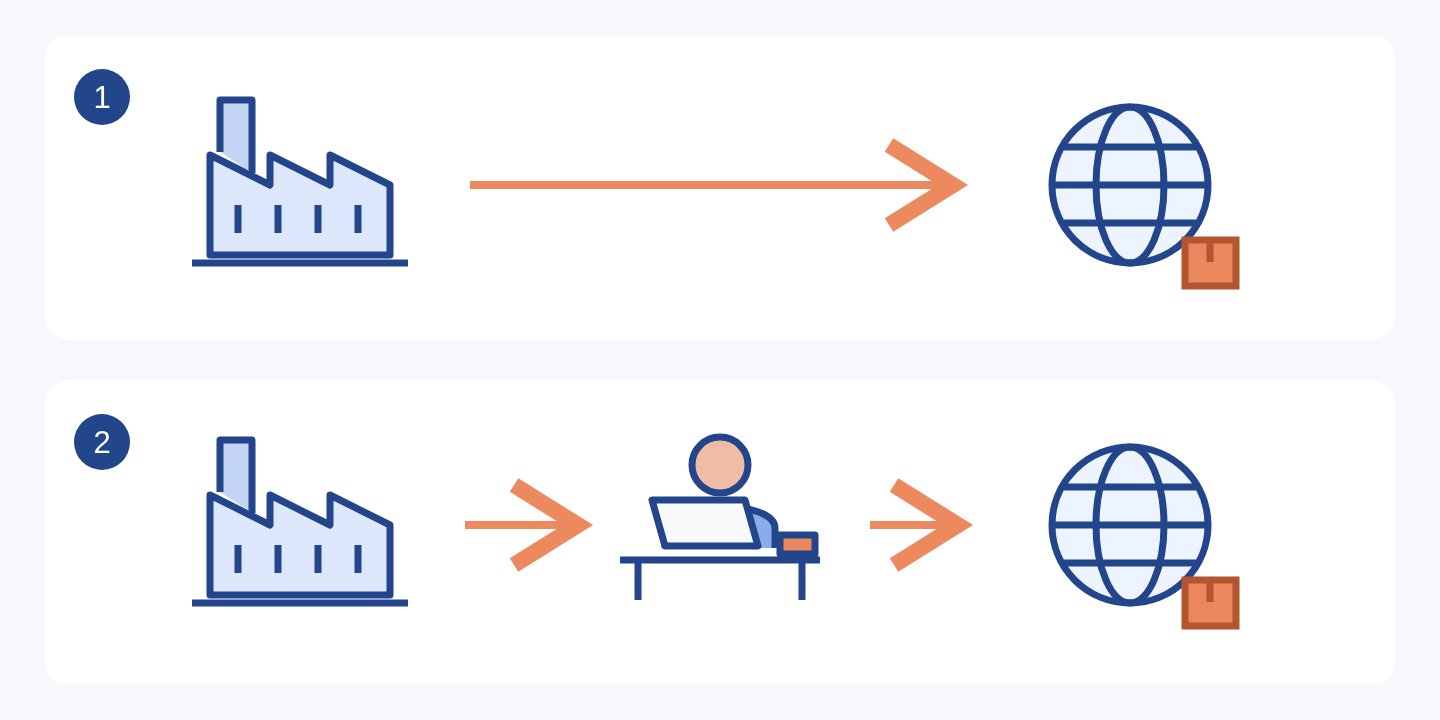
Buying directly, buying through a purchasing agent and buying from an agent that resells goods are not the same arrangement. The account used to place the order is a useful starting clue, but the contract and actual transaction determine the parties. Resolve this before telling the seller which company name to print.
In a direct purchase, establish the legal seller behind the shop and your own buying entity. In a resale arrangement, the Chinese supplier may sell to the agent, which then makes a separate sale to you. The supplier-to-agent invoice and agent-to-you invoice can therefore document different transactions rather than duplicate paperwork.
An agent may instead act under an agreed purchasing mandate. Do not assume that every service called “sourcing” follows one invoicing pattern. Ask who buys the goods, who pays the seller, who arranges export and which document each party will issue. Record the answers in the quotation or service agreement.
A practical sourcing guide updated in September 2026 highlights how the buying route changes the paperwork. The platform's own service terms also distinguish the contractual framework for overseas users. That is a reason to check the actual account, channel and order terms, not to apply a domestic workflow to every international purchase.
Prepare the buyer details
Give the seller the exact legal name of the entity that bought the goods. An overseas trading name, an employee's name and a Chinese warehouse recipient are not automatically interchangeable. Confirm the spelling and entity before issuance, especially when several businesses share a brand.
Do not invent a Chinese Unified Social Credit Code because a form appears to demand one. A Tianjin tax authority explanation published in February 2025 states that, for ordinary VAT invoices, the purchaser's Chinese taxpayer identification number or Unified Social Credit Code may be omitted for foreign customers. This is not permission to use somebody else's identifier or misstate who made the purchase.
That guidance does not guarantee that every 1688 account or invoice-request screen supports the same foreign-buyer entry. If the actual workflow blocks a legitimate request, keep the order reference and ask the seller or platform support how to enter the overseas purchaser correctly. Do not select a local company merely to make the form submit.
Send a compact request containing the order reference, buyer name, document needed, invoice delivery contact and the agreed goods and amount. Include additional registration information only where it is relevant and requested through the proper process. Ask for a confirmation of the buyer details rather than sending unrelated personal documents.
Request it against the order
Open the order under the account that made the purchase and use its invoice request process where available. If an agent controls that account, agree that the agent will submit the request and return the original file. Keep the request and seller's response connected to the order rather than relying only on an off-platform conversation.
For eligible products carrying the fast-invoicing service mark, the 1688 fast-invoicing agreement, version 20251221, sets a conditional timetable. An online request made before transaction completion is generally due within 15 calendar days after completion; a request made within 180 days after completion is generally due within 15 calendar days after application.
These terms are not a universal deadline for every 1688 purchase. The agreement contains qualifications for separately agreed deadlines, missing or incorrect application details, and refund, return or exchange situations. Check that the purchased item carried the service and retain the relevant order evidence. Do not promise yourself automatic compensation based solely on elapsed days.
The same service agreement treats demanding an extra fee solely to issue the invoice as a refusal scenario. Agree the transaction's total price, tax treatment and required paperwork before ordering, but do not interpret an “invoice fee” as an official tax or a universal platform charge. If the seller introduces one afterwards, save the exchange and raise the specific issue through the applicable order process.
Read the returned invoice
Start with the issuer's Chinese legal name and taxpayer identifier. A shop name can differ from its registered operator's name, so compare identities rather than expecting a brand label to match word for word. If an unrelated company appears, ask what transaction that company actually carried out.
Then compare the buyer, goods, quantities, amount and tax fields with the order. A description such as “service fee” may be appropriate for an agent's service but does not automatically describe the goods you purchased. Separate genuine charges and transactions instead of accepting a convenient total with the wrong subject.
The State Taxation Administration's April 2026 invoice compliance guidance emphasizes truthful underlying business, appropriate parties and accurate invoice information. A successful invoice lookup does not by itself establish that the document belongs to your order. Matching the commercial facts is a separate part of the review.
- Record the original invoice file, number and date without editing the document.
- Match the seller and buyer to the actual transaction, including any documented intermediary role.
- Reconcile items and amounts with the order and payment; explain freight, agent fees, refunds or split deliveries separately.
- Check the invoice through a suitable verification route and save the response.
- Resolve any mismatch with the issuing party before treating the document as complete.
Never fix an incorrect buyer name by editing the PDF yourself. Ask the issuer to use the applicable correction process. If the transaction is refunded or the invoice is replaced, retain the relationship between the original, any red-letter adjustment and the replacement rather than keeping only the most attractive version.
A small order with an agent
Consider a hypothetical overseas shop ordering CNY 6,000 of products. Its agent buys the goods from the 1688 seller and resells them to the shop, charging a separately described service. The shipment reaches the agent's consolidation warehouse before export. These facts must be established in the agreement; the illustration is not a rule for all agents.
The seller's fapiao may document the sale to the agent. The overseas shop then needs the agreed billing and shipping documents for its purchase from the agent. Replacing the agent's name with the shop's name on the domestic invoice would change the recorded buyer; it does not solve the documentation gap.
A practical request to the agent is: “Please provide the document for your sale to our company, identify the goods and service charges, and explain which supporting supplier invoice belongs to the domestic purchase.” This asks for a coherent record rather than insisting that every document name the same party despite separate sales.

Close the file with evidence
If the seller has not issued the promised invoice, collect the order, request date, buyer details, service promise and response. If the invoice is wrong, identify the exact field and the evidence supporting the correction. A concise issue tied to one order is easier to handle than a general accusation that the shop cannot invoice.
For the supplier itself, our 1688 supplier verification guide explains how to connect a shop with its registered business. Use a company search to examine the relevant entity, and ChinaValidate's invoice verification tool for supported invoice checks. Company identity and invoice verification answer different questions; neither guarantees delivery, export treatment or reimbursement in your country.
Before closing the purchase file, make sure someone outside the original conversation can trace who sold what to whom, what was paid and which document records each part. That clear chain is more useful than collecting a document titled “invoice” without understanding the transaction it represents.