
VAT Rates on Chinese Invoices
Read 13%, 9%, 6% and reduced collection rates on Chinese invoices without confusing tax treatment, price calculations and invoice authenticity.
Start with the Chinese legal name or USCC. Confirm the matching company before opening its profile.
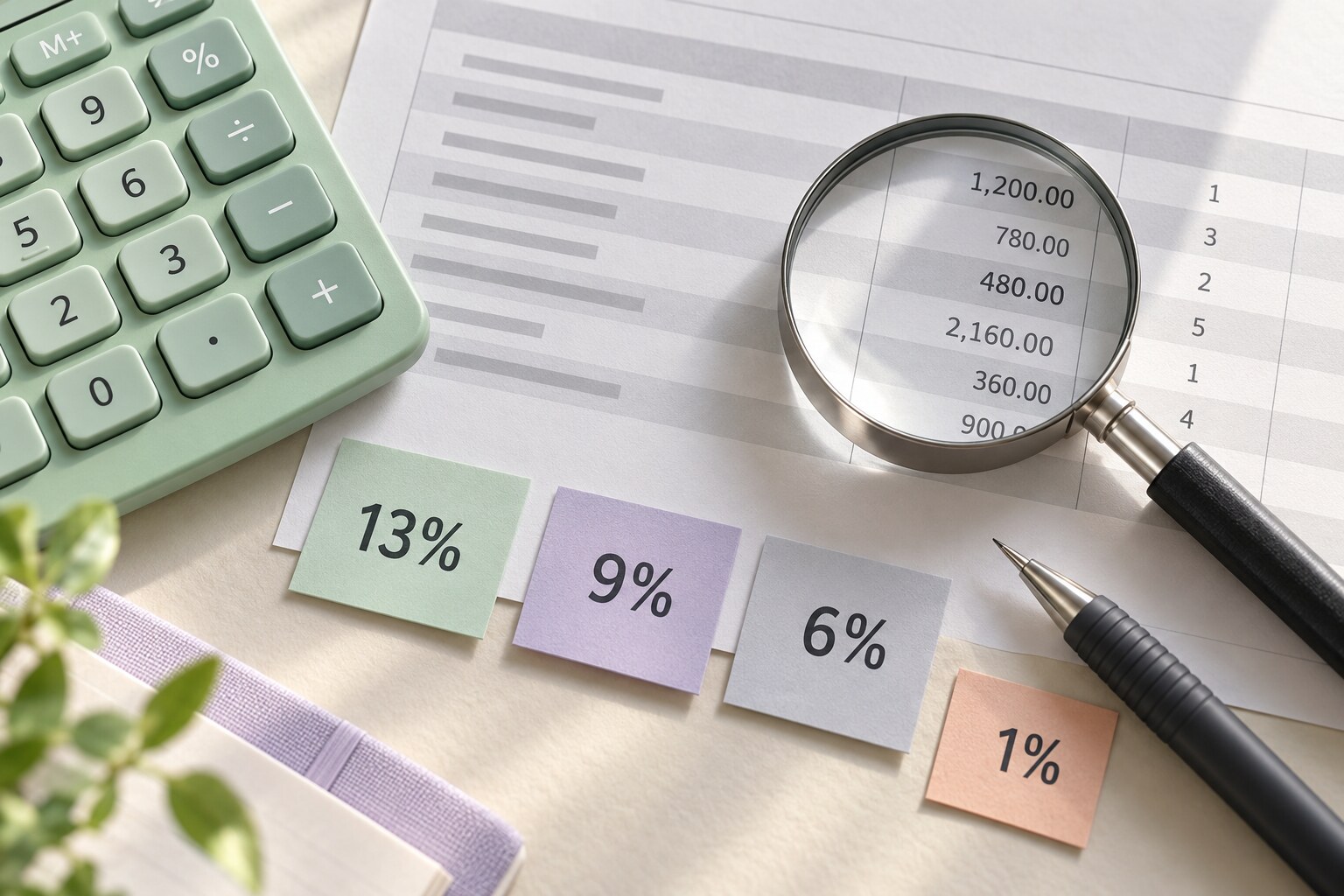
A Chinese supplier sends an invoice showing 13% VAT. Another shows 1% for a similar purchase. The difference is worth understanding, but it does not automatically mean that one document is fake. The applicable treatment depends on the transaction, the seller's tax status, the calculation method and any relief in force.
For an overseas buyer, the practical job is to read the amount correctly, identify the reason for an unexpected rate and check that the invoice belongs to the real purchase. You do not need to turn every invoice into a tax-law research project. You do need to avoid rejecting a legitimate document—or accepting an unrelated one—because a percentage looks familiar.
The rates you will encounter
China's VAT Law took effect on 1 January 2026. Its main rates remain 13%, 9% and 6%, with zero rating for specified transactions. The law separately sets a 3% collection rate for the simplified calculation method. A collection rate and a general VAT rate are not merely different labels for the same calculation system.
| Figure | Typical context | What to check |
|---|---|---|
| 13% | Most goods; processing, repair and replacement; leasing tangible movable property | The actual item and whether general taxation applies |
| 9% | Specified goods and activities, including transport and construction | The precise category rather than a broad word such as “service” |
| 6% | Other taxable services and intangible assets outside the specified higher-rate categories | What service was supplied and how it was classified |
| 3% | The statutory simplified-method collection rate | The seller's applicable method and any specific preferential treatment |
| 1% | Eligible small-scale taxpayer transactions under the current reduction | Eligibility, transaction exclusions and the policy period |
| Zero or an exemption indication | Different zero-rated or exempt treatments | The stated basis; these are not interchangeable explanations |
This is an orientation table, not a complete classification schedule. A description such as “equipment” or “consulting” may help you frame a question, but the real supply and applicable provisions still matter. PwC's China tax summary provides a useful independent overview of the main categories; use the official rules to settle a specific treatment.
Do not infer a company's VAT category from its registered capital, its English name or the size of its online shop. Company registration and VAT treatment answer different questions. A large-looking supplier profile does not establish which method should appear on a particular invoice.
The current 1% reduction
The relevant 2026 basis is Ministry of Finance and State Taxation Administration Announcement No. 10 of 2026. From 1 January 2026 through 31 December 2027, eligible small-scale taxpayers apply a reduced 1% collection rate instead of 3% to taxable transactions other than sales or leasing of immovable property and transfers of land-use rights.
That scope matters. “All Chinese invoices are 13%” is wrong, but “every small seller can charge 1% on anything” is also wrong. Ask the issuer which taxpayer treatment and transaction category it used. Do not substitute your estimate of the company's turnover for a confirmation from its finance team.
The reduction also has an end date. Save the policy basis with the invoice issue date, especially when checking documents from different years. Baker McKenzie's China VAT reference separately identifies the 2026–2027 reduction and its exclusions, which is useful when explaining the distinction to an overseas accounts team.
Older online guides may still describe a blanket 3% or 5% simplified-rate structure. The Shanghai tax authority's 2026 explanation addresses the move to the statutory 3% collection rate and how adjustments to pre-change business are reported. Historical invoices and specific transitional treatments need their own context. A rate outside this introductory table is a reason to request the applicable basis, not an automatic fraud finding.
Separate the amount from the tax
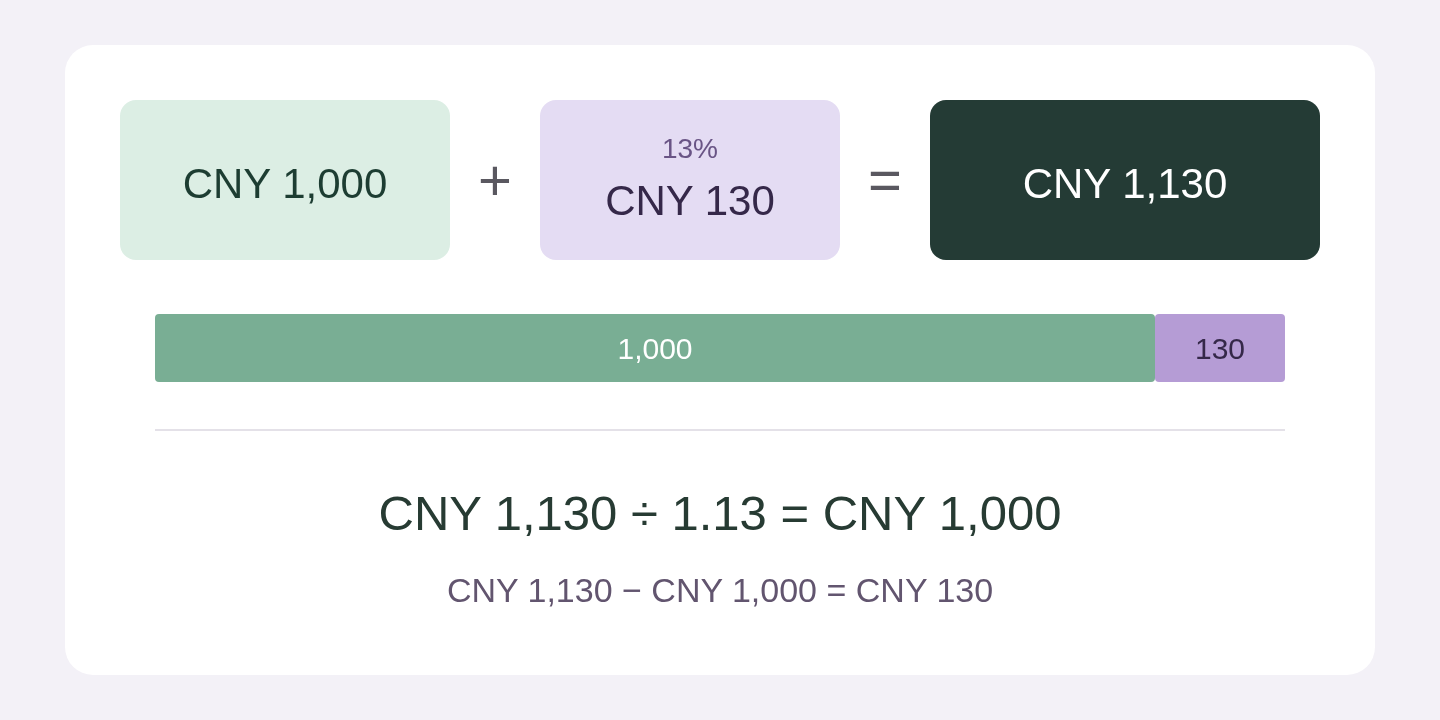
On a fapiao, the amount before VAT, the tax amount and the total including tax perform different jobs. If an invoice shows a taxable amount of CNY 1,000 at 13%, the illustrative VAT is CNY 130 and the total is CNY 1,130. The rate is applied to the tax-exclusive amount, not to the final total.
If the agreed price is already tax-inclusive at CNY 1,130, multiplying that total by 13% gives the wrong VAT component. For this simple single-rate example, divide CNY 1,130 by 1.13 to obtain the CNY 1,000 base, then subtract it from the total to obtain CNY 130. Rounding and invoice-line details still need to be reconciled in a real document.
Check the quotation before challenging the seller's total. A quote may state an inclusive price, an exclusive price or leave the point unclear. Clarify that commercial agreement separately from the tax treatment. A correctly calculated invoice does not prove that an additional amount was agreed in your purchase contract.
For multiple invoice lines, compare each line before applying one percentage to the grand total. Distinct transactions may involve different rates, while the law has separate rules for a single transaction involving more than one rate. Do not tell the seller to split one supply artificially or merge unrelated charges just to reach the number you expected.
Zero is not the same as exempt
A zero rate and an exemption can both produce no VAT charged on a line, but their legal treatment is different. Read the description and ask for the relevant basis instead of treating a zero amount, an exemption label and an empty field as equivalent. An empty field may also reflect the document format or a reading problem.
The VAT Law provides zero rating for exports of goods subject to exceptions, and for specified cross-border services and intangible assets. An overseas buyer's address alone does not turn every domestic purchase into a zero-rated export. Establish which transaction the invoice records and who is carrying out the export.
This is especially relevant when an agent buys inside China and later sells goods abroad. The domestic supplier invoice and the overseas sale can belong to different stages. Ask for the documents for your own purchase rather than demanding that the supplier change the domestic tax line simply because the final destination is overseas.
Likewise, do not assume that a Chinese invoice entitles your overseas business to recover Chinese VAT or obtain a refund in your own country. Recovery depends on the applicable rules, taxpayer status and supporting documents. Refer that accounting decision to the adviser handling the actual transaction.
Different rates on two quotations
Consider two hypothetical offers for similar packaging. One supplier quotes a CNY 1,000 tax-exclusive base and CNY 130 VAT under a 13% treatment. Another quotes the same base and CNY 10 under an eligible 1% treatment. Their respective totals are CNY 1,130 and CNY 1,010. The arithmetic differs without establishing anything about product quality or document authenticity.
First compare the actual scope: material, quantity, delivery, tooling and any separate service. Then ask each supplier to explain the applicable tax treatment. Comparing only the tax percentage can conceal a different specification or an omitted charge. An attractive total is not a substitute for a complete offer.
Do not ask the second supplier to print 13% merely to make the quotations look alike, or ask the first to use 1% without a valid basis. Your task is to understand the real price and obtain the correct document for the actual transaction. Tax treatment is not a styling choice for the invoice.
Rate checks and authenticity checks
A plausible rate is only one field on the invoice. A fabricated document can display 13%, and an authentic document can contain an error that requires correction. The State Taxation Administration's April 2026 invoice compliance guidance treats correct rates alongside truthful transactions, appropriate parties and complete invoice information.
- Confirm the issuer and buyer, then match the goods or services to your order.
- Read the rate or exemption field together with the date and the issuer's explanation.
- Recalculate the tax-exclusive amount, tax and total for the relevant lines.
- Verify the invoice details through a suitable lookup route and retain the response.
- Keep unresolved classification or amount questions separate from the lookup result.
A lookup match is not a professional ruling that every tax classification is correct. Conversely, a failed lookup is not proof that the percentage is wrong. Entering the wrong number, amount or date can affect the search. Our invoice-number lookup guide explains the identification step so that a search-input problem is not confused with a tax issue.
If you receive a sales receipt or a commercial invoice rather than a fapiao, first identify the document type. The absence of a familiar Chinese tax-rate field on a different document is not by itself a defect. See the fapiao and receipt comparison before treating unlike documents as though they follow the same layout.
A focused request for clarification
When something looks wrong, ask a narrow question: “Please confirm the VAT treatment for this item, whether the agreed price includes VAT, and the basis for the rate shown.” Include the order reference and the disputed line. This gives the finance team a concrete issue to resolve without accusing the supplier of fraud.
Do not edit the rate or amount in the PDF. If the issuer confirms an error, it should use the applicable invoice correction process. Preserve the original and the relationship to any replacement or red-letter adjustment so that later reconciliation does not count the purchase twice.
ChinaValidate's invoice verification tool can help check supported invoice details, while a company search helps you examine the issuing entity. Use those results with the order and the issuer's explanation. The useful outcome is a coherent transaction record with a supported rate—not a decision made from the percentage alone.