
Supplier Store Age vs Company Age
Read marketplace years, company establishment dates and manufacturing experience as separate claims. Build a clear timeline before treating a long history as supplier evidence.
Start with the Chinese legal name or USCC. Confirm the matching company before opening its profile.

A supplier's profile shows a long trading history, its marketplace account is newer, and the company record gives a third date. The dates can all be accurate. They may describe a business entity, an online sales channel and the experience of a team rather than one continuous clock.
The useful task is to attach each date to the claim it actually supports. For a Mainland Chinese supplier, the registered company's establishment date anchors the legal entity. Marketplace years describe a platform relationship under that platform's definition. Manufacturing experience needs evidence about the relevant people, operation and product. None should silently replace the others.
Three clocks on one profile
Read the label beside the number before interpreting it. “Years on the platform,” “established in” and “years of experience” look similar in a sales presentation, but they answer different questions. Copy the wording with its source and the date you viewed it. A cropped number without its label loses much of its meaning.
| Clock | What it can describe | What it does not establish alone |
|---|---|---|
| Company establishment | When the specific registered entity was formed | Uninterrupted production or experience with your product |
| Store or membership history | A platform account or programme relationship | The incorporation date of every business linked to the store |
| Operating experience | A team, factory, predecessor or product activity | The age of the company accepting your order |
Alibaba's own paid-supplier years explanation describes the period since a supplier became a paid member. That is a membership measure. Other platform labels can use different definitions, so do not transfer this wording to every badge, store anniversary or “experience” claim you encounter.
An independent supplier-verification guide likewise distinguishes platform activity from company evidence. That distinction is useful without adopting a rule that older automatically means safer. A long-lived account can be relevant history while leaving current ownership, product suitability or order responsibility unresolved.
A timeline without a contradiction
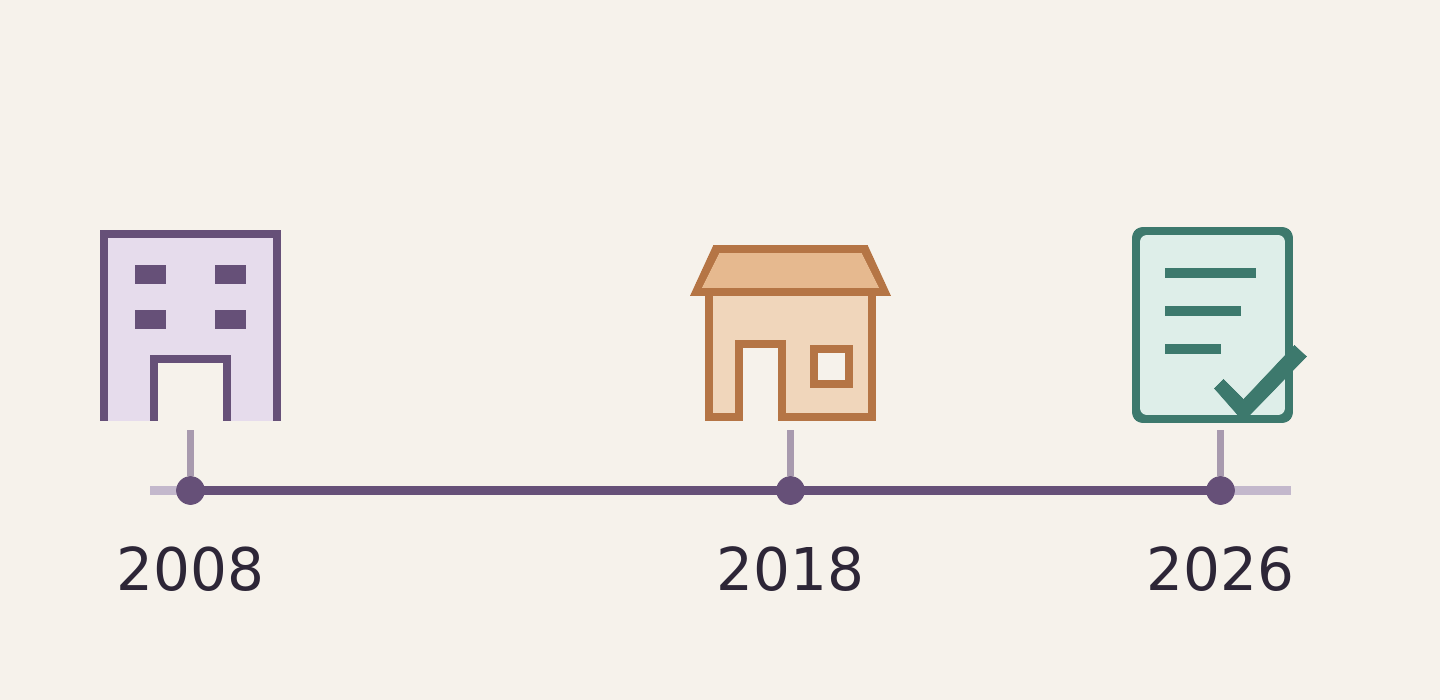
Consider a fictional Mainland company established in 2008. It opens the marketplace store under discussion in 2018. You review the business in 2026. The store has a shorter history than the company because the company existed before using that channel. Nothing in those three dates, by itself, indicates a false claim.
Now add a salesperson who says the team has experience predating the company. That may be true, but it is a fourth claim to explain. Ask whose experience is being counted and in which activity. Experience gained by a founder at a former employer is not the same as operating history of the current legal entity.
Keep the dates as events before calculating a rounded number of years. A platform may display an annual membership count, while an exact company-age calculation depends on the establishment date and the date of review. A difference created by rounding should not be presented as proof of deception.
A clear note for the example would say: company established in 2008; this store opened in 2018; records reviewed in 2026; earlier team experience remains a separate statement. That is more informative than compressing the whole story into “old supplier” or “new supplier.”
Find the exact company
Obtain the Chinese legal name and Unified Social Credit Code of the business that will sell to you. Do not search only the brand, shop name or an approximate English translation. A supplier group can include multiple companies established at different times, and the oldest one may not be the company accepting your order.
Compare the identifier in the company record with the license or seller disclosure. If a company name has changed, follow the documented connection rather than assuming the new name marks a newly formed entity. Conversely, a familiar trade name does not make two companies with different identifiers the same business.
China's market-entity registration rules distinguish establishment registration from changes and deregistration. They also provide for replacement licenses following changes to recorded matters. This is why a later document or change date should not automatically be read as the original establishment date.
Our establishment-date guide explains locating the relevant field. For the present comparison, retain the actual date, the matched entity and the source. A date copied from a marketing profile is a claim to compare, not a substitute for identifying the registered business.
History of another business
A common explanation for a young company with an older business story is that it was created to handle sales for an established factory. Another is that a founder formed a new company after working elsewhere. These explanations can be plausible without making the new company inherit every credential, customer relationship or responsibility of the earlier operation.
Ask which organization performed the earlier work and what connection exists now. A business relationship, common shareholder and internal group role are different connections. Record the supported relationship without treating “same group” as a complete answer. The current order still needs a named seller and a clear production arrangement.
If a trading company uses an older factory's photographs or history, ask whether that factory is proposed for your product and whether the evidence is current. The fact that the factory existed before the trader may be useful context. It does not establish that your order will actually be made there or that the trader owns the facility.
Sometimes the claim concerns a brand rather than a company. A brand can continue through different operators or be used by several authorized businesses. Keep brand history separate from the age of the seller. Do not assign an old brand's founding date to a newly registered company merely because its catalogue carries the logo.
Where the supplier provides a documented predecessor relationship, preserve the documents and describe the connection narrowly. Do not call separate entities identical or assume liabilities transfer simply because the commercial story sounds continuous. Questions about legal succession require the actual transaction and legal documents, not a timeline graphic.
Age is not continuous activity
An establishment date marks the start of the entity. It does not prove that the company has manufactured the same product every year since then. A business may change its activities, location, team or ownership. An older registration can coexist with a recently introduced product line.
For the product you want, ask for relevant and dated evidence: an assessment covering the proposed operation, a sample against your specification, records appropriate to the product requirements, or a clear explanation of which work is performed where. These are different types of evidence; choose them according to the claim being evaluated.
Suppose an established bag supplier now offers electronic accessories. Its company age still describes the entity, but it does not establish electronics experience. A new product line needs its own explanation of sourcing, quality control and applicable requirements. Years in business cannot fill those gaps by arithmetic.
Likewise, a recently formed seller might have an experienced team and a suitable manufacturing arrangement. Investigate those claims directly rather than rejecting the company solely because it is young. Your decision can reflect limited history without turning a date into an unsupported accusation.
Read changes in context
A name change, address change or new legal representative is not automatically a new company. These events may nevertheless matter to a purchase, depending on what changed and when. Keep the event date and affected field visible so you can ask a focused question rather than declaring every update a warning sign.
If the proposed factory has moved, an old site assessment may no longer describe the operation making your goods. If ownership or management has changed, an earlier relationship with a salesperson may not answer who now handles the order. The useful follow-up concerns the current arrangement, not the age statistic alone.
For an existing supplier, update the parts of your file affected by a material change. You do not need to discard every historical document or restart every enquiry. Keep earlier records as dated evidence and add the current explanation. This makes continuity—or a break in continuity—visible without pretending the past disappeared.
A changed storefront also needs a clear link. If a supplier asks you to use another account, identify the business associated with the new account and confirm the transition through established channels. A screenshot of an older account's years does not automatically belong to a different storefront.
A useful question about history
Please identify the Chinese company that will accept this order and its USCC. Your profile mentions a longer business history than this company's establishment date. Please explain which company, factory or team that history describes, and how it is connected to the proposed production for our order.
The wording leaves room for a legitimate explanation. It also asks for something more specific than a reassuring statement that the business is experienced. Keep the reply and its supporting material together. If it answers only part of the question, record the remaining gap instead of converting the entire history claim into a pass or fail.
For a short buying decision, summarize the result in separate lines: entity identified; establishment date checked; store history understood; relevant product experience supported or still open. Avoid a formula that awards automatic trust points for each year. The significance of the evidence depends on the purchase.
With the exact Chinese legal name or USCC, search the Mainland company record. If the information arrives on a license image, use business-license verification to help read and compare supported fields. Then place that result on the correct timeline: the company's history, alongside the store's history and the evidence for the work you need today.