
Chinese VAT Invoices from Supplier Branches
Check a Chinese VAT invoice when a supplier’s head office signed the contract but its branch issued the fapiao. Reconcile the seller, delivery and payment records.
Start with the Chinese legal name or USCC. Confirm the matching company before opening its profile.

The head office signed the contract. The local branch performed the work and wants to issue the Chinese VAT invoice. The two names look almost identical, but the invoice would identify a different registered operation from the one in your supplier file. Before booking the invoice or releasing a payment against it, identify the branch and ask for the documents that connect its role to your order.
This was a real procurement question in Zhongshan. In a June 2022 consultation, a service supplier said its head office had bid for a hospital logistics contract while its local branch supplied the staff. The buyer expected the head office to invoice and collect. The supplier argued that the local branch should do both. Zhongshan’s tax service replied that the parties providing the service and collecting the money had to be determined from the actual transaction. The published reply gives the principle, with no published outcome for that contract. Zhongshan tax consultation.
For a buyer, the practical starting point is to keep four records in view: the contract, proof of delivery or performance, the fapiao and the payment instruction. Each can identify a different role, even when every document carries the same brand.
The branch and its head office
A mainland Chinese company can establish a branch, or 分公司. Under Article 13 of the Company Law, the branch has no separate legal personality and the company bears its civil liability. A subsidiary has its own legal personality and generally carries its own obligations. That distinction matters when a salesperson describes a local operation as “our branch.” The English description could refer to a registered branch, a subsidiary or simply an office. Company Law, Article 13.
Separate registration can give the branch its own full Chinese name, Unified Social Credit Code (USCC) and business licence. Start with the name and identifier shown on the invoice. Then obtain the branch's licence or registry entry and the head office's details. Confirm the relationship using the registration record or supporting registration documentation. A city appended to the company name helps you recognize a possible branch, but the records establish which company it belongs to. Market entity registration rules.
Keep both entries in your supplier file even if your accounting system uses a single vendor profile. Record which name signed the agreement and which name appears in the seller section of the fapiao. That makes a duplicate invoice review or a dispute about a later delivery easier to trace. If the search returns a separately incorporated company instead, ask the parties to document its own role in the sale. Group ownership alone leaves that question open. Branch registration and legal relationships.
The seller fields
On a fully digital fapiao, look for the seller information panel (销售方信息). The name and taxpayer identifier in that panel belong together. Keep them separate from the invoice number, which identifies the document, and from the purchaser's identifier. Copy the Chinese name as shown, including any city and branch wording. If you received a screenshot or an excerpt that cuts off the seller panel, request the original electronic invoice. State Taxation Administration guidance on fully digital invoices.
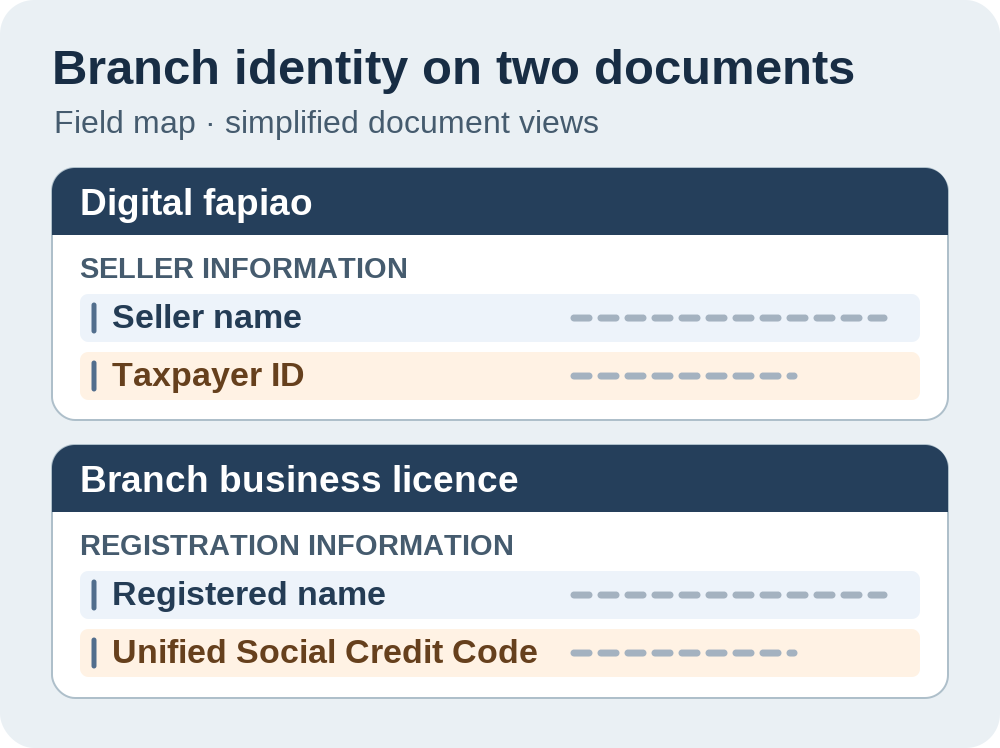
Search the invoice seller by its identifier and check the returned Chinese name against the branch licence. If the seller identifier leads to the head office but the invoice names the branch, save both results and ask the issuer to explain the discrepancy using the original document and registration details. A head-office code copied from the contract is no substitute for the identifier that appears on the fapiao. Look up a Chinese invoice seller.
A four-document check
Once you know the names, record what each party actually did. Use the purchase order, contract or project reference to tie each document to the same purchase. If the fapiao covers one instalment or a particular service period, use that scope in the comparison. A single transaction can produce several records over time.
| Document | Field to record | Evidence to request |
|---|---|---|
| Contract or order | Chinese name of the contracting supplier, order reference, settlement terms | Signed schedule or amendment identifying the branch and stating what it will do |
| Delivery or service record | Who delivered or performed, where and for which period | Signed receipt, service acceptance record or other proof tied to the order |
| VAT invoice | Seller name and taxpayer ID, invoice number, items and amount | Original fapiao and a matching verification result |
| Payment instruction | Named beneficiary, account details and the invoice or instalment it covers | Confirmed account instruction and documented collection arrangement where the parties differ |
Different entries call for different explanations. A branch can appear on the service report because its staff were on site, while the contractual and financial documents identify the head office. In that case, ask for the document assigning the branch the work and check the head office's role in the sale and settlement.
A different case arises when the branch appears on the invoice and expects to collect directly. There you need to establish the branch's role in the underlying transaction and see how the collection instruction fits the agreed terms. The branch registration helps with identity in either case.
Check the total, tax and billing period against the acceptance record before putting the invoice in the payment queue. A month of completed on-site service and an invoice for an advance on the following month may both have valid paperwork, but they describe different amounts or stages. Ask for the invoice-to-order breakdown when several sites, branches or instalments are combined.
Suppose a head-office contract covers equipment and installation. The head office sends an invoice for the equipment, and a branch sends another invoice for the installation. In that example, ask the supplier to map each charge to the signed price schedule and the separate delivery and acceptance records.
Compare the branch invoice with the installation line, including the billing period and any deposit applied to it. A matching total across the two invoices can still conceal a duplicated charge or an amount billed against the wrong milestone. If the equipment is already paid, check the ledger before releasing the branch payment.
The issuer and payee
China's invoice administration rules generally require the party collecting payment for business activity to issue the invoice to the payer, with exceptions under the rules. The tax authority's compliance guidance asks businesses to look at the parties behind the contract, goods or services, funds and invoice together. In a branch arrangement, focus on the evidence for the actual supply and collection. The legal connection between branch and head office explains civil responsibility. The invoice and payment treatment still depends on the facts of the sale. Invoice administration rules, Articles 18 and 21 · Tax authority compliance guidance.
A documented branch role
Ask for a contract clause, an addendum or another order-specific document identifying the branch and the tasks assigned to it. Check the names, date and reference against the agreement you actually signed. For a buyer asked to pay the branch, the record should also explain who is authorized to collect and how that payment is credited against the buyer's obligation. Send the assembled documents to the person responsible for approving invoice treatment where the arrangement requires a tax judgment.
A supplier might explain a head-office invoice by saying it files VAT centrally. In March 2026, Shanghai's tax authority explained the approvals available under China's VAT law for head offices and branches in different tax jurisdictions to file on a consolidated basis.
If that explanation is material to your review, ask the supplier's finance team to identify the arrangement that covers this branch and confirm how it applies to this invoice. Consolidated filing concerns where tax is reported. The order records still show who supplied, billed and collected for the specific transaction. Shanghai tax authority guidance on consolidated VAT filing.
A different payee
If the branch is the seller on the fapiao but a head-office account appears on a late payment instruction, keep the invoice check and the bank change separate. Verify the instruction through an established supplier contact and request the contractual or written basis for the account. Keep the payment on hold while the beneficiary is unresolved. Changing the vendor record to match an emailed instruction could hide the very difference you need to explain. Invoice and bank beneficiary reconciliation.
An invoice issued in error
If the supplier confirms it billed under the wrong registered name, ask the issuer to correct the document through the applicable invoicing process. For a fully digital invoice, the national guidance sets out red-letter procedures for issuance errors and other adjustments, with steps that depend on whether the recipient has confirmed use or recorded the invoice. Keep the reference to the original and verify any replacement before matching it to the order. A revised PDF sent by email is insufficient without a corresponding invoice record. Digital invoice correction procedures.
An order-specific request
Send one request that purchasing, finance and the supplier can work from. Include the order reference, billing period and the two names as printed. A short request gives the supplier a way to respond with the relevant documents:
For the order and billing period shown above, please confirm the registered Chinese names and identifiers of the head office and branch. Please identify which operation supplied the goods or services, which issued the fapiao and which will collect payment. If the branch is acting under the head office's contract, please provide the document assigning that role and the settlement instructions for this order.
If the branch is new to your vendor system, agree with accounts payable how to record it before creating a second supplier profile. Keep the contract vendor and the invoicing record traceable to the same purchase order. Record the issuer's tax identifier alongside the invoice number so staff reviewing the head-office and branch inboxes can spot a duplicate. Set up the payee only after its details have been independently confirmed. This also gives the next reviewer a record of which arrangement was approved and for which order.
Once the supplier responds, attach the branch registration record, the evidence of its role and the verification result to the same order. If all you received was a new set of payment details or a general letter stating that both operations belong to one company, record the remaining question explicitly. That might be who performed the work, who can collect this payment or why the tax invoice identifies a different seller. A named outstanding item is easier to resolve than a generic mismatch flag.
The verification record
Use business licence verification to check the registration document and invoice verification to check the fapiao. Keep those results with the transaction records. A matching invoice result confirms the invoice data against the verification record. The contract, acceptance documents and approved payment instruction explain whether that invoice belongs to the purchase your team is about to settle.