
Chinese Invoice Date vs Payment Date
Separate a Chinese invoice's issue date from payment, delivery and file receipt dates, and build a clear transaction timeline before investigating a mismatch.
Start with the Chinese legal name or USCC. Confirm the matching company before opening its profile.

The invoice is dated Monday, the bank transfer was sent on Wednesday, and the goods arrived the following week. A colleague flags the purchase because the dates do not match. Before calling it an error, identify which event each date records. Issuing an invoice, paying an amount and accepting a delivery are separate events.
For a Mainland Chinese fapiao, 开票日期 is the issue date. It is not automatically the date of payment, the date of delivery or the day the attachment reached your inbox. A useful review connects those dates through the actual transaction rather than forcing them to be identical.
Make a timeline before a conclusion
Start by collecting the documents that show what happened. Keep the order or contract, original invoice, payment record and any delivery or service-acceptance evidence. Write the date beside the document that supports it. If an event has only been described in a message, record it as an explanation awaiting evidence rather than as a confirmed fact.
| Date | Where to find it | What it describes |
|---|---|---|
| Order date | Accepted order or contract record | When the recorded order was placed or agreed |
| Invoice issue date | 开票日期 on the fapiao | When that invoice was issued |
| Payment date | Bank or payment-provider record | The payment event and status recorded by that provider |
| Delivery or service date | Delivery note or acceptance record | When goods arrived or the service was performed or accepted |
| File receipt date | Email or document system | When your team received that particular copy |
Do not fill a missing delivery date with the invoice date just to complete a spreadsheet. An unknown event remains unknown. Likewise, an email timestamp establishes receipt of a message, not necessarily the original creation of its attachment or completion of the underlying sale.
A short timeline often reveals that the apparent discrepancy comes from comparing different events. It can also expose a real gap, such as a claimed delivery with no acceptance evidence. Both outcomes are more useful than treating every date mismatch as either fraud or harmless administration.
The invoice is not a bank statement
Covington's practical fapiao guidance notes that business invoices may be presented before or after payment. That explains why the dates can differ; it does not mean every timing arrangement is compliant or that the invoice proves settlement.
A document may be needed before the customer's payment process starts. In another transaction, payment may happen first and the invoice may arrive later. Establish the arrangement that applies to the purchase in front of you. Do not infer it solely from what your previous supplier did.
Payment evidence also has its own vocabulary. “Submitted,” “processing” and “completed” can describe different stages. A screenshot of a transfer instruction is not necessarily evidence that the intended beneficiary received funds. If settlement is disputed, consult the actual payment record and the provider rather than relying on the invoice date.
Keep the invoice and payment identifiers separate. A payment reference may help the supplier locate money, while an invoice number identifies a tax document. Neither should be pasted into the other's field merely because a finance system uses one generic “reference” column.
Tax timing still matters
The distinction between events does not make issue dates arbitrary. Article 28 of the VAT Law effective from 2026 addresses when VAT liability arises and includes an earlier-invoice rule. Applying that rule to a particular sale requires the relevant transaction facts and applicable detailed provisions.
For an overseas purchasing review, the practical implication is limited: do not ask the seller to change a date simply to make your records look tidy. An invoice is not a calendar entry that a buyer can move freely. If timing appears wrong, describe the actual events and ask the issuer to explain or correct the document through the proper process.
A financial reporting cutoff is another question. Your finance team may need to determine the accounting period for goods received or services performed. That decision should use the relevant accounting rules and evidence; it cannot be settled by declaring that every expense belongs to the invoice's month.
The same caution applies across a year end. A late-arriving invoice may document an earlier transaction, while a recent invoice may concern something not yet delivered. Record both the source date and the date your team received the file, then refer the accounting treatment to the responsible person. Do not backdate a supplier document yourself.
A purchase across several dates
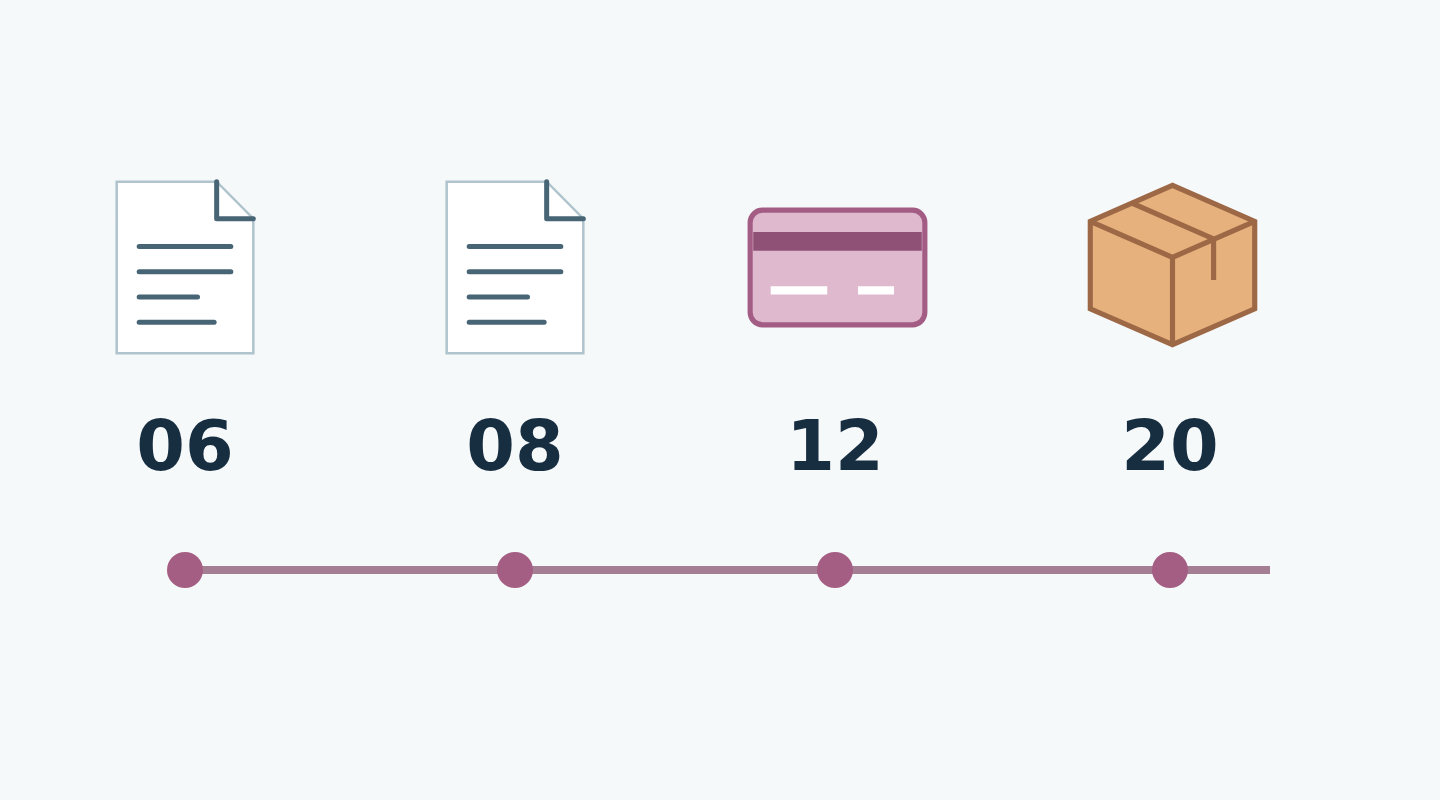
Consider a hypothetical equipment order. The purchase is agreed on 6 October, the seller issues a fapiao on 8 October, a payment is recorded on 12 October, and the warehouse accepts the goods on 20 October. The example illustrates different events; it does not prescribe when a particular business must invoice or pay.
The review should connect the accepted order to the invoice and the payment, then connect the delivered goods to the same order. Matching company names and totals helps, but an order reference, item description and delivery record may be needed to distinguish this purchase from another one with the same supplier.
Now suppose the invoice reaches the buyer on 22 October. That is the file receipt date, not a reason to replace the issue date with 22 October in a verification request. Preserve the date printed on the invoice and add the receipt date as separate administrative information.
If the payment is only a deposit, say so in the timeline. A deposit and final balance can relate to one invoice or a more complex documented arrangement. Reconcile the actual amounts and documents rather than assuming that one invoice must always correspond to exactly one bank transfer.
Read dates without changing them
Chinese invoice dates commonly use year, month and day, with 年, 月 and 日 indicating each component. A date copied into another country's form can become ambiguous when only slashes remain. Preserve the original and use an unambiguous written month in your working explanation.
Check whether a date came from the visible invoice, a filename or file metadata. A downloaded file may carry a creation timestamp from the download or conversion process. A filename can have been assigned by a colleague. Neither is a substitute for the invoice's actual issue-date field.
Time zones can explain some differences in message or payment timestamps, especially around midnight, but do not use that explanation automatically. Establish which clock each source uses and whether the specific events are close enough for the conversion to matter. A large unexplained gap is not resolved by saying “different time zones.”
When a scan is unclear, ask for the original electronic invoice or a clearer copy. Guessing a digit can move the apparent transaction into another month. If optical character recognition extracts the date, compare its result with the source before relying on it for a lookup or an accounting entry.
Corrections and later copies
A resent attachment is not automatically a newly issued invoice. Compare the invoice identifier, issue date and parties. If the supplier has simply sent the same document again, record another delivery of the file rather than creating a second purchase or treating the email date as a new issue date.
A correction is different. The digital-invoice announcement provides for red-letter invoices in specified situations, including invoicing errors and returns. Original and correcting documents have a relationship that needs to remain visible; a newer date does not tell the whole story.
Keep the original, the adjustment and any replacement with an explanation of what changed. Do not simply keep the latest PDF and delete earlier evidence. Our red-letter invoice guide explains that separate status question.
If the business changed its name between the transaction and your review, distinguish the old invoice identity from the current company record. A present-day record is useful for checking the entity, but it does not authorize rewriting historical documents. Request evidence of the change when it is relevant to connecting the records.
Verify with the issue date
Use the invoice issue date requested by the verification route, not the payment or receipt date. The national invoice-verification instructions describe the fields for the relevant invoice types. A mistaken date can prevent a lookup from matching even when the other fields are correct.
If no record is returned, first compare the input with the original. Do not try a succession of nearby dates in the hope of finding something. A result for a different invoice would not authenticate your document. Our new-invoice lookup guide covers no-record situations and the distinction between input problems and unavailable data.
- Label each date by the event it records.
- Keep the source document for the event.
- Explain the link between order, invoice, payment and delivery.
- Retain corrections and resends without overwriting history.
- Use the printed issue date for the appropriate invoice check.
For supported invoices, ChinaValidate invoice verification helps check the recorded information. Use company search if the seller's identity needs investigation. Neither result establishes that payment settled or goods arrived; those events require their own evidence.
The finished review does not need a single “correct date” for everything. It needs a coherent sequence, clear document roles and an explanation for any gap that matters. That gives finance and purchasing a usable record without making the invoice say more than it does.