
Chinese Invoice Amounts Explained
Read amounts before tax, VAT and tax-inclusive totals on a Chinese invoice, then reconcile quantities, deposits and payments without mixing the price bases.
Start with the Chinese legal name or USCC. Confirm the matching company before opening its profile.
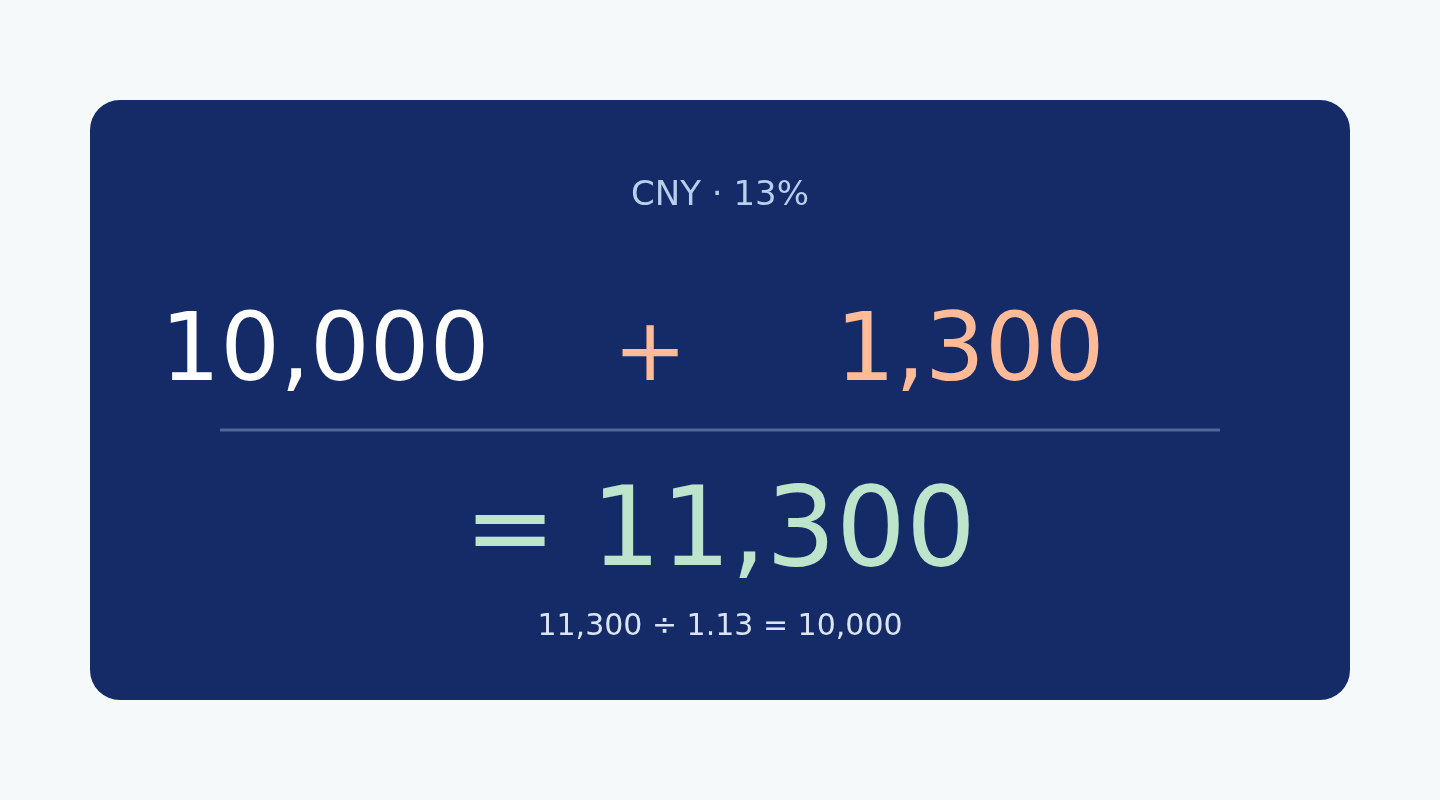
A Chinese supplier's invoice shows an amount of CNY 10,000, tax of CNY 1,300 and a total of CNY 11,300. Your payment record shows CNY 3,390. None of those figures is necessarily wrong. They can describe the price before tax, the tax, the invoiced total and a deposit against the same purchase.
The useful starting point is to name each amount before comparing it. This guide explains the arithmetic on Mainland Chinese tax invoices and shows how to reconcile it with an order and payments. It does not choose the correct tax treatment for a product, establish a deduction entitlement or turn a correct sum into proof of a genuine transaction.
Read the labels before the figures
The word “amount” can refer to different fields in an English conversation. On the invoice, 金额 usually identifies a line amount, 税额 is the tax amount, and 价税合计 is the combined price and tax. Read the relevant column heading and the row it belongs to rather than copying whichever number is largest.
| Label | Meaning | Illustrative value |
|---|---|---|
| 金额 | Amount before tax in this example | CNY 10,000 |
| 税率/征收率 | Applicable tax rate or levy rate shown | 13% |
| 税额 | Tax amount | CNY 1,300 |
| 价税合计 | Total including tax | CNY 11,300 |
These are teaching figures for a transaction assumed to use a 13% rate. They are not a statement that every Chinese sale uses that rate. The VAT Law effective from 2026 distinguishes sales value from VAT and provides different rates and calculation methods. Check the actual invoice category and transaction before applying an example.
Read an item row all the way across. Quantity, unit price, amount, rate and tax belong to that row. A short description on the invoice may need an order attachment to explain which product was supplied. Correct multiplication of the wrong item does not reconcile a purchase.
One purchase, two price bases
In the teaching example, the seller's price before tax is CNY 10,000. Multiplying that base by 13% gives CNY 1,300 of tax. Adding the two produces CNY 11,300. These relationships are straightforward once the base has been identified:
- Tax = amount before tax × applicable rate.
- Total including tax = amount before tax + tax.
- Amount before tax = total including tax ÷ (1 + applicable rate).
If the quotation already says CNY 11,300 including tax, do not add another 13% merely because the invoice displays a tax column. The tax-inclusive amount already contains the tax. Dividing CNY 11,300 by 1.13 gives the CNY 10,000 base; the difference is CNY 1,300.
A common wrong calculation is to multiply CNY 11,300 by 13% and call CNY 1,469 the included tax. That applies the rate to a total that already contains tax. It does not extract the original tax component. Record whether the quotation is tax-inclusive before entering a formula in a comparison spreadsheet.
Keep the currency explicit. A Chinese tax invoice amount in yuan should not be compared directly with an overseas payment in dollars as though the numbers share a unit. Exchange conversion, bank charges and settlement timing belong in a separate reconciliation. Do not alter the invoice amount to match the bank's converted debit.
Quantities, unit prices and rounding
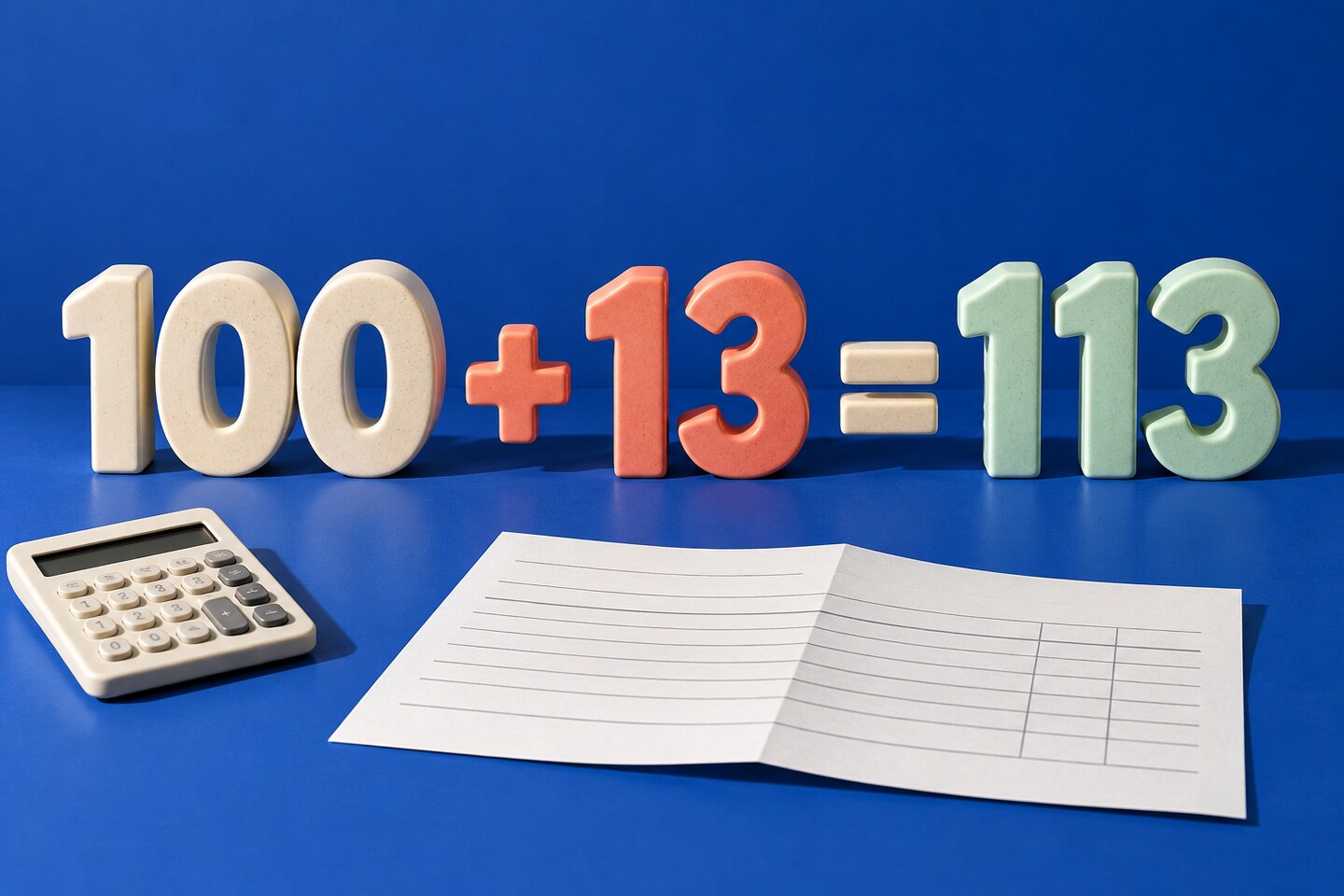
Suppose the invoice records 100 units at CNY 100 each before tax. The line amount is CNY 10,000, before adding the tax in our example. If your order instead states CNY 113 per unit including tax, those can describe the same price basis. Compare like with like before reporting a CNY 13 per-unit discrepancy.
Check the unit of measure as well. A price per carton is not a price per piece. A quantity of 100 sets may contain more than 100 individual objects. Keep the order's packaging and unit definition with the invoice when the brief item description cannot explain the relationship by itself.
Small rounding differences need a specific explanation. A system may display fewer decimal places than it uses in a unit-price calculation, and calculations across several rows can produce a small difference from a manually rounded total. Ask which row and rounding method explains the difference; do not assume that any unexplained amount is harmless merely because it is small.
Retain the source values exactly and put your recalculation in a separate worksheet. Do not change displayed tax or line amounts inside the invoice file. If the issuer confirms an actual invoicing error, it must address the document through its applicable correction process.
Mixed rows and tax treatments
An invoice containing several kinds of goods or services cannot always be reduced to one rate applied to the grand total. Read each row's treatment and the associated tax amount. A delivery charge, service and product may require separate analysis of the actual transaction; their names alone do not determine the legal treatment.
PwC's China tax summary describes multiple VAT rates and simplified arrangements. This is useful context for why a familiar percentage is not a universal test. Our Chinese invoice VAT-rate guide covers the rate question separately; the task here is reading and reconciling the figures already recorded.
If a row is exempt or treated differently, retain the actual notation rather than replacing it with a guessed percentage. A blank-looking or nonnumeric entry should be read with the invoice type and explanation. Zero-rated, exempt and outside-scope transactions should not be treated as interchangeable labels merely because a calculation appears to produce no tax.
Discounts also need a traceable basis. Confirm which items the discount applies to and whether the quoted reduction is before or after tax. A commercial reduction in an email may not yet be reflected in the issued invoice. Obtain the agreed document relationship instead of manually reducing the total and presenting that figure as the invoice's amount.
The payment does not have to equal one invoice
Return to the CNY 11,300 purchase. A 30% deposit is CNY 3,390, leaving CNY 7,910 to be paid under the assumed arrangement. The smaller bank transfer does not automatically mean the invoice is inflated. It may represent only part of the agreed consideration.
| Record | Amount | Explanation to retain |
|---|---|---|
| Invoice total | CNY 11,300 | The full amount recorded on this invoice |
| Deposit payment | CNY 3,390 | 30% under the hypothetical order terms |
| Remaining payment | CNY 7,910 | The balance before other agreed adjustments |
Label this as a reconciliation example, not a rule about when every seller should issue an invoice. The correct invoicing timing and amount depend on the actual transaction. Your payment schedule explains the arithmetic; it does not authorize an inaccurate tax document.
The opposite pattern is also possible: one payment can cover several invoices. List each invoice number and the amount allocated to it, then compare the allocated sum with the payment. Avoid attaching the same full bank transfer to every invoice and treating each one as independently settled.
Separate supplier consideration from bank fees, platform charges and an intermediary's service fees. If another business issues a document for its own charge, that amount should not be silently folded into the goods seller's invoice. Keep the parties, currencies and charge descriptions visible.
Use the amount required by the check
The amount entered for invoice verification depends on the invoice type and route. The national verification platform's instructions distinguish the relevant fields. Some routes use an amount before tax; fully digitalized invoice verification can require the total including tax. A correct number in the wrong amount field can produce an unsuccessful lookup.
Do not substitute the deposit, bank debit or amount still outstanding for the invoice field requested by the tool. Use the issued document as the source and preserve leading zeros in identifiers. Our VAT invoice verification guide explains the document-specific inputs.
A matching verification result establishes a comparison with recorded invoice information. It does not prove that the price was commercially reasonable, that the tax is deductible for your business or that every invoiced item was delivered. Keep those decisions connected to their own supporting evidence.
Close the reconciliation
A useful review note should let another person reconstruct the difference without repeating the entire conversation. State the invoice total, its currency, the order reference, payments allocated, any outstanding amount and the explanation for adjustments. Attach the source documents rather than merely saying that finance “checked it.”
- Identify the before-tax amount, tax and tax-inclusive total.
- Recalculate the relevant rows using the correct price basis and units.
- Explain discounts, mixed treatments and any rounding difference.
- Allocate deposits or combined payments to the relevant invoices.
- Use the required invoice amount for verification and retain the result.
If the total remains unexplained, ask a precise question: identify the row, the source amount and the calculation that differs. A request to explain CNY 1,469 versus CNY 1,300 is more useful than a general accusation that the invoice is wrong. Preserve the issuer's answer and any corrected document.
Use ChinaValidate invoice verification for supported invoice checks, and company search when the invoicing business needs separate identification. The goal is a purchase file in which each number has a name, a currency, a source and an understandable relationship to the transaction.