
Chinese Company Name Search
Search a Chinese company name accurately, handle incomplete characters and old names, and distinguish a supported match from a similar-looking result.
Start with the Chinese legal name or USCC. Confirm the matching company before opening its profile.

A Chinese supplier sends its name as an image. You copy the characters into a company search and get no result. A shorter search produces dozens of businesses with similar wording. The next step is not to choose the name that looks most familiar. It is to establish which part of the input is reliable and which result actually matches the source.
A Chinese company name search is a small evidence task: preserve the original name, use a suitable search input, compare the returned identity and keep uncertainty visible. This guide focuses on searching a name already available in Chinese. If you have only an English trading label, first follow our English-name discovery guide.
Start with the name field
Obtain the company name from a document or disclosure that identifies the business relevant to your purchase. On a business license, look for the name field rather than the large document title. A marketplace can show a shop name and a separate registered operator. A quotation can carry a brand in the header and the actual seller in the terms.
Keep the name in its original Chinese characters. China's enterprise-name registration rules provide for a registered enterprise name using standard Chinese characters. A convenient English translation or pronunciation aid should sit beside that name, not replace it as the identity you are trying to find.
If text is available, copy it directly. If it appears only in a scan, transcribe carefully and compare the result with the image. Optical recognition can confuse similar characters, omit a bracketed place name or drop the final organization wording. Do not repair an uncertain character by selecting whichever spelling returns a result.
Also record where the name came from and what role it describes. The name on a test report might identify the applicant or manufacturer. The name on a platform disclosure might identify the store operator. Neither automatically identifies the company that will sign your purchase agreement. A correct search can still answer the wrong transaction question.
Read the name in parts
The usual Chinese enterprise-name structure combines an administrative location, a distinctive name, an industry or business characteristic and an organization form. The implementation measures for enterprise names describe that structure and its permitted variations. It is a reading aid, not a rule that every valid name must contain four visibly separate blocks.
| Part of a name | Use in a search | Common mistake |
|---|---|---|
| Location wording | Helps distinguish candidates when the source includes it | Adding a city that the registered name does not contain |
| Distinctive name | Can help discover candidates from an incomplete name | Treating a shared short name as unique nationwide |
| Industry wording | Helps preserve the exact registered string | Replacing trading with manufacturing to fit the product |
| Organization wording | Distinguishes the complete named business or branch | Deleting a branch ending or converting every form to Co., Ltd. |
For a fictional teaching example, imagine a name presented as “City A + Example + Trading + Limited Company.” Those labels are not a real company name or search suggestion. They show why deleting the city or replacing “Trading” with “Technology” creates a different input. Keep the actual source wording even when another version sounds more natural in English.
Some names have permitted arrangements that differ from the common sequence. Parentheses may contain a location or another relevant designation. Some qualifying enterprises may omit a location or industry expression. Do not reject a result solely because its shape differs from a beginner's naming formula; compare the complete registered record.
Use exact input before broad input
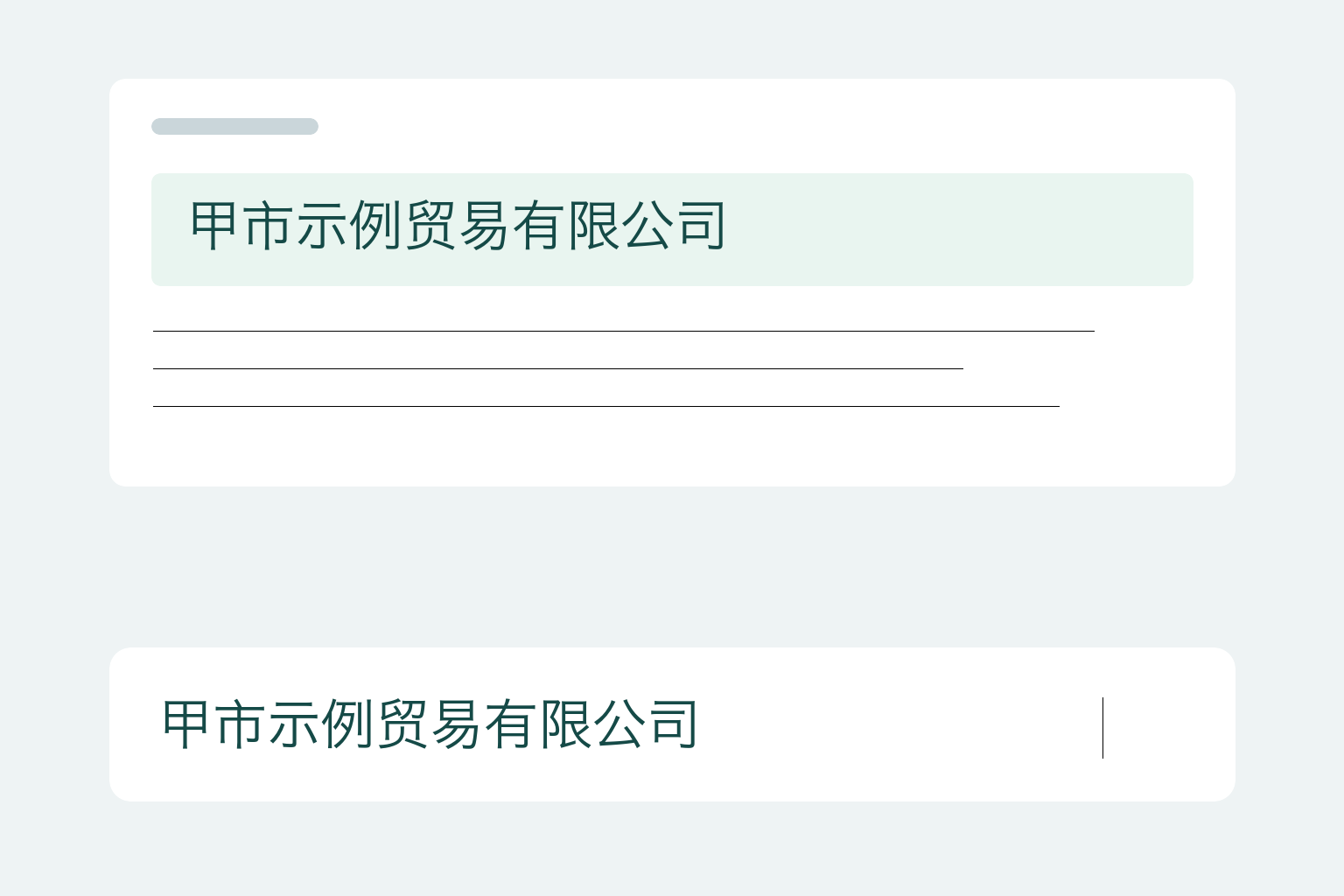
Start with the full Chinese name when it is legible and complete. Remove accidental spaces or line breaks introduced by copying, while retaining the meaningful characters and punctuation. Save the untouched original as well. Search cleanup should make the same name usable, not create a new name.
If the service returns a direct match, open the record. Compare the full name, code, status and relevant location with your source. If the interface also matches historical names or aliases, read which field produced the match. A result can be relevant without its current name being identical to your original input, but that relationship needs evidence.
If the exact search returns nothing, inspect the input before broadening it. Check for a cropped final line, a branch suffix, a mistaken character or a label copied from the wrong part of the document. Request a text version from the supplier if the image is unclear. This is often more efficient than running many guessed spellings.
Only then try a distinctive fragment supported by the source. Keep any reliable location or industry clue beside the results. A broad search is a discovery step, so its success means you have candidates to inspect. It does not lower the evidence needed to identify the actual seller.
Separate a match from a resemblance
A candidate deserves attention when its identity fields connect to the source, not merely because it shares an attractive brand word. Compare the complete Chinese name and any USCC supplied. Use the address, document date and transaction role as supporting context. Keep conflicting fields visible rather than selecting only the ones that agree.
Imagine two fictional candidates that share a distinctive name. One is a trading company in one city; the other is a technology company in another. Your supplier's English signature contains only the shared word. That signature does not select either candidate. A current license or a Chinese legal name from the contracting documents is the stronger next input.
Now suppose the license provides a full name and code that match the trading company. You can identify that business without claiming it manufactures the goods. If the supplier names the technology company as its factory, investigate it as a second entity and request the relationship. Do not combine fields from both businesses into one supplier profile.
CNToolbox's supplier-verification guidance similarly emphasizes the company behind the quotation rather than relying on an English commercial name. The useful practical principle is to anchor the enquiry to an identifiable Mainland entity. Service descriptions and report offerings do not establish that every supplier or every field will be available.
Our candidate-comparison guide covers a larger multi-entity investigation. For this name-search task, a compact record is enough: input, candidate, matching identity evidence, conflicting evidence and the next item needed. Avoid numerical confidence scores that obscure a missing legal name.
Handle old names and branch names
An old certificate or catalogue can carry a former Chinese name. Keep the date and original wording, then use the code if one is reliably available. A current record under a different name may be the same business, but the connection should come from a name-change record or another suitable authoritative source.
Do not assume that every search service indexes all former names. A failed old-name search may reflect the search function or data coverage. Conversely, a current result mentioning the old wording may be only a lead until the change history is confirmed. Our former-name guide explains how to preserve the sequence and relevant dates.
A branch name needs its ending. If the supplied Chinese name includes a branch designation, removing it may take you to the head company instead. That can be useful for a separate relationship check, but it is not the same search result. Record the branch's identity and the head company's identity separately where the transaction involves both.
Commercial rebranding is another possibility. A new website logo or English spelling does not necessarily mean the registered Chinese name changed. Ask which event occurred and request the relevant evidence. Updating a marketing alias and replacing a legal counterparty are different changes in a vendor system.
Recognize an unfinished search
A timeout, access challenge or unavailable page is not a “company not found” result. Record the technical obstacle and repeat through an available legitimate route. Likewise, a blank field in a returned profile is not proof that the fact does not exist. State what the source actually returned.
If a readable exact name still produces no defensible match, check the jurisdiction and entity type stated in the source. This workflow concerns Mainland registered businesses; do not force an unrelated jurisdiction's document into the same search. A personal seller's commercial label may also differ from the registered market entity, if registration applies to that seller.
Send a focused request instead of asking the supplier to “prove it is real”: “Please provide the full registered Chinese name and USCC of the seller for this order, with a clear current business-license copy.” If another business will invoice, manufacture or receive payment, request its identity and role separately.
Do not buy a detailed report on a merely similar candidate to compensate for uncertain input. More information about the wrong business makes the file larger without making the decision better. Resolve the identity first, then choose the depth of review appropriate to the order.
Save the name you verified
After a defensible match, retain the exact Chinese name, USCC, source and retrieval date. Keep an English reading name in a separate field. Attach the document that supplied the original input so another colleague can see how the record was selected.
- Preserve the complete Chinese source name.
- Record the search input and whether it was exact or partial.
- Compare the returned identity with the source evidence.
- Explain any former name, branch or separate transaction party.
- Keep unresolved differences out of automatic supplier approval.
Use the confirmed name or code in ChinaValidate company search. A supported source document can also be checked with business-license verification. These tools help connect the company identity and available records; a name match alone does not prove payment authority, product quality or future performance.
The final result should be simple enough to reuse: this Chinese name identifies this registered business, based on these matching details. If the evidence cannot support that sentence yet, preserve the candidates and ask for the missing identifier. That is a useful search outcome, even before a company has been selected.