
China Credit Compliance Reports
Learn how to request and verify a Chinese company’s special-purpose public credit report, read its coverage, and match it to a tender or supplier review.
Start with the Chinese legal name or USCC. Confirm the matching company before opening its profile.

When a Chinese tender, customer, or licensing authority asks for proof of whether a company has violated laws or regulations, the relevant document is often a provincial special-purpose public credit information report. The Chinese name can include 专项公共信用信息报告 or 有无违法违规记录证明. Ask the recipient for the exact document name, company, jurisdiction, period, and record categories it expects before the company generates a report.
The report addresses specific public records within the scope printed on the file. A bank credit report, a corporate registration extract, and a general supplier credit report each answer different questions. A company can send an authentic report that still falls short of the request, for example because the dates are too narrow or the report names its factory when the requirement applies to the bidder. Review the issuer and the scope before drawing any conclusion from the results. Guide to general Chinese company credit reports
The recipient sets the submission requirements
Start with the tender clause, application checklist, or written supplier onboarding request. Save it with your evidence file. If the requester just says “compliance certificate,” ask whether it needs proof of whether there are violation records, which legal entity must be named, and whether it accepts the original electronic file, a scan, or verification through an official service. Capture the date the report must cover through and any limit on how long before submission it may have been generated.
A waterworks tender posted on the Jiangsu Public Resource Trading Network on 10 June 2026 shows how specific these instructions can be. It called for the bidder’s special-purpose credit report as an original electronic file or electronic scan, with a lookback of 3 years and all listed categories selected. The 4 categories were administrative penalties, administrative compulsory measures and enforcement, criminal judgments, and serious untrustworthy-entity lists. The same clause gave separate instructions for bidders registered outside Jiangsu, including submitting supporting documentation with the local report. Other bidders should follow the terms in their own notice. Jiangsu tender qualification clause
For a purchase, establish whether the request concerns the company that will sign the contract, the manufacturer, or both. Use the full registered Chinese name and Unified Social Credit Code of each required company. An English group name can appear on documents belonging to several entities. ChinaValidate’s company search can help establish the legal identity to put in the request. Obtain the compliance report through the applicable official channel.
Each report has a defined scope
Joint national notice 565 of 2025 provides for replacing separate proofs of whether an entity has violated laws or regulations with special-purpose reports drawn from shared public credit information. The notice applies to market entities including enterprises, individual businesses, and farmers’ professional cooperatives. The underlying provincial systems must at least bring together administrative penalties, including penalties imposed under simplified procedures, administrative compulsory measures and enforcement, serious untrustworthy-entity lists, and criminal judgments that record offenses. The fields actually selected for a report matter when reading an individual file. Joint national notice 565 of 2025
Determine which jurisdiction’s records the issuing service covers. The Jiangsu implementation plan, effective 19 September 2025, concerns records generated within the province for the period and fields covered by the report. If a supplier is registered in one province and operates a site in another, check the scope against the requester’s intended review. Ask the recipient which jurisdictions it requires and confirm with the relevant services what documents the company can obtain. National guidance calls for recognition of the other region’s special-purpose report when a region requires proof concerning that other region. A commercial buyer should confirm its own acceptance requirements in writing. Jiangsu implementation plan
The national notice says the period should in principle be no more than 5 years unless the recipient specifies otherwise. Jiangsu’s plan sets a general period of 3 years. Check the actual dates on the file against the request. A report generated today can still show a period that ends earlier than the date the buyer specified, or the buyer may need a newly issued copy for the same historical period. The generation date, coverage period, and freshness rule in the tender or onboarding request are separate checks.
Read a result such as “no records found” alongside the jurisdiction, dates and category labels for that report. If a category is absent from the scope, ask the company to check whether it was selected and whether the service can issue the required version. The same principle applies to older events and records from other regions. Payment performance, bank credit, and other categories that fall outside the report require their own evidence.
Identity fields on the Jiangsu report
The Jiangsu government gazette publishes a blank layout headed 江苏省专项公共信用信息报告, with the subtitle 有无违法违规记录证明版. The cover identifies the subject through 主体名称 (entity name) and 统一社会信用代码 (Unified Social Credit Code). Match both to the bidder or supplier in the request. For a recently renamed company, confirm the current registered identity and keep any official evidence that links the old name to the same code.
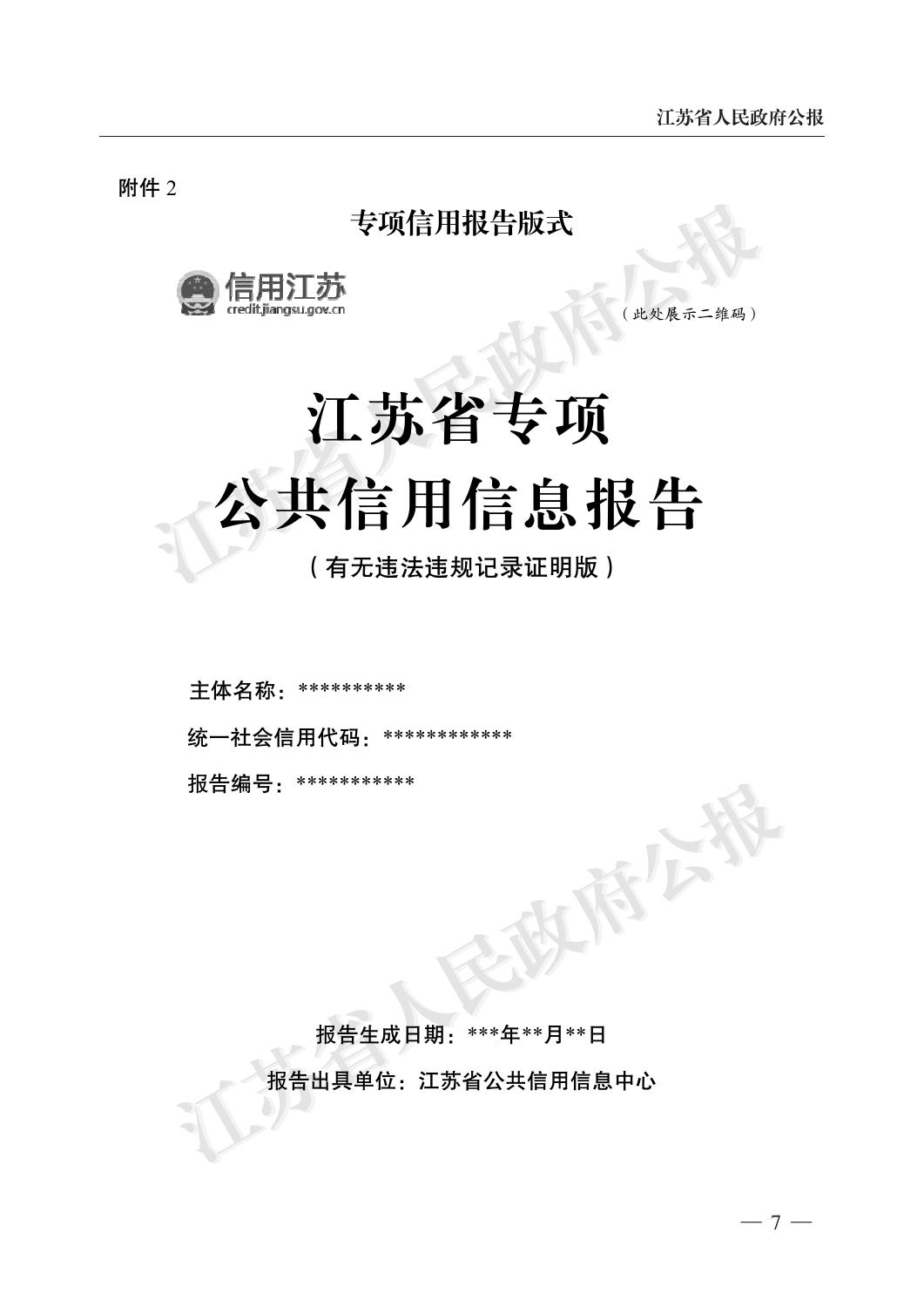
The remaining cover fields are 报告编号 (report number), 报告生成日期 (generation date), and 报告出具单位 (issuing body). Use the number and date to identify the particular issue you received. Get the entire issued document, including the pages setting out coverage and the results. The cover helps identify the report. The scope and results pages show the evidence the recipient asked to review.
On the results pages, check which industries or administrative fields are included as well as which kinds of records are included. The Jiangsu tender above specifies both that the bidder should select all fields and which types of information it should request. If the issuing service distinguishes the two, a list of the 4 record types alone may leave the selected fields unclear. A report limited to a single field can be suitable for a narrowly defined application when the recipient accepts it. For an all-fields submission, compare the coverage text or selection details to the required fields before sending the report. If the file is unclear, ask the issuing service which selections the report number corresponds to.
Authorized access and official verification
Use the credit service designated by the relevant province. The national notice directs Credit China to bring together links to regional services and calls for free online and offline channels for these reports. Under Jiangsu’s public credit information rules, a subject can obtain its own information through real-name authentication or identity checks. A third party applying for access needs the subject’s authorization and is limited to its scope. The Suzhou guidance points applicants to Jiangsu’s dedicated report service. If you are the buyer, ask the supplier to generate the report itself or use the official authorization process. Jiangsu public credit information rules, Articles 25 and 26 · Suzhou report service guide
Give the company the exact name and code expected in the submission alongside the required dates and categories. Ask it to send the original file it downloaded and the official way to verify it. Use the issuing service’s verification route, including the report’s QR code if the service provides one. Where verification requires authorization, arrange it through the service. Compare the entity, report number, generation date, and available scope or results with the file you received. Follow the recipient’s format rules when you submit it and retain the original in your working file.
A QR image forwarded on its own gives you little to reconcile. If a scan opens a service page but you cannot see enough information to match it to the report, ask for the original electronic copy and the correct verification access. Record the verification date and the fields you actually checked. A verified report can still name another entity or cover the wrong dates, so carry the verified identity and scope into the submission review.
Repaired and disputed entries
The national notice and Jiangsu plan both call for repaired public credit information to be shown with a repair marker, 已修复. A report can therefore show an earlier entry and its repaired status together. Read the entry, record-producing authority, and status against the recipient’s actual rule. For instance, a clause about an unrepaired penalty in the tendering field and a general request to disclose past violations ask for different determinations. Keep the issuer’s status label with any entry you refer to in your review.
If the company says an entry belongs to another entity or that a status update is missing, ask which record it disputes and what evidence it can provide. The national notice provides a route to raise an objection through the provincial public credit information system, which can refer the underlying record to its producer for verification. Keep the entry and any official response or revised report together. If the submission deadline comes first, ask the receiving party how it treats a pending objection and use its written instruction to handle the file.
If an entry has a decision or case reference, use it to tie a question to the exact item on the report. Check the category and the relevant dates as well as the description. The date an authority issued a decision and the date a repair became effective can refer to different steps. For a tender with a cutoff, ask the recipient which date or status it uses and which document it accepts to establish it. If the receiver requests the underlying decision or a separate check of a named public list, keep that result beside the report and record the source and date for each.
A supplier file with two legal entities
Suppose a buyer is onboarding a Jiangsu trading company as the seller and a separate factory as the manufacturer. The intake form asks for the contracting seller’s compliance report covering 3 years. The supplier contact sends an original Jiangsu report issued for the factory. The report number verifies and the selected fields show no entries. The factory’s registered name and Unified Social Credit Code still differ from the seller’s on the proposed contract. File that copy under the factory and ask the seller for its own report covering the requested period and fields.
When the seller’s copy arrives, compare the code in the official verification result with the code on the contract and check the dates and selected categories. Write a short note beside the original file recording which entity it covers, the jurisdiction and period, the categories reviewed, and the date you verified it. If a quality or compliance team later adds a separate requirement for the manufacturer, compare its definition with the factory report already in the file before requesting another one. This keeps the evidence tied to the company and purpose for which it was obtained.