
Applying for a Chinese Certificate of Origin
Prepare the consignee, goods and invoice details your Chinese exporter needs to apply for a certificate of origin before shipment.
Start with the Chinese legal name or USCC. Confirm the matching company before opening its profile.

If you need a certificate of origin for goods leaving China, give the exporter the exact document requirement as soon as you confirm the order. The Chinese exporter, producer or their authorized agent normally handles the application. The overseas buyer supplies the details the exporter cannot safely guess, such as the consignee, destination, reason for the request and document format the recipient will accept.
Keep the request tied to a particular shipment. A clear handover gives the applicant enough time to confirm the form, identify the goods it can support and submit the application before or at shipment. Under China Customs Order No. 270, an exporter or producer that delegates the application must provide an authorization letter to the issuing body. China Customs rules on certificate issuance
The first handover
Send one message that the supplier can forward to the person preparing the certificate. Include the name of the form or agreement if the recipient has specified it, the destination, the person or organization that will use it, and the planned shipment date. If a broker is preparing a tariff preference claim, ask it to confirm the applicable proof first. If a customer or bank asked for a certificate, send the exact wording of that request to the exporter. A letter of credit can impose details on names, dates or presentation that are easy to miss in a short request for a certificate.
The buyer may be different from the consignee. For example, a purchasing company can place the order and pay the invoice while a local affiliate receives the goods. Give the supplier both names with their roles. Ask the broker or recipient which consignee details should appear on the relevant form, and supply the spelling, full address and country it has confirmed.
| Detail | What to send or confirm |
|---|---|
| Document request | The named form or agreement, intended use, and any delivery or format requirement from the recipient. |
| Parties | The confirmed consignee details from the buyer or broker. The exporter checks its own registered identity and the producer’s role. |
| Goods | A line-by-line list with commercial descriptions, quantities, units and the applicable tariff classification when the form asks for it. |
| Invoice | The commercial invoice reference and date, with each product linked to its invoice line. |
| Transport | The planned date, route and other transport details the form requests. Identify anything the forwarder still needs to confirm. |
| Origin | The exporter confirms which items it can support with the producer’s evidence and the criteria applicable to those items. |
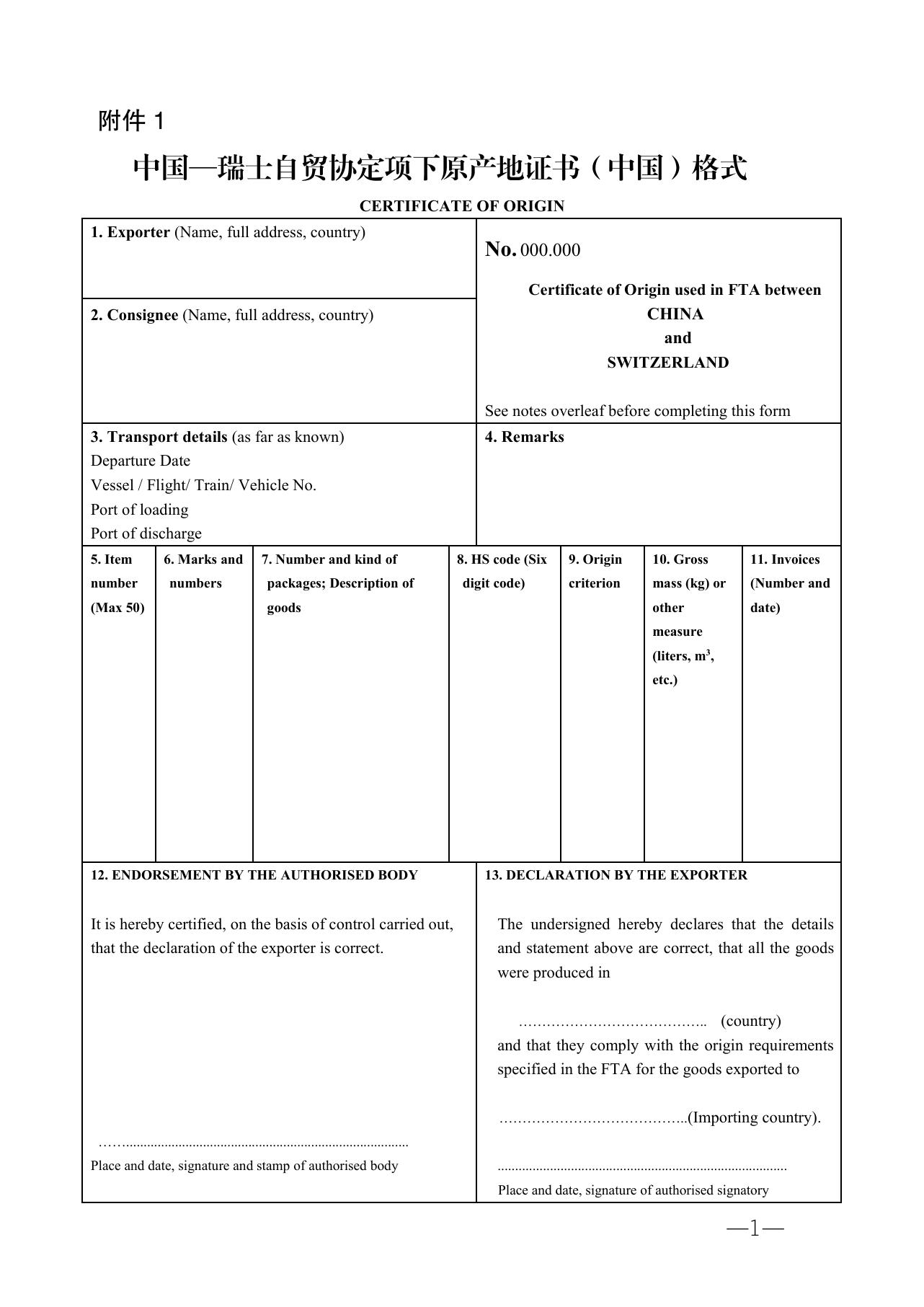
The China–Switzerland form specimen illustrates why a request should point to the actual form. On that form, boxes 1 and 2 identify the exporter and consignee, box 3 asks for transport details as far as known, and boxes 7, 9 and 11 distinguish the goods, origin criteria and invoice references. Use the instructions for the form that applies to your shipment, even if another certificate has familiar headings.
Lines the producer can support
The exporter needs to connect the goods in the application to evidence of origin. A trading company can issue a commercial invoice and coordinate the shipment while a separate factory has the production records. Ask which firm will apply and who can confirm how the goods were made. In China’s issuance rules, the applicant provides the commercial invoice and other materials that establish origin or eligibility, and supplies its Unified Social Credit Code and English name on its first application. Updated identity information should be provided when it changes.
A purchase order is a useful starting point. Turn it into a list of goods that will actually be dispatched. If the order includes spares, accessories or goods from a second producer, make those lines visible. For each eligible item, the exporter should be able to identify the matching commercial invoice line and the origin evidence that supports it. The buyer can supply product specifications and the agreed quantity. The producer is better placed to supply information about materials and production.
In an illustrative order, a buyer has ordered metal housings from a Chinese manufacturer with a separately packed spare kit. A trading company takes the order and invoices both. The producer can support the origin of the housings while the trader is still collecting documentation for the kit. The exporter can ask the issuing body how to handle the proposed application and coordinate with the buyer’s broker on the treatment of each line. Record the unresolved line explicitly. A statement about the origin of the housings leaves the spare kit’s status open.
Use the form’s unit and level of detail. A commercial invoice might use pieces while packing records give carton counts and weights. If the form asks for a particular measure, give the applicant a clear way to reconcile the two. The same applies to a style or customer stock code that describes a model inside your purchasing system. Pair it with a description that identifies the actual goods, especially where similar items use different materials or come from different plants.
If you are setting up a new supplier, check the named exporter separately against its registered identity. That helps you address the request to the right organization and trace the documents it sends back. Origin evidence remains a separate file tied to the goods on the shipment. Check a Chinese exporter’s registered company details.
Check who will issue the commercial invoice before a final reference goes into the application. For example, the Chinese exporter may deliver the goods while an overseas trading company invoices the buyer. Some certificate forms or agreements have specific instructions for third-party invoicing. Tell the applicant about the arrangement and ask the broker what the destination needs. Keep the two invoices identifiable by issuer, number and date. If the exporter first sends a pro forma invoice or an order confirmation, mark it as a planning document and agree on who will provide the final commercial invoice reference before submission.
Two application routes
The importer generally stays out of the issuing system. The Chinese applicant can tell you which submission it plans to use, whether it already has access and what is still needed from the buyer. The China Customs and CCPIT overview covers how to recognize both issuing routes on a certificate.
In the Customs process, the applicant creates a certificate entry under origin management, enters basic information and goods details, and checks the official response in the certificate query area. Customs’ service guide describes how the applicant can revise and resubmit information when it receives a correction message. It also describes self-printing for a Customs-approved formatted certificate through the China International Trade Single Window. China Customs application and issuance guide.
The China Council for the Promotion of International Trade, known as CCPIT, describes steps for linking the account to a company, submitting product information for preliminary review, and then applying for the certificate with goods details and supporting evidence. The exporter can check approval and learn whether the certificate can be printed on its account or needs to be collected. A supplier that has never used this route for the product may need time for setup and product review before lodging the shipment’s application. CCPIT application procedure.
Working back from shipment
Put the application on the same schedule as the commercial invoice and packing list. During order confirmation, send the form requirement and identify the applicant. Before booking, settle the consignee fields, product lines and evidence route. As the booking becomes firm, send any remaining transport details that the selected form actually requires. Give the exporter a buyer-side contact who can resolve questions about names or the receiving party without restarting the whole conversation.
China Customs’ service guide lists a review period of two working days from acceptance of an application, excluding time spent investigating or confirming facts. That is a review timetable. The exporter also needs time to prepare the information and respond to any request for evidence or corrections. If the certificate is for a tariff claim, have the broker confirm its own document deadline and whether a later submission is available for this claim.
- Preparing: Establish which fields are still expected from the buyer, the forwarder or the producer and give each one a due date.
- Submitted: Ask for a status update and find out whether the issuing body needs additional information. Track the exact correction request if one arrives.
- Issued: Ask for the issued certificate in the format the recipient accepts and associate it with the commercial invoice and shipment. Share the issued version with the party who asked for it.
If the booking moves or part of the order is held back, tell the applicant which goods and dates changed. Before submission the applicant can update the preparation details. After issuance, ask the applicant to check whether a formal amendment or a new certificate is required and follow the issuing body’s instructions. Keep old and current versions distinguishable in the broker’s file. If the exporter has missed the normal application time, ask it to check any late-issuance route with the issuing body and let the importer confirm the effect on its own claim.
A shipment handoff in practice
Return to the order for housings and a spare kit. The broker asks for proof under a named trade agreement. Purchasing sends the exact form name and consignee address to the trader. The supplier sends a draft schedule showing both the housings and the spare kit. The packing list is still being revised and includes both lines in the same pallet count.
The buyer asks for separate item references and has the forwarder confirm the departure details. The trader checks with the producer about the supporting records for the spare kit. Meanwhile, the broker confirms how it plans to handle the two goods lines if only one is ultimately supported. The commercial invoice stays accurate to the shipment, including both goods. By the time the application is ready, each party knows which line can be put forward and which matter is still open.
After the certificate is issued, the exporter sends it with a note naming the invoice and shipment it covers. The buyer forwards that version to the broker, along with the commercial invoice and packing list. If the destination requires additional evidence for the claim, the broker can request it against a specific line and document version. The file remains useful to the purchasing team if the remaining goods ship later under a separate booking.
A request you can send
For this shipment, our broker has requested the following certificate of origin: [form or agreement]. Please confirm who will apply, which goods can be supported and when you plan to submit. Use the consignee and shipment details attached. Let us know which fields or commercial invoice references still need confirmation. Please send the issued certificate in the agreed format and tell us promptly if anything changes.
Save the form requirement, accepted consignee details, product list and final document together. A future purchase may use the same parties and goods, while its shipping details and supporting documents still belong to its own application.