
China Certificates of Origin: Customs vs CCPIT
Recognise Customs and CCPIT certificates of origin, choose the correct lookup route, and connect the named exporter to a Chinese company record.
Start with the Chinese legal name or USCC. Confirm the matching company before opening its profile.
China Customs and the China Council for the Promotion of International Trade (CCPIT) both issue certificates of origin. A certificate carrying a CCPIT certification is not automatically the wrong document because it lacks a Customs stamp. Equally, a Customs-issued certificate should not be searched for in CCPIT's database.
For an overseas buyer, the useful distinction is practical: who issued this document, whether that issuer meets the recipient's requirement, and which service can check it. Start with the certificate you received, including its complete certification section. The supplier's email description of it as a “China CO” leaves those questions unanswered.
Two issuing routes
China's origin-certificate issuance measures, effective from September 2024, identify Customs, CCPIT and its local trade-promotion bodies as issuing authorities. The measures also allow electronic signatures and seals. A printed electronic certification therefore needs a record check, not a demand for a wet-ink stamp simply because that is what an earlier shipment used.
CCPIT is the institution usually meant when a Chinese supplier refers to the chamber-of-commerce route. Its initials are not a certificate type. The International Chamber of Commerce's explanation describes CCPIT's place in its certificate-of-origin accreditation chain and documents CCPIT's issuance of RCEP certificates.
| Decision | What identifies it | What to confirm |
|---|---|---|
| Issuing institution | Customs or a CCPIT issuing body | The named issuer and its corresponding verification route |
| Certificate type | The full title, such as Form E or an RCEP certificate | The evidence required for the destination and intended use |
| Commercial requirement | The actual wording supplied by the buyer, bank or other recipient | Any specified issuer, format or additional certification |
These choices do not collapse into one. “CCPIT” does not mean non-preferential, and “Customs” does not itself establish a particular tariff entitlement. If your question is which trade agreement to use, our Form E and RCEP comparison addresses that separate decision. Here, the focus is recognising and checking the issuing route.
The recipient's requirement
Read the document request before asking a supplier to replace a certificate. The Beijing CCPIT service guidance distinguishes requests for issuance by a Chinese official authority from requests for a chamber or non-governmental institution. That distinction makes the recipient's wording material; it does not establish universal interchangeability.
For a customs entry, give the destination broker the certificate's full title and issuing body. For a letter of credit, check the documentary condition with the bank handling presentation. The London Chamber's documentation guidance explains that certificates can serve both customs and commercial documentary requirements. Its UK application rules are not the rules for Chinese exporters, but the distinction between those purposes is useful.
If the request simply says “certificate of origin,” clarify the intended purpose before choosing a route. Ask whether a particular form or issuer is required and who will confirm acceptance. A supplier can arrange paperwork more accurately from that answer than from an instruction to obtain whichever certificate looks most official.
Please confirm the certificate type and issuing institution required for this shipment. Our supplier proposes [certificate type] issued by [institution]. Please identify any different issuer or document format needed before we ask the supplier to apply.
This is a request template, not a statement that every order needs additional certification. Use the actual recipient's requirement; do not add an apostille or another certificate merely because a document agent offers one.
Read the whole certificate
A certificate's title, exporter declaration and issuing authority's certification perform different jobs. Inspect them together. A photograph showing only the company name or a stamp may leave out the information needed to identify the form and select its lookup service.
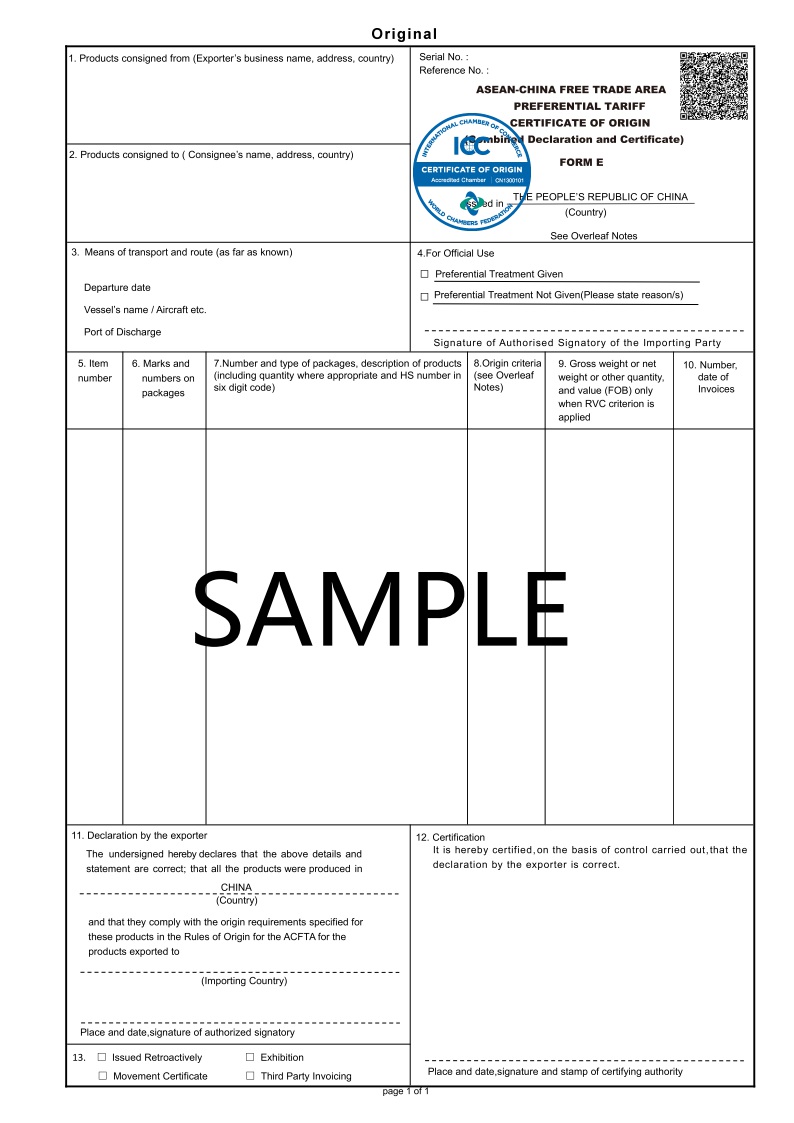
The official specimen above is useful because it shows the numbered boxes in context. It does not establish that every current certificate uses exactly this layout. On this form, look in three places:
- Upper right: the certificate title and the separate Serial No. and Reference No. fields. Preserve both references when requesting a complete copy.
- Box 1: the exporter information. This identifies a business involved in the shipment, not the institution certifying origin.
- Bottom of the form: Box 11 contains the exporter's declaration; Box 12 contains the certification. Do not treat a seller's signature in its own declaration as the issuing authority's certification.
A sample, an application draft and an issued certificate are different documents. A supplier may legitimately show a specimen to confirm the requested format. Keep it identified as a specimen until the issued document for your goods arrives. Never copy a sample reference into a live query or treat a blank certification box on a sample as a defect in an actual shipment.
The Customs lookup
For the Customs route, open China Customs' export-origin platform. Its public interface is available in English. The certificate search is distinct from its searches for origin declarations and approved exporters; choose the function that corresponds to the document in front of you.
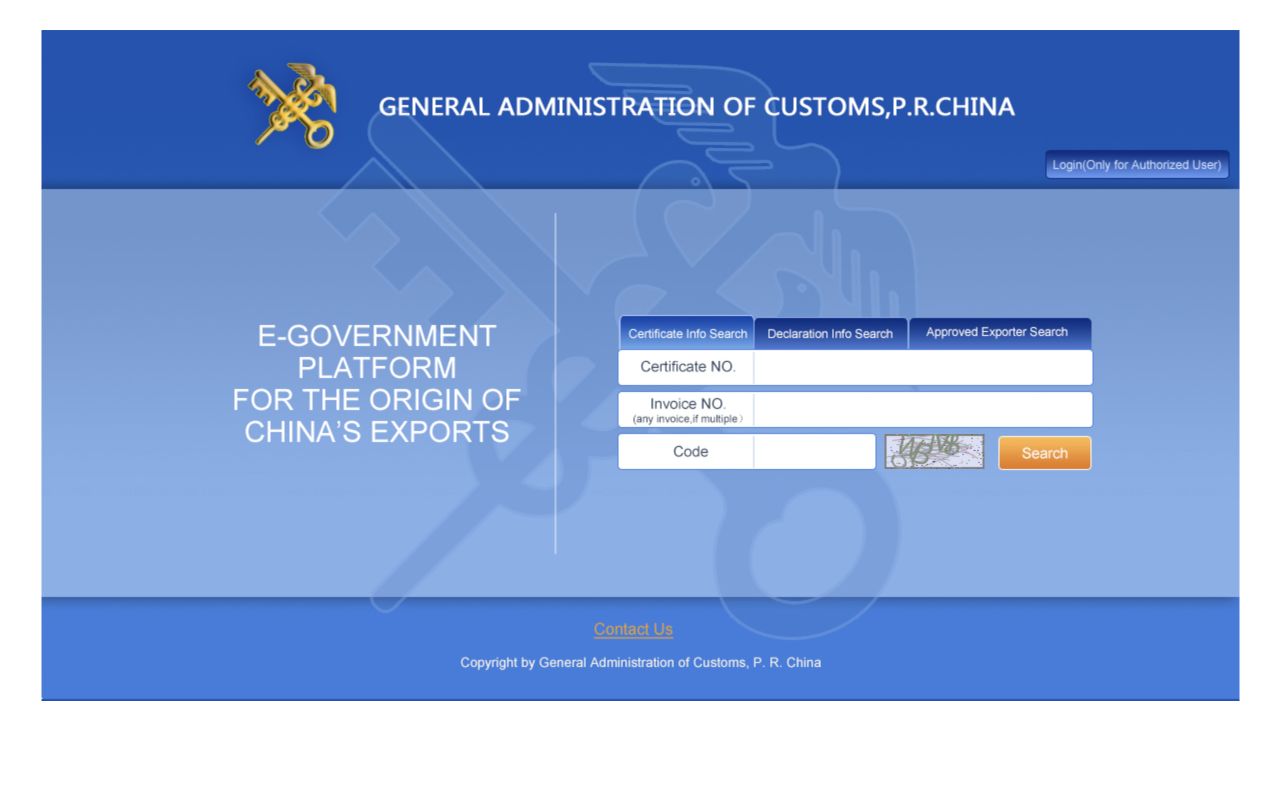
| Field | Use | Avoid substituting |
|---|---|---|
| Certificate NO. | The complete origin-certificate reference | A company registration number or purchase-order reference |
| Invoice NO. | The invoice reference associated with the certificate | An unrelated invoice from the same supplier |
| Code | The current visual challenge shown beside the field | A certificate serial number or an invoice check code |
The invoice input includes a note allowing any invoice where there are multiple invoices. Read that note with the certificate: it does not mean any invoice ever issued by the exporter. If you are unsure which reference was declared, ask the exporter to identify it. Do not try a succession of unrelated invoice numbers until a record happens to appear.
The login control is marked for authorised users. Its presence should not be confused with the public certificate form visible below it. Start with that form and follow the current instructions. If the website fails to load, no certificate check has taken place; a connection error is not a “certificate not found” result.
The CCPIT lookup
For CCPIT-issued documents, follow the verification link in CCPIT's official process guide, which identifies check.ecoccpit.net. The application service used by exporters and the service used to inspect an issued certificate have different purposes. An overseas buyer checking a document should not begin by registering a Chinese exporting company in the application system.
The CCPIT system manual, section 1.6, illustrates an ordinary-user query using a certificate number, a serial number and a verification challenge. It separately describes the Customs-user route. Its examples are published instructions, not a promise that every public query exposes all certificate details.
Keep the two document numbers separate. On CCPIT's Form E specimen, Serial No. appears above Reference No. at the upper right. The first number you see on the paper is therefore not necessarily the first number the search form wants.
Vietnamese customs practitioner QuangLogi's documented Form E checking workflow describes entering the certificate's Reference No. in the certificate-number field and its Serial No. in the serial-number field. It also records number reversal as a recurring lookup mistake. Use that explanation alongside your actual document and the current portal labels, rather than memorising the order of the boxes.
If a supplier sends only one of the references, ask for the complete certificate. If the live form gives a specific instruction about a prefix or number format, follow that instruction; do not remove characters solely because an old tutorial recommends it. Save the original references even if the search interface asks for a particular part of one.
Interpret the response
A public lookup provides a comparison with the issuer's available record. Read the information returned, including the exporter, invoice reference, destination, issue date and any goods details shown. Compare each visible value with the certificate. A successful search for a reference is more useful than the appearance of an impressive stamp, but it is not the whole import decision.
- A matching record
- The displayed information agrees with the document you received. Retain the response with the original certificate and the date of your check. Continue any shipment or destination checks required for the intended use.
- No record
- Confirm the issuing route and the exact input fields. If those are correct, ask the issuer or exporter to investigate the specific document. Keep the actual response; do not replace an unresolved lookup with an accusation of forgery.
- Different information
- Identify the field that differs. Request clarification or an authorised correction rather than accepting a supplier-edited PDF as evidence that the issued record changed.
Do not treat a field omitted from the public response as a blank field on the certificate. The official CCPIT manual distinguishes limited public information from fuller access, and the two institutions do not need to display identical result screens. A missing display field leaves that comparison unfinished; it does not supply a positive or negative answer.
For the broader task of reconciling the certificate with goods, quantities and origin requirements, use our certificate-of-origin verification guide. That review is separate from establishing that you selected the right issuer's service.
The company on the form
The institution certifying origin is not necessarily the business selling you the goods. Read the exporter name as a company identity to establish, not as a government endorsement of every claim the salesperson makes. A trading company, manufacturer and agent may have different roles in the same transaction.
Ask the supplier for the Chinese legal name and Unified Social Credit Code of the Mainland business identified as exporter. Compare that identity with the business you contracted with. Where the names differ, obtain a clear explanation of the roles instead of asking someone to make all the documents display one convenient name.
ChinaValidate company search can help find the registered Chinese entity. If a business licence is supplied, use business licence verification to compare its company information. Neither action authenticates a certificate of origin or decides tariff eligibility; those questions stay with the issuing and destination authorities.
A useful handoff to your broker is concise: the complete issued certificate, the recipient's requirement, the identified issuer, your lookup response and any specific discrepancy. That gives the next person something concrete to resolve without repeating a generic supplier checklist.