
Verifying a Chinese Company’s Articles of Association
Compare a mainland Chinese supplier’s company charter, amendments and public disclosures when shareholder, capital or contribution details differ.
Start with the Chinese legal name or USCC. Confirm the matching company before opening its profile.

The supplier sends a signed copy of its articles of association. The Chinese company name is right and the registered capital matches the public record. One date is different. In the signed copy, a shareholder’s contribution is due in December. In the company’s current public disclosure, the same amount is due in June.
Start by asking for the document that changed that date. It may be an amendment to one clause or a full replacement set of articles. A newer public entry tells you where to look. The signed amendment, or the revised articles and the decision adopting them, gives you something to compare with the original. If the supplier also says the contribution has already been paid, ask what evidence supports payment. That is a separate check.
This guide follows that example for a mainland Chinese limited liability company. The dates and amounts are illustrative. You can use the same method when a shareholder name or the registered capital is different.
The original articles
In Chinese, the document is usually headed 公司章程. Some suppliers call it the company charter. Under Article 46 of China’s Company Law, a limited liability company’s articles cover its name and domicile, business scope, registered capital, shareholders, and each shareholder’s contribution amount, method and date. They also cover governance and how the legal representative is appointed or replaced. Shareholders sign or seal the articles. Company Law of the People’s Republic of China
Begin with the full Chinese legal name. Ask for the Unified Social Credit Code (USCC) from the current business licence, especially if the charter itself has no code or uses an earlier company name. Where the names differ, use the recorded name change to link the two versions. An English trading name can appear on emails and sales documents for more than one company in a group. Use the Chinese legal name and the USCC as the reference for your check. Search for a Chinese company
Next, look for the date of adoption or signature and check that the copy includes the signature pages and any annex with the contribution schedule. A date in the file name may be the day somebody scanned the document. An incorporation copy with original signatures can be perfectly genuine and still show a schedule that has since been amended.
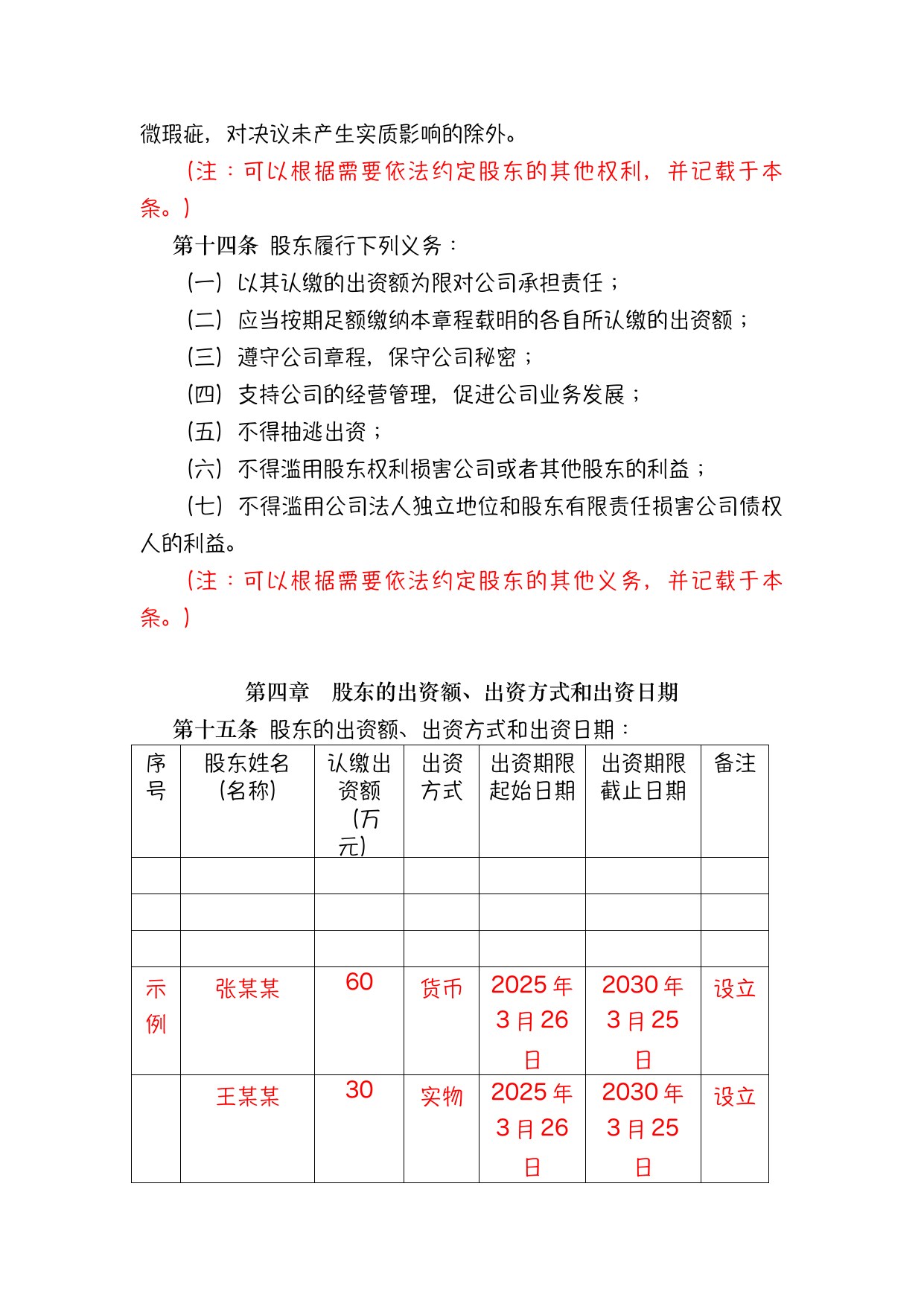
In the first red row, the form shows a subscription of 60 in a column measured in units of RMB 10,000. That comes to RMB 600,000. The payment method is cash, and the right-hand date is the contribution deadline. The row also gives a start date. That is part of the schedule, rather than a record that money arrived on that day. When copying details into a supplier file, keep those dates in separate columns and record the original unit beside the converted amount.
When you reach the contribution schedule, take one shareholder’s entry at a time. A row can contain the subscribed amount, the contribution method and the deadline. Check the units before you compare amounts. For example, 200 万元 is RMB 2 million. Also check whether the date applies to the whole commitment or just one instalment. A date for the first instalment and a date for the final balance can both be correct.
The amendment
In our example, the original articles have one shareholder committing RMB 2 million by 31 December 2027. The National Enterprise Credit Information Publicity System shows that same shareholder, the same amount and a deadline of 30 June 2027. To work out whether the contribution deadline was brought forward, ask for the change to the contribution clause or schedule. Write the two dates in your request. That gives the supplier’s finance or administration team a specific record to find.
There are two useful replies. A standalone amendment, often headed 章程修正案, replaces or adds specified provisions and should be read with the earlier articles and any other relevant amendments. A complete revised set puts the current text in one document. With either version, ask which decision adopted the change and whether any later amendment affected the same clause. A new copy of the old charter adds no evidence about the new deadline.
| Record | Date in the example | What to compare |
|---|---|---|
| Original articles | 31 December 2027 | The shareholder, the RMB 2 million subscription and the original clause. |
| Amendment | 30 June 2027 | The same shareholder and amount, the clause it replaces, and the decision adopting it. |
| Current disclosure | 30 June 2027 | The corresponding subscribed contribution entry, the matching entity and the date of the lookup. |
For this example, the amendment explains the difference once it can be tied to the right company, shareholder and clause. The table records three versions of a deadline. Keep the date the amendment was adopted and the date you captured the public record in separate notes. Otherwise, someone reviewing your file later may mistake the payment deadline for the date on which the company changed or disclosed it.
If all you have is an English summary, ask for the corresponding Chinese pages with the clause number and adoption date. If the amendment is a standalone page, keep it with the version whose terms it changes. Otherwise an amendment that looks complete by itself can be read against the wrong shareholder list or an older capital figure.
Registration and filing
A change to a registered item such as registered capital or a limited liability company’s shareholder names calls for change registration. Article 35 of the Company Law also requires the amended articles to be submitted when the registration change involves an amendment. The articles themselves are a filing item under the market-entity registration rules. Ask for evidence of the relevant filing or registration outcome if the distinction matters to your decision. A submission receipt tells you an application was lodged. A completed registration result answers a different question. Regulation on the Registration and Administration of Market Entities
If the supplier changed only the shareholder’s deadline and the registered capital stayed the same, a new licence showing the same company name and capital would tell you little about the amended schedule. Follow the articles and the disclosure entry. If the registered capital changed as well, check the registered amount and the supporting change record alongside the revised schedule.
The current public record
Open the public record using the company’s Chinese name or USCC. Match the identity and check the registered particulars first. Then look at the company’s separate shareholder contribution disclosures. Article 32 covers registration particulars the authority publishes. Article 40 covers information the company must disclose, including its shareholders’ subscribed and paid-in contributions. Both can appear in the national publicity system, but they come from different sources and answer different questions.
For the subscribed contribution, look for 认缴. For reported paid-in capital, look for 实缴. Look at the individual shareholder row and read the column label alongside the number or date. A current subscribed deadline is the one to compare with the charter schedule. A paid-in date is the date of a reported contribution. If you are looking at a dated annual report rather than the company’s current contribution disclosure, note the report year before comparing it with a later amendment.
The company registration measures require limited liability companies to publish subscribed and paid-in contribution information within 20 working days from when the relevant information arises. That is a disclosure requirement. It does not date the amendment for you or tell you when a commercial data provider refreshed its copy. For a recent change, record when you checked and ask the supplier for the underlying document. Where the records still disagree, keep both versions in your file until you can reconcile them. Company Registration Administration Measures
Other mismatches
- Different shareholder
- Compare the full names before assuming there was a transfer. A corporate shareholder may have changed its own legal name. If the supplier says the shares were transferred, ask for the relevant change registration evidence and the updated articles or shareholder register. Record separately who appears in the former articles and who is shown now.
- Different amount
- Check whether you are comparing the registered capital of the whole company with one shareholder’s subscription. Compare amounts in the same currency and units. If the current company total really differs from the charter, ask for the capital change record and the revised allocation so you can see how the new total is made up.
- Different dates within one row
- Match each date to a label and an instalment. A shareholder might have paid part before the final deadline. The payment date for that instalment and the due date for the remaining balance belong in separate fields in your notes.
Decide whether the difference affects the supplier decision you are making. A historical spelling variation and an unresolved change to the contracting entity deserve different responses. If the current identity is clear and your decision does not depend on the disputed capital field, keep the discrepancy open in your notes. If the field is part of an approval condition, ask for the supporting record before treating it as settled.
Evidence of payment
Suppose the signed amendment and the public subscribed entry now agree. You have reconciled the deadline. If the paid-in entry shows RMB 500,000 on the same RMB 2 million subscription, record that as the amount the company reports as paid. A buyer who needs independent evidence of actual contributions should ask the supplier for records specific to the amount, contributor, receiving company and date.
For a cash contribution, that could mean a redacted record showing receipt by the company and the corresponding accounting entry. For a non-cash contribution, ask for evidence of what was transferred and how it was valued. The specific material depends on the asset. One bank record will not answer a question about the transfer of equipment. If you only need to confirm the contracting entity for a routine order, a payment evidence request may be outside the scope of that check.
Even a confirmed contribution is a historical funding fact. If your decision depends on the supplier’s ability to finance production or repay an advance today, ask for evidence that addresses that decision directly. Read the charter to understand what shareholders committed, and use current financial evidence for questions about the company’s present position.
A request you can send
When only one date is disputed, start with that date. A precise request is easier for the supplier to answer and gives you a clear way to close the issue.
We’re updating our records for [Chinese legal name] ([USCC]). In the charter you sent, [shareholder]’s RMB [amount] contribution is due on [old date]. The public disclosure we checked on [lookup date] shows [new date]. Could you send the signed amendment covering that contribution or the current signed articles, together with the date they were adopted? If the change was filed, please include the filing confirmation or the relevant registration result, if available. Please also let us know if any later amendment affects that entry.
When the reply arrives, compare the same entity, shareholder, contribution amount and instalment again. Keep the original articles, the document that explains the change and a dated copy of the disclosure together. If the supplier can only resend the old charter, mark the current deadline as unresolved and specify what would settle it. That way the next reviewer knows exactly what was confirmed and where to pick up.