
Chinese Supplier Certificates: ISO 9001, 14001 and 45001
Three ISO certificates answer different purchasing questions. Compare quality, environmental and worker-safety systems, then match the evidence to the Chinese supplier and production site.
Start with the Chinese legal name or USCC. Confirm the matching company before opening its profile.

Two Chinese suppliers reach your shortlist. One sends an ISO 9001 certificate. The other sends three certificates: ISO 9001, ISO 14001 and ISO 45001. It is tempting to give the second supplier three points and the first supplier one. That would measure the size of the document pack, not how well either supplier fits the order.
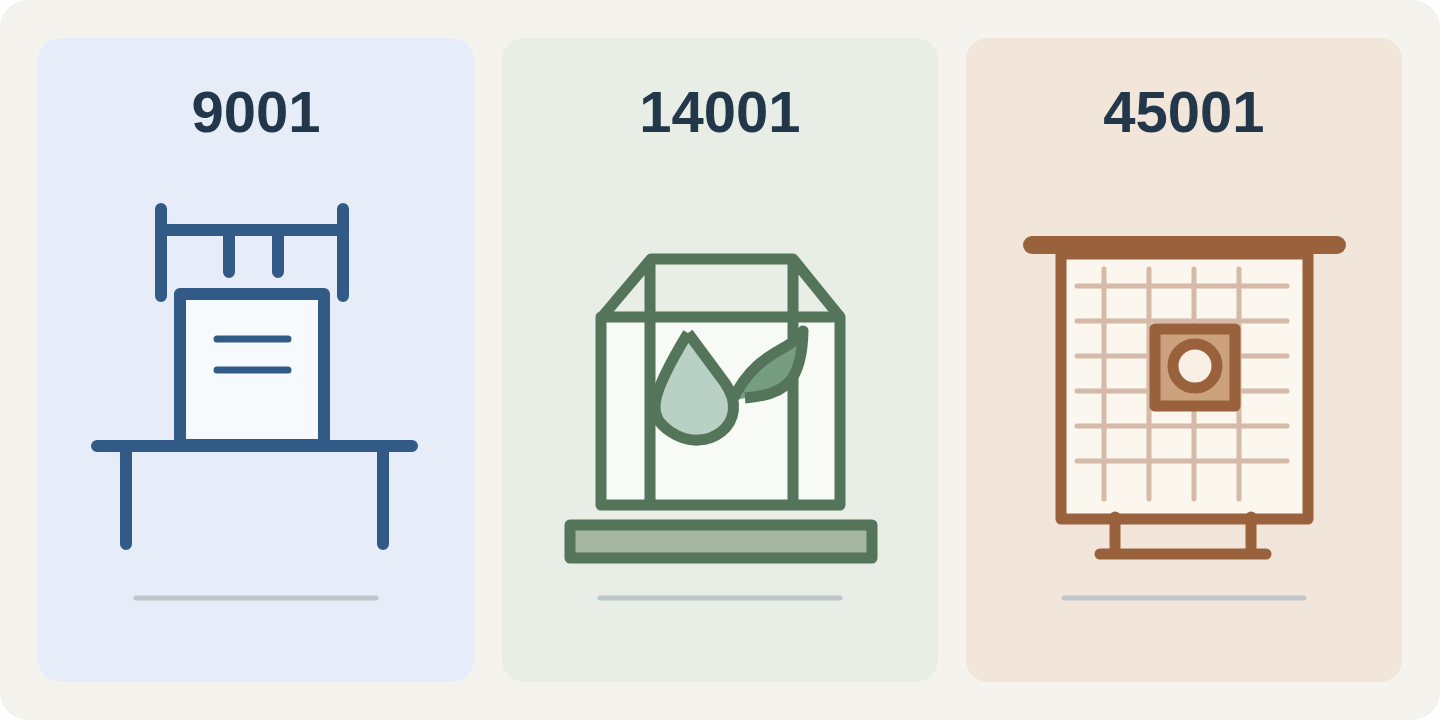
The three standards concern different management systems: quality, environmental management, and occupational health and safety. Their relevance depends on what you are buying, where it will be made and what your customer or contract requires. None is a universal certificate for the finished product.
This guide helps you decide what to request from a Mainland Chinese supplier. Start with the purpose of the evidence; use a separate authenticity check once you know which company, activity and site the certificate needs to cover.
Three systems, three purchasing questions
| Standard | Main focus | Useful purchasing question | Not established by the certificate alone |
|---|---|---|---|
| ISO 9001 | Quality management. | How does the supplier control the processes needed to meet agreed requirements? | Every delivered unit meets your specification. |
| ISO 14001 | Environmental management. | How are environmental aspects of the covered operation managed? | Your product is recycled, carbon neutral or an independently approved green product. |
| ISO 45001 | Occupational health and safety management. | How are work-related health and safety risks managed in the covered operation? | The finished product is safe for consumers or every working condition has been independently approved. |
These are complementary questions, not a ladder with ISO 45001 at the top. A trading office and a metalworking factory can have very different activities under certification. The certificate number is useful only after you understand what the certified organization actually does for your order.
ISO 9001: consistent processes
ISO's explanation of ISO 9001 describes a framework for quality management, customer requirements and continual improvement. For a buyer, its practical value lies in the processes relevant to the purchase: how requirements are understood, how work is controlled and how problems lead to corrective action.
Consider a hypothetical order for machined aluminium housings. A quality-system certificate is a useful starting signal, but the immediate purchasing questions are more concrete. Which drawing revision will production use? How will critical dimensions be checked? How are nonconforming parts separated? Who approves a change to material or subcontracted finishing?
Ask for evidence tied to that order, such as an agreed inspection plan or a relevant example of change control. You do not need an entire management manual for a straightforward purchase. You do need enough detail to see that the supplier's described process connects to your specifications and acceptance decision.
Keep shipment acceptance separate. A good process can reduce uncertainty without proving the condition of a particular lot. Samples, dimensional checks and any necessary product testing address the goods you are actually receiving. The ISO certificate does not replace them.
ISO 14001: environmental management
ISO 14001 provides a framework for an organization's environmental management system. Its focus includes environmental aspects of operations, obligations and improvement. That makes it relevant when your supply requirements concern how a factory manages environmental impacts, rather than merely how the product looks or performs.
For the same hypothetical housing order, machining may be followed by surface treatment. Ask whether the relevant operation is performed at the certified site or by another company. A certificate covering the main assembly plant does not automatically describe a subcontractor's treatment line. Identify the actual process and location before deciding what further evidence is appropriate.
Keep a product claim separate from the management-system claim. If your purchasing specification requires a stated recycled content, request evidence for that material claim. If it requires a particular chemical restriction, request the applicable product or material evidence. An ISO 14001 certificate alone does not supply either answer. It is also not a carbon-neutrality certificate for the shipment.
This distinction improves supplier requests. “Send your environmental documents” produces an unfocused folder. “Identify the site performing this treatment and explain the environmental evidence relevant to our agreed process” gives the supplier a question it can answer and gives your team a basis for follow-up.
ISO 45001: people at work
ISO 45001 concerns occupational health and safety management. Its scope is work-related risks and the organization's management system, not approval of a consumer product. Relevant buyer questions can include how the specified operation manages its significant hazards and how workers participate in identifying and addressing problems.
In the housing example, guarded machinery, handling practices and exposure controls may be relevant subjects for the factory's own risk assessment. The purchasing task is not to invent a universal checklist from a photograph. It is to establish which operation is covered and, where the order or customer policy requires it, obtain a competent assessment of that operation.
Do not use ISO 45001 as shorthand for every aspect of social compliance. Your customer's supplier policy may separately address working hours, wages or other labour practices. Confirm what evidence that policy accepts. A health-and-safety management certificate is not automatically a substitute for a specified social audit or the underlying labour-law review.
Likewise, a safety management system is not a promise that an accident can never occur. For procurement, the meaningful question is how the relevant risk is managed and how the supplier responds when a problem is identified, not whether a brochure contains a safety logo.
The company and site behind the claim
Suppose the three certificates in your shortlist belong to three related companies. The quality certificate names the contract seller, the environmental certificate names a production subsidiary and the safety certificate names a different group factory. That structure may have a valid explanation. It does not justify describing the seller as if one certificate pack covered every activity everywhere.
Make a short mapping for the order:
- Seller: the legal entity entering the purchase contract.
- Manufacturer: the entity responsible for making the agreed goods.
- Site: the operating address where the relevant work takes place.
- Certificate holder: the organization named in each certificate and any site annex.
For Chinese entities, preserve the registered Chinese name and Unified Social Credit Code beside any English name. Use ChinaValidate company search to compare the legal identity with the supplier details. If the source is a business licence, the business licence verification tool supports that identity check. Neither action certifies the management system or authenticates the issuer's decision.
Read the activity scope as well as the address. “Sales” does not silently become “manufacture”; an office does not become a factory because both use the same brand. For a multi-site certificate, ask for the relevant schedule rather than assuming the headquarters page covers every branch.

Current editions and live status
Checked 29 October 2026: ISO's published pages list ISO 9001:2026 and ISO 14001:2026 as the current editions. The ISO 45001 page lists ISO 45001:2018, confirmed in 2024, with an amendment. Record the complete standard designation on the supplier's certificate instead of shortening every entry to “ISO certified.”
A newly published standard is not, by itself, proof that every certificate to the previous edition has immediately become invalid. ISO's page for the replaced ISO 9001:2015 edition directs certified organizations to consult their certification body about transition arrangements. Check the relevant scheme, live certificate status and issuer instructions. Do not invent a common expiry date for all three standards.
ISO develops standards; it does not certify suppliers or issue their certificates. The certification body makes the certification decision. Accreditation is a separate layer concerning that body's competence. If your contract requires accredited certification, verify that requirement explicitly rather than inferring it from the design of a logo.
For applicable accredited management-system certificates, IAF CertSearch explains the available record fields, including status, scope, locations, certification body and accreditation body. For Chinese records, use the CNCA management-system services and the issuer's appropriate public verification route. A missing result needs investigation; it does not settle authenticity by itself.
Query channels can change. For example, CQC's notice of 30 September 2026 distinguishes certificates searchable through CNCA from certificates under CQC's own rules that must be checked through CQC. That notice concerns its own certificates; it is not a reason to apply one issuer's workflow to every supplier. For detailed certificate-number and record checks, use our Chinese supplier ISO 9001 verification guide.
A purchasing decision with reasons
Return to the two shortlisted suppliers. The buyer should first write down which requirement is mandatory, which is useful supporting evidence and which is irrelevant to this order. A customer may require a certified environmental system at the manufacturing site. Another order may primarily need dimensional process control and shipment inspection. The acceptance criteria should make that difference visible.
Do not quietly turn a preference into a disqualification after quotations arrive. If a particular certified system is mandatory, specify the applicable scope, site and acceptable evidence before comparing bids. If it is preferred rather than required, record the missing evidence and the practical control proposed instead of pretending both suppliers supplied identical assurance.
Use a compact review note with four fields: purchase requirement, evidence received, relationship to the actual company and site, and unresolved action. For example, a verified environmental certificate covering the proposed treatment plant can address the system requirement. It still leaves any specific coating test or material claim to its own evidence.
For the supplier with only ISO 9001, ask the unanswered environmental or safety question if it matters to the purchase. The absence of a certificate does not automatically prove unlawful operations or poor performance. It may, however, leave a contractual condition unmet. State that precise finding and agree what must happen before approval.
For the supplier with three certificates, do not skip the product specification, factory relationship or sample review. Confirm that the documents cover the work proposed for your order, then carry the verified legal names, site and requirements into the purchasing record. Revisit the evidence if the production site, subcontractor, certified scope or certificate status changes.
The useful outcome is not “three certificates received.” It is a clear explanation of what each certificate contributes, which company and operation it covers, and which product or purchasing questions still require a different answer.