
Chinese Invoice Header: Fapiao Taitou
Choose the correct buyer name for a Chinese invoice, keep tax identifiers and contact details separate, and resolve an incorrect fapiao header through the issuer.
Start with the Chinese legal name or USCC. Confirm the matching company before opening its profile.
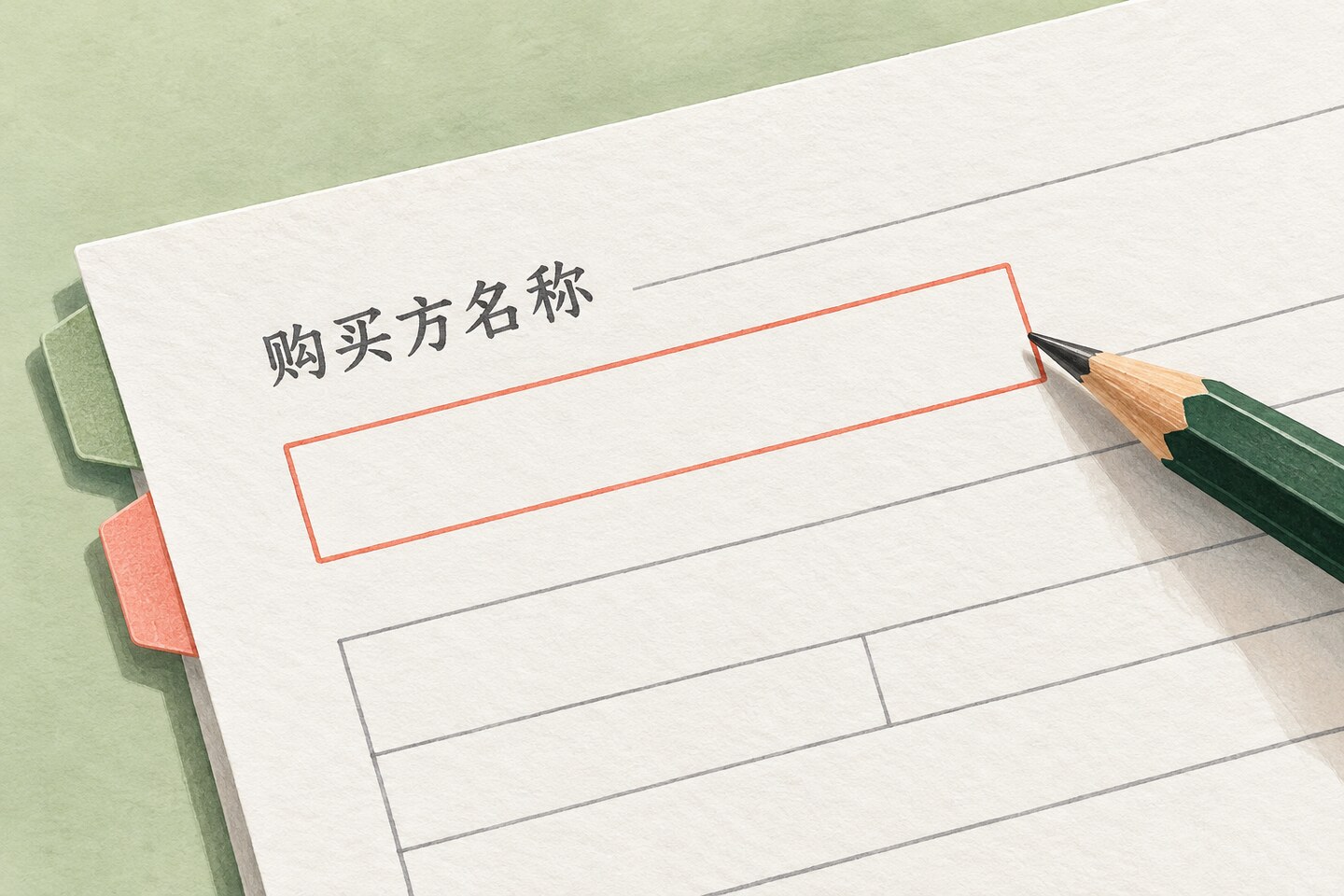
The cashier asks for your “invoice title.” You give the project name, but finance later says the document should name the company. In another purchase, a colleague enters the employer's tax number beside an employee's name. Both mistakes begin with the same misunderstanding: an invoice header identifies the buyer; it is not a free-form description of the expense.
On a Mainland Chinese fapiao request, 发票抬头 is commonly called the invoice title or header. It usually means the purchaser name to be recorded. Getting that field right requires deciding who bought the goods or services before copying information into a form. The address receiving the parcel, the person paying and the company receiving the invoice may play different roles.
The name that belongs in the header
Start with the actual purchasing arrangement. If your mainland company buys the goods, use that company's registered name and applicable taxpayer identifier. If an overseas business is the purchaser, record that overseas entity accurately. If it is genuinely a personal purchase, do not borrow an employer's name to make the expense look like a corporate purchase.
This is a different task from choosing the document's title. A heading such as “ordinary electronic invoice” identifies the invoice category. The purchaser name identifies a party. The seller name identifies the invoicing business. All three can appear prominently on the same page, so translating every one of them as “invoice title” creates avoidable confusion.
| Chinese label | Meaning in this task | Use it for |
|---|---|---|
| 发票抬头 | Invoice purchaser name | The person or entity that should appear as buyer |
| 购买方名称 | Buyer name | Checking the issued invoice against the requested header |
| 纳税人识别号 | Taxpayer identification number | The identifier belonging to that named party, where applicable |
| 销售方名称 | Seller name | Identifying the invoicing seller, not filling your buyer header |
| 发票名称 | Invoice name or category | Recognizing the document type |
The Shanghai tax authority's invoice guidance distinguishes purchaser and seller information and explains the buyer-identifier requirement for enterprise purchasers. It also identifies situations in which that identifier may be omitted, including foreign customers. A company name and a taxpayer number must therefore be considered together, without assuming every purchaser has the same identifier.
When several companies use one group brand, ask which entity made this purchase. “The group” is not a substitute for a legal name. A supplier should not have to choose between your parent, subsidiary and regional office based on a logo in your email signature.
Build one reliable buyer record
Create a short, reusable buyer record from information confirmed by the person responsible for purchasing or finance. Keep the legal name and identifier together. Add the contact email separately, so the merchant does not mistake a staff member's name or mailbox label for the purchaser.
For a mainland business, obtain the name and Unified Social Credit Code from the company's own current registration information. Copy the Chinese name as recorded, including its legal-form ending. An abbreviated brand may be convenient for internal conversation but should not silently replace the registered buyer in the invoice request.
For an overseas company, use its complete legal name and clarify that it has no Chinese USCC when that is the case. Do not manufacture an eighteen-character value or reuse the seller's identifier. The foreign-customer field question is covered in our guide to fapiao for foreign companies; it does not justify recording a different purchaser to satisfy a form.
A useful buyer record separates four items: the purchaser name, the applicable identifier, the invoice-delivery contact and the order reference. Other information should be supplied when the particular invoice or issuer's process requires it. A saved template containing obsolete bank details and an old address can cause more confusion than a concise, current record.
Keep the record under a named internal owner. If the company changes its name, do not leave staff selecting whichever saved header looks familiar. Confirm the new information and its effective context, retain the earlier record for historical purchases, and tell the issuer which transaction the request concerns.
Three purchasing situations
An employee pays for the employer. A staff member may use a personal card while buying something for the business. The cardholder's name alone does not settle the invoice purchaser. Confirm the arrangement with finance and give the merchant the correct buyer details. Keep payment evidence to explain who advanced the money rather than forcing every document to show the same role.
A company buys through a purchasing intermediary. Establish whether the intermediary buys in its own name and resells, or acts under a purchasing mandate. In the former case, two sales can have different buyers and invoices. A warehouse address or an agent's payment account does not, by itself, resolve the relationship.
Several employees share one order. A combined booking or purchase can involve different cost centers without involving different legal buyers. Conversely, two companies may share a brand without being one purchaser. Ask the issuer what documents can accurately reflect the transaction; do not divide or rename invoices solely to fit a convenient internal budget.
Consider a hypothetical office-equipment purchase. An employee orders on behalf of Company A, the parcel goes to a shared warehouse, and a group administrator submits the invoice request. The warehouse name and administrator's employer are not automatic alternatives to Company A. The team should document the actual purchase and provide one consistent buyer instruction.
Submit a clear request
Identify the order before sending the header. A correct legal name is not enough if the merchant has several purchases under the same account. Include the relevant order or booking reference, confirm the requested document and provide a delivery contact through the merchant's established channel.
You can adapt this message: “Please issue the invoice for order [reference] to [full purchaser name]. The buyer identifier is [applicable identifier], or the purchaser is an overseas company without a Chinese USCC. Please confirm the buyer details before issuance and send the original electronic invoice to [contact].” Remove any option that does not apply; the bracketed wording is correspondence guidance, not invoice data.
If an online form offers “personal” and “company” options, choose according to the actual purchaser and the issuer's supported process. Do not treat an error message as authority to change the transaction. When the proper foreign-buyer or organizational entry is unclear, ask the issuer how to complete it accurately.
Be cautious with saved headers shared through QR codes or messaging apps. Check the displayed name and identifier before submitting them. A reusable entry can be efficient, but it can also spread one outdated spelling or a different subsidiary's details across many purchases. The convenience of scanning does not confirm the identity.
Ask for confirmation of the recorded details, especially on a first purchase or after a change. Keep that response with the order. There is no need to send unrelated personal identification, a full bank statement or a complete company archive merely to communicate a purchaser name; supply additional evidence only for a specific, explained requirement.
Check the issued buyer block
When the invoice arrives, compare the purchaser block with the instruction you sent. Read the heading first. An unfamiliar name in the seller block is not evidence that your buyer header is wrong, while your own company name appearing correctly somewhere else does not fix an incorrect buyer block.
Check the exact name and the identifier as a pair. A typographical error, an old company name and a completely different legal entity are not the same discrepancy. Record the actual difference and ask the issuer for the applicable correction process. Do not edit the original PDF, replace characters in a screenshot or add a handwritten company name and treat that as an issued correction.
Merchant procedures vary. For example, Starbucks' e-fapiao help directs customers with incorrect invoice information to its store or support channel. This is useful evidence that corrections belong with the issuer; its process is not a universal instruction for every merchant or invoice generation.
For fully digitalized invoices, the national digital-invoice announcement provides for red-letter treatment in specified correction situations. Let the issuer use the procedure that applies. Keep any original, correcting and replacement documents connected, rather than deleting the earlier file and losing the explanation.
A header is one part of acceptance
A correctly named buyer does not establish that the whole invoice is correct. Compare the seller, goods or services, amount and date with the purchase. A genuine invoice addressed to your company can still concern another order, and an accurate header cannot justify a false description chosen to fit an expense category.
- Confirm the actual purchaser before submitting the request.
- Keep that purchaser's name and applicable identifier together.
- Separate delivery addresses and contact people from buyer identity.
- Compare the issued buyer block with the saved instruction.
- Resolve corrections through the issuer and retain the document history.
Use ChinaValidate invoice verification to check supported invoice information. If the seller needs a separate identity review, use company search with its Chinese legal name or registration identifier. These checks support the document review; they do not decide your employer's reimbursement policy or authorize changing the purchaser.
The practical result is a buyer record that the merchant can use and finance can trace. Once that record, the actual purchase and the issued invoice agree, the header stops being a recurring guessing exercise and becomes a reliable part of the purchase file.