
Chinese Company Name Abbreviations
Read Co., Ltd., LLC, Group and branch labels in Chinese supplier names without confusing an English abbreviation with a registered legal identity.
Start with the Chinese legal name or USCC. Confirm the matching company before opening its profile.

A Chinese supplier's website ends its name with “Co., Ltd.” Its quotation shortens the same name to “Ltd.”, while a marketplace profile adds “Group.” These labels may be convenient English forms, but they do not tell you whether every document refers to the same registered business.
Read Chinese company-name abbreviations as language clues first. Then connect them to the complete Chinese name and registered type. This guide explains the labels buyers encounter in catalogues, invoices and vendor forms, with a focus on Mainland entities. It is a reading guide, not a method for identifying a company from a suffix alone.
Co., Ltd. and the Chinese source
In ordinary English company names, “Co.” abbreviates company and “Ltd.” abbreviates limited. Chinese suppliers frequently use “Co., Ltd.” in their English rendering. Punctuation and spacing can vary across a website, email signature and commercial document without necessarily identifying a different business.
The important comparison is with the source name, not a preferred punctuation style. China's enterprise-name implementation measures distinguish the registered Chinese name from foreign-language translation for use. They also specify organization wording in Chinese names. An English suffix is therefore not an independent registry identifier.
If a license says 有限公司 or 有限责任公司, a limited-liability-company rendering can help an overseas reader. Keep the complete Chinese name beside it. Do not replace every long registered name with a short English name merely because the short version fits a purchase-order field.
| English label | Reading use | What to confirm |
|---|---|---|
| Co., Ltd. / Company Limited | A common English company-name rendering | The full Chinese name and actual registered type |
| Ltd. | An abbreviated limited-company expression | Whether it shortens the same entity name or belongs to another business |
| LLC | An English description of limited liability company form | The Chinese category, rather than importing another country's rules |
| JSC / joint-stock company | A possible description of a company limited by shares | The Chinese type and any separately claimed listing status |
| Group | A group-related name or commercial label | The specific contracting entity and any claimed ownership relationship |
LLC and joint-stock wording
The Company Law distinguishes limited liability companies and companies limited by shares. English labels such as LLC or joint-stock company may help describe those forms, but they should follow the Chinese record. Do not treat an American-style abbreviation as proof that an American legal framework applies.
Likewise, “joint-stock” does not automatically mean listed on a stock exchange. If a supplier claims listed-company status, verify the exact issuer and relevant listing separately. A subsidiary of a listed group is also not necessarily the listed issuer itself. The corporate-name suffix cannot resolve that relationship.
Translations vary. One document may use “Company Limited by Shares,” another may use a shorter expression. Retain the Chinese type when the distinction matters to onboarding or contract review. If the English rendering is ambiguous, ask for the source category rather than choosing the most familiar label.
Our Chinese company types guide covers the wider legal forms. Here, the practical task is narrower: prevent a shortened or translated name from silently changing the entity category in your supplier file.
Group is not the seller's identity
A supplier may use “Group” in a website brand, in an English rendering of a registered name, or in a description of related businesses. These uses require different evidence. Start by asking which company is making the offer and which company will sign the contract.
China's enterprise-name rules address group-related naming. A lawful group expression still does not identify every member or make every member responsible for a particular order. The word is not a substitute for a legal name, code or documented undertaking.
Consider a fictional catalogue headed “Harbor Equipment Group.” The quotation comes from one company and the proposed warranty from another. Keep the catalogue label as a brand or group label until the relevant entities are identified. Do not create a vendor called only “Harbor Equipment Group” and attach whichever license arrives first.
If the buyer expects parent support, establish which entity is the parent and what commitment it is actually making. Shared branding, a common salesperson or a group chart is not an express guarantee. The right outcome may be two identified companies and a documented division of responsibility, rather than one shortened group name.
Branch endings must survive
A long Chinese name can end in a branch designation such as 分公司. An English signature may shorten the result to a brand and city. If you omit the branch wording when copying the name, you may change the identity being reviewed from a branch to the head company.
Keep the complete branch name and its own registration information where shown. Then identify the head entity through the relevant relationship record. A branch may have its own business license and code while having a different legal-responsibility structure from a subsidiary.
The distinction is explained in our branch-office guide. For abbreviation handling, the key point is that shortening should never erase a material identity component. A display label can be brief; the underlying vendor record and contractual identification need the full evidence.
A city label alone is ambiguous. “Harbor Equipment Shenzhen” could describe a registered branch, a separately incorporated business or simply a sales territory. Ask for the Chinese name and record before choosing among those possibilities. Avoid interpreting the English layout as a corporate structure chart.
Trading and manufacturing words
Commercial names often include Trading, Industrial, Technology, Import & Export or Manufacturing. These words can suggest how a supplier presents its business, but they are not an inspection result or a complete statement of its activities. The registered business scope and actual operations answer different questions.
Do not change “Trading” to “Manufacturing” in a working translation because the supplier sells factory-made products. Preserve the source name, then ask which entity operates the factory. A trading company can be a legitimate seller without becoming the manufacturer.
Similarly, “Import & Export” in an English name does not establish every registration, license or product-specific permission needed for a particular shipment. Identify the actual exporter and check the relevant requirements for the goods. A name can guide the enquiry but cannot supply missing permissions.
Industry wording also helps distinguish similar names. If a search returns one company whose Chinese name says trading and another whose name says technology, do not merge them because both translate a shared distinctive name the same way. Retain the complete strings and compare identifiers.
One owner and a limited name
“Sole-owned,” “private,” “individual” and “family business” are especially easy to misread in English introductions. They may describe ownership informally, or they may be attempts to translate a particular registered form. Ask for the Chinese type before using those labels in a compliance decision.
A company with one shareholder is not automatically an individual proprietorship. A registered individual business is not automatically a company. The Chambers China business-structure discussion distinguishes these forms. Preserve that distinction even when a salesperson uses the same English phrase for several of them.
Do not append “Ltd.” to an individual business to make its name resemble the other entries in your purchasing system. If the system requires a display name, use a neutral reading label and keep the legal form in its correct field. A user-interface convenience should not become an inaccurate statement on a contract.
When your policy requires a company of a particular form, check the actual record against that policy. The remedy for a mismatch is a clear procurement decision or a properly identified alternative supplier, not an edited translation.
A name record that remains usable
Keep separate fields for the Chinese registered name, the code, the registered type, the English reading name and any commercial alias. This takes slightly more space than a single name box, but it prevents different kinds of information from overwriting one another.
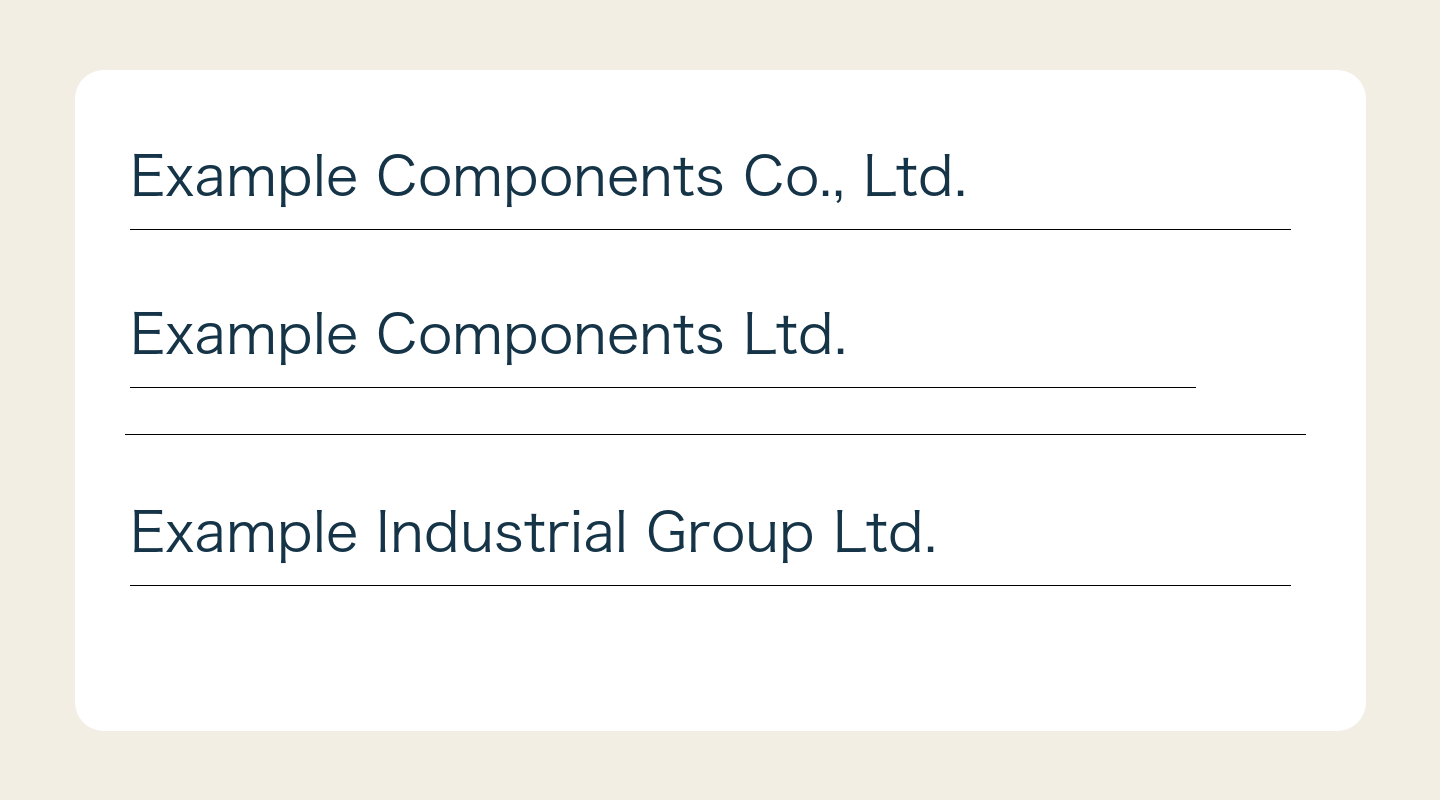
Suppose a fictional supplier uses “Example Components Co., Ltd.” on its quotation and “Example Components Ltd.” in an email. If both are documented renderings of the same complete Chinese name and code, the punctuation difference need not create two vendors. Preserve the alias relationship and the evidence that supports it.
Now suppose the payment instruction uses “Example Industrial Group Ltd.” with a different Chinese identity. That is not merely an abbreviation to normalize. Identify the other business and explain its role before changing the payee or contract record. Do not let a broad English-name matching rule erase the difference.
- Copy the full Chinese name and type from a suitable source.
- Use the English abbreviation only as a reading or display aid.
- Retain branch, group and ownership distinctions where relevant.
- Resolve changes in the legal entity separately from punctuation or wording changes.
- Use the confirmed name or code for the company lookup.
ChinaValidate company search helps you examine the identified Mainland business. When a supported license is available, business-license verification can help compare the source details. Neither tool turns an English suffix into proof of authority, group support or manufacturing capability.
Read the abbreviation, but make the decision from the underlying identity. “Co., Ltd.” can be perfectly normal English usage; it simply does not answer which Chinese business is involved. A short display name and a precise legal record can coexist as long as you keep their purposes separate.