
Chinese Company Names on Bills of Lading
Check the shipper, consignee, notify party and carrier on an ocean bill of lading. Match them to the Chinese supplier, purchase order and documents for the shipment.
Start with the Chinese legal name or USCC. Confirm the matching company before opening its profile.

When the shipper on a draft ocean bill of lading differs from the Chinese seller on your invoice, identify the issuer and the role of each company before approving the draft. Ask the booking contact whether the draft is the carrier’s bill or a house bill issued by an intermediary. Open the purchase order, commercial invoice and packing list alongside it. Use those documents to confirm which goods are in the shipment, which entity sold them and which entities are handling transport and receipt.
A typical file may name a mainland trading company on the invoice, a factory on a production record and a freight forwarder on the carrier’s draft. Each entry has a purpose. An unexplained consignee change is a separate issue from an expected difference between the invoice seller and the party booking space with the carrier. Resolve each difference against the field and document it affects.
The roles on the bill
Read the header, party fields and signature block together. A freight forwarder can send a carrier’s draft by email, so the sender’s address is only a clue to the source. The carrier named on the face and the capacity shown beside the signature help you identify who issued the bill and for whom. The full blank specimen below, published by Hapag-Lloyd, shows the positions of the fields on one carrier form.
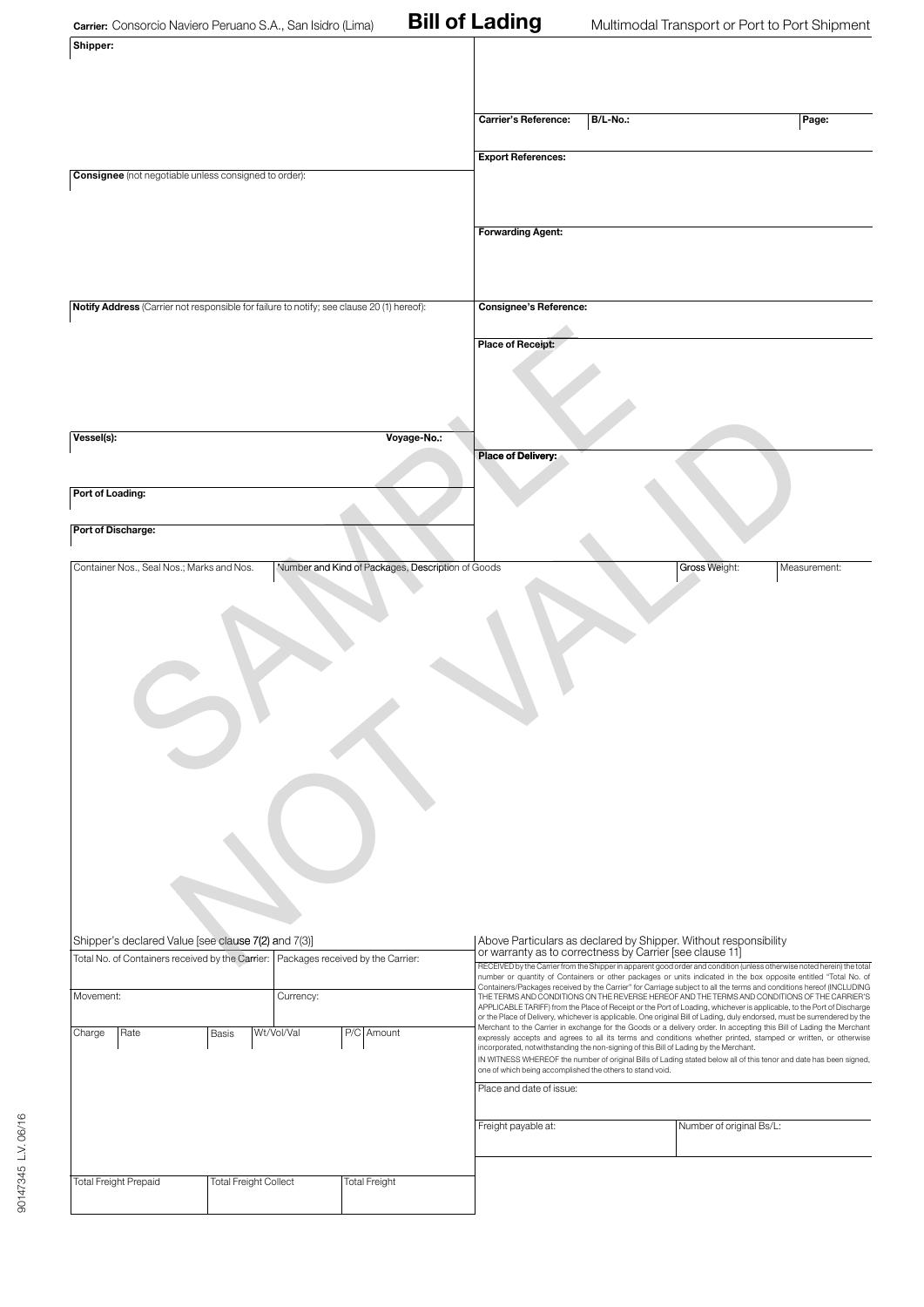
- Shipper
- Check which party the bill names for the carriage arrangement. Compare it with the shipping instructions and ask who contracted for the carriage or handed over the goods in that arrangement. The seller, manufacturer and shipper can be different companies. If the draft uses an unfamiliar name, ask the issuer or booking contact for the full entity and its role.
- Consignee
- Look for a named consignee or an instruction such as “to order.” Compare the wording with the agreed document type and receiving instructions. A buyer, an affiliate or another party might appear under a particular arrangement. Confirm the name and release requirements with the issuer or its agent before assuming the receiving team can collect the goods.
- Notify Party or Notify Address
- Check who should receive shipment notices and whether their address and contact details are current. A destination broker or logistics agent may be the contact. If the receiving warehouse or the notice contact changes, confirm which field needs updating. A notice address on its own establishes only the notification designation.
- Carrier and Forwarding Agent
- Read the carrier name and any wording showing that the signature is on its behalf. A forwarder can arrange a booking and pass on shipping instructions, or an intermediary can issue a transport document in its own capacity. Look at the bill and booking confirmation to see which role applies. Treat the vessel name and voyage as shipment references when matching records.
Shipping instructions supply details for the issuer to prepare a bill. Hapag-Lloyd’s online guide, for example, distinguishes the party names and addresses from booking references, vessel and voyage, ports, and container and cargo information. Save the instructions that were sent and compare the issuer’s draft against them. If the issuer’s template includes a field your freight provider calls by another name, confirm the field’s purpose before inserting a company name. Hapag-Lloyd shipping instructions guide
Keep company addresses separate from route points. The registered office identifies the company in its registration record. Place of receipt is where the carrier takes the cargo under the booking, and place of delivery is the agreed transport destination. A factory’s pickup address or a warehouse’s delivery address can differ from the address the issuer needs in a party field. Give the issuer the correct value for each field.
The bill as a transport record
China’s Maritime Code was revised in 2025 and took effect on May 1, 2026. Where the revised Code applies, Article 44 defines the bill of lading as evidence of the contract for carriage by sea and of the carrier receiving or loading the goods, with delivery undertaken against the bill. Article 73 addresses issuance by the carrier or an authorized person. Article 74 lists particulars including the carrier, shipper, consignee name or instructions, cargo details, ports and signature. For international sea carriage, Article 295 provides for Chapter 4 to apply when the port of loading or discharge is in China. Check the applicable law and dates for the actual carriage contract, especially if the transaction straddles the effective date. PRC Maritime Code, Articles 44, 73, 74, 295 and 310 · Supreme People’s Court rules on temporal application
The bill can record receipt of goods for carriage or show that the goods have been loaded. If the document is only a draft, check the subsequent issued copy for the status and any on-board notation. Under Article 78 of the revised Code, an issued bill is prima facie evidence of receipt or loading in the condition stated, subject to the provision on reservations. Read any qualifications on the bill. A loading port establishes the transport point shown in the document. Use production records for the manufacturer and the supporting origin documents and rules for the origin claim.
Identify the bill type before making a delivery decision. Under the revised Code where applicable, Articles 80 and 87 give different transfer and delivery rules for named, order and bearer bills. An order bill may require an endorsement check as well as a check of the named parties. Where the carrier uses an electronic record or a different transport document, confirm how that record works in the particular shipment. The purchase and any transfer of ownership need their own evidence, including the sales terms and relevant transfers. The name in a transport field alone cannot settle that question.
Master and house bills in one shipment
If you receive two versions with different names, first check whether they are actually two different bills. In some arrangements, an ocean carrier issues a master bill and a non-vessel-operating common carrier (NVOCC) issues a house bill for its customer’s shipment. The intermediary can act as carrier toward its customer and as shipper toward the vessel-operating carrier. That makes different shipper names possible across the two bills. A forwarder can also simply arrange a booking as an agent, with no separate house bill. Ask which arrangement the booking uses. U.S. Federal Maritime Commission guidance on ocean transportation intermediaries
Ask the freight contact for the link between the booking, the master bill and the house bill when both exist. Record each issuer and reference number. Match the house shipment to the master movement using the available booking, vessel and voyage, container and seal, and routing details. In a consolidation, a master bill may cover cargo from more than one house shipment. Compare the portion that belongs to your order and ask for the consolidation breakdown if totals differ. Before passing a bill number to your broker or a bank, confirm which document their filing or presentation requires.
A purchase order reconciled to both drafts
Suppose a buyer places an order for 240 cartons of shelf brackets with a mainland Chinese trading company. A separately registered factory makes the brackets. The trading company’s commercial invoice names the contracting buyer, and the packing list supplied for this order shows 240 cartons with the agreed marks. The forwarder is also acting as an NVOCC for this booking. It sends a house draft naming the trading company as shipper and a carrier draft that names the NVOCC as shipper. The house draft names the buyer’s former distribution affiliate as consignee, even though the receiving instructions name the buying company. A destination broker appears as notify party.
| Field or document | Evidence to compare | Person to follow up with |
|---|---|---|
| Invoice seller and factory | The purchase order and invoice identify the trading company. The factory record identifies the manufacturer for these goods. | Ask procurement and the seller to confirm each role, with separate company records if needed. |
| House and master shippers | The house draft shows the trading company. The carrier draft shows the NVOCC. The booking and container details should link the two. | Ask the booking contact to confirm the arrangement and give both bill references. |
| House consignee | The receiving instructions name the buying company. The house draft still shows the former affiliate. | Ask the receiving team to confirm the intended party. Send the approved wording to the house bill issuer. |
| Notify party and cargo | The broker’s contact matches the receiving instructions. The packing list accounts for this order’s 240 cartons and marks. | Confirm notification details with the receiving team and reconcile the cargo lines with the forwarder. |
In this example, keep the registered Chinese name and Unified Social Credit Code (USCC) of the trading company and the factory in separate records. Use the China company search to compare their licenses with the company records. Save the exact English wordings from the invoice and bill fields and the document that links each wording to its underlying company. A shortened English name can be an alias. If the registration code or legal entity changes, ask the source which party is involved and have procurement or logistics check the difference.
The buyer can retain the NVOCC in the master shipper field once the transport arrangement is confirmed. The consignee issue goes to the issuer of the house bill for correction. The broker can stay as notify party if that is the agreed contact. For a difference in quantity, go back to the packing list and cargo breakdown, then determine whether it comes from the number of cartons, individual units, or a master bill total covering several shipments. The packing list and commercial invoice guide covers the separate comparison of those documents.
Corrections before and after issue
For a draft, send one list of discrepancies to the booking contact and the issuer concerned. Include the booking or bill reference, draft version, affected field, exact proposed wording and source. Procurement confirms the name of the seller or buyer on the purchase documents, the receiving team confirms delivery and contact details, and the relevant issuer updates its own transport document. Ask whether a change to one bill also changes the other bill, the shipping instructions or a filing already made. Review the returned draft before approving it. Hapag-Lloyd submission and draft amendment guidance
If the bill has already been issued, tell the issuer which version and form you hold. Ask it what approvals, documents and timing apply to the requested change. If bank presentation or a filing is already underway, notify the responsible team so it can check its instructions and deadlines. Keep the issued bill intact and use the corrected document that the issuer actually provides. Keep the superseded copy with its date so colleagues can distinguish it from the current version.
Leave a short handover beside the documents, with the order covered, the issuer and number of each bill, the agreed roles and any open correction. Save the booking confirmation, evidence for the names, the final packing list and commercial invoice, and the reply approving each change. A receiving colleague should be able to identify the document to use and the person to contact about delivery without relying on a company name from a forwarded email.