
China Company Tax Payment Certificate
Check a mainland Chinese company’s tax payment certificate and read the named taxpayer, tax type, period, issue date and verification information.
Start with the Chinese legal name or USCC. Confirm the matching company before opening its profile.

If a Chinese supplier sends a 税收完税证明, check the taxpayer name, tax ID and period before reading the amount. The document can establish recorded payment or refund information for the taxpayer and entries it covers. It answers a narrower question than a general request for tax compliance, and the wording of the original request determines whether you received the right document.
A buyer usually needs the supplier to obtain and share a complete certificate. Use the issuing tax authority’s route, where it provides one for the document, and compare the official verification result with the file you received. Use the company record to confirm the taxpayer’s identity. These checks work together when the tax certificate is part of a procurement, audit or onboarding file.
Choose the proof by the question
English requests use expressions such as “tax certificate,” “tax clearance” and “proof of tax” for several Chinese documents. Before sending a request, write down what you need proved. The relevant Chinese name makes the request much easier for a supplier’s finance team to route.
| Need | Document or check |
|---|---|
| Evidence of payment or refund for a specified tax or period | Tax Payment Certificate, 税收完税证明, in the form and scope required. |
| Evidence of the absence of tax arrears as recorded at issuance | No Tax Arrears Certificate, 无欠税证明, where the taxpayer meets the conditions for issue. |
| Evidence of Chinese tax residence for a specified purpose | Chinese Tax Residency Certificate, 中国税收居民身份证明. |
| Identity of the enterprise or its taxpayer ID | Current business license and registration record. Confirm that the exact entity matches your documents. |
| Verification of an invoice for a specific transaction | The original fapiao and the applicable invoice verification process. |
The State Taxation Administration's No Tax Arrears Certificate rules make that separate document a statement about the tax administration system at the time of issuance. If the requirement calls for arrears evidence, use that requirement to frame the request. A payment certificate showing a payment for one tax or quarter cannot answer the same question about all of the supplier’s obligations.
For a buyer gathering evidence about an item in a contract, also be precise about who paid it. A tax document in a subcontractor’s name covers that taxpayer. In a group filing or branch arrangement, ask the supplier to identify the relevant company and explain the relationship to your order before you attribute a payment to the seller.
Two forms of payment evidence
China’s tax authority distinguishes between a table-format certificate, 表格式, and a document-format certificate, 文书式. The Zhejiang tax authority's issuance guide describes eligible circumstances, materials and service channels for both. Examples for the table format include requesting payment proof after an eligible electronic payment or reissuing specific lost payment documentation. The document format can summarize a taxpayer's position over a continuous period in applicable cases. The guide also specifies that the document format cannot be used as a bookkeeping or deduction voucher.
Ask for the form that fits the recipient’s stated purpose. A single transaction may require an identifiable payment entry. A review of payments over a defined period may ask for a document-format statement. If an audit checklist uses only an English title, ask the reviewer whether it needs an itemized amount, a specific time range, or a particular Chinese form before requesting another document.
Official instructions also give examples of electronic delivery. The Guangzhou tax authority's notice explains online issue, download and verification of the table-format certificate in its service. Use instructions for the place and type on the certificate you hold. When the supplier shares a PDF, keep that file so you can see the issuer, original page layout and any verification details. A photograph may be sufficient to recognize the intended form and still leave important verification fields unreadable.
A field-by-field reading
Put the certificate, business license and original request next to each other. A government table-format specimen shows how the identifying information and tax entries fit together. Formats can evolve, so use these fields by meaning rather than relying on their exact positions.
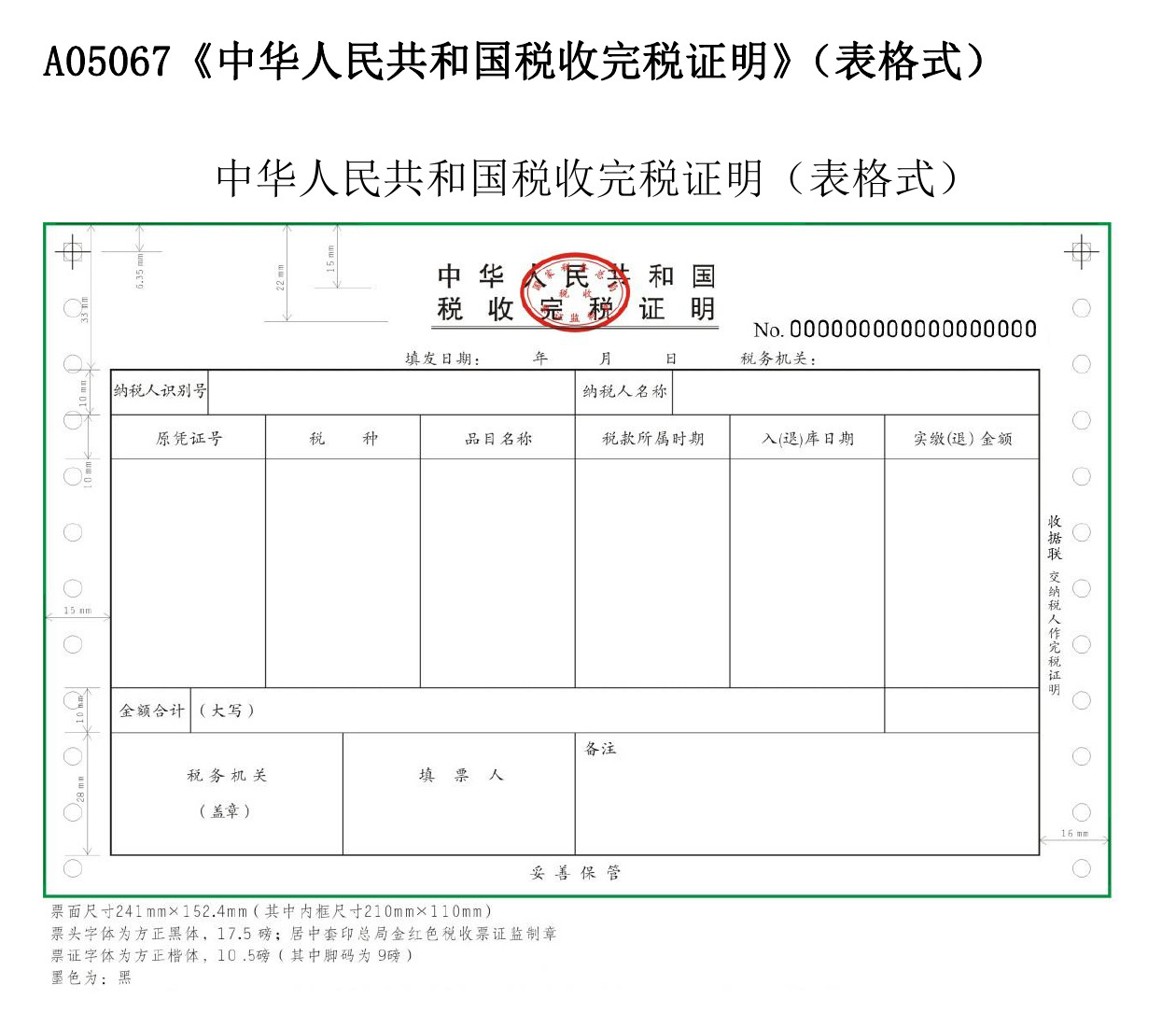
- Taxpayer name and identifier
Copy the original Chinese name and the taxpayer ID as printed. If applicable, use the complete Unified Social Credit Code from the business license and company search to confirm the mainland Chinese entity. If a recent name change explains a difference, keep the evidence connecting that name to the same entity at the relevant date.
- Tax and item
Read the entry for the particular tax you requested. A statement showing several rows can include different taxes or categories. Put the row label beside the amount in your notes. An amount on its own cannot identify the obligation to which the entry relates.
- Period, payment date and issue date
The tax period indicates the period to which the entry relates. A payment or refund can be recorded at a later date. A certificate can be issued later still. Compare the date or range relevant to the question. Reading only the print or issue date can put an accurate entry in the wrong reporting quarter.
- Payment, refund and currency
Identify whether the entry shows an amount paid or an amount returned. Keep the currency and the sign or notation from the source. If the document summarizes multiple entries, review the period and taxes included before making any comparison with a separate total.
- Issuing office and reference
Record the issuing tax authority, certificate reference and date. Keep issuer-provided verification information with the original document. For a multi-page file, check that the pages and totals belong to the same certificate before sending it to the reviewer.
An example with two different dates
An overseas buyer asks for evidence that a supplier paid a specified tax for its previous reporting quarter. The certificate arrives in the next month. The issue date falls outside the quarter, while the tax period on the relevant line matches the request. The document can still answer the question about that quarter. Set aside the issue date for the verification step and make the substantive comparison using the period and the tax entry.
Change one detail in the example. The same document shows a payment dated in the next month but the tax period on the relevant row is for another quarter. Ask the supplier to share the certificate or entry for the requested period. A date in the intended month and a correct enterprise name do not complete the match. The tax period itself is the missing evidence. This kind of targeted request is also useful when an annual summary started after the date you intended it to cover.
If the supplier sends a replacement certificate, save the original request and both versions. Keep the later file connected to the specific problem it resolves. A second file may add missing coverage or correct the entity you were given. Document that distinction so colleagues reviewing the same evidence can see which certificate supports the conclusion.
Confirm the issuer’s result
- Identify the source. Read the issuing office and the certificate type. Find the tax authority's electronic tax bureau or service page through an official address. Where the issuing office provides specific instructions for this document format or vintage, follow those.
- Use the information the service requests. A verification service may ask for reference fields or a code from the document. Use the issuer's instructions as the source for what to enter. Keep reference details private where access is restricted, and use the verified channel for any direct inquiry.
- Compare the response with the original. Where the service returns the taxpayer, reference, issue date or a rendered certificate, match the available fields. A useful verification record gives you the date checked and the results you actually saw.
- Resolve a missing result with the supplier. Check the place, document type and transcription. Ask the supplier to re-download the document or provide a confirmation from the issuer when online verification is unavailable to you. Save that line of evidence as distinct from your public company lookup.
For electronic records, use the current official route given for that kind of certificate. A regional verification service may limit which formats or issue periods it covers. The document may also be available only through the taxpayer's own account or an authorized representative. When you cannot repeat the official check yourself, preserve the original, state the part you could confirm and identify the issuer evidence still needed. A registered-company result helps with identity but is a separate check from tax payment.
Payments made through another party
When a record refers to a withholding agent, keep its name separate from the named taxpayer. The party that collected or remitted the tax may be identified in the evidence, while the certificate itself relates to the taxpayer shown in the relevant field. Confirm whose obligation you are reviewing. If the purchaser needs to match an individual payment, ask the supplier to point to the precise row and describe the agent’s role. A record issued by a bank, a withholding agent and a tax authority may relate to the same process while documenting different steps.
A common comparison starts with a bank payment confirmation and the tax certificate. The bank file can help trace a debit, payment reference or transfer date. The official certificate can identify the tax and period recorded by the tax administration. Compare through a shared reference or a reconciliation from the supplier. Where the totals differ, check whether the bank debit covers several entries, includes a different period or was later refunded in part. Ask for evidence of the specific allocation before assuming the two files describe the same amount.
A branch can create a similar need to be precise. If the tax certificate is under the head office’s name and the order names a branch, ask which entity was responsible for the tax covered by the evidence. Confirm the branch registration and the connection to the head office, then ask the supplier’s finance team to explain what the certificate covers. Record the explanation with the evidence. A correct corporate relationship helps you understand the documents, while the tax period, item and taxpayer named on the certificate determine the scope you can report.
Where a third party specified the requirement, send it that precise description before requesting sensitive records beyond the original scope. For example, confirm that its review accepts a certificate for the head office or requires branch-specific evidence. This lets the supplier produce the relevant form and reduces unnecessary disclosure.
A precise request to send
Give the supplier the complete legal name for the entity being reviewed, then state the tax, period and purpose. Ask for the full official file, including its issue details and applicable verification instructions, and specify the form if the recipient has a stated requirement. For example, ask for a tax payment certificate in the contracting supplier's name covering the specified tax and accounting quarter, with a reference that lets your reviewer match the payment entry to that request.
Make the last line in your record equally precise. Identify the taxpayer and scope covered, how the file was verified, and the date of the check. If you also need tax residence, arrears status or an invoice for a specific order, request the separate document suited to that decision. This leaves a useful audit trail without collecting unrelated financial records about the supplier.