
When a Supplier Address Looks Residential
Test a residential-looking Chinese supplier address against local registration rules, premise evidence, the claimed business role, and any separate factory.
A supplier address that looks residential is a question, not a fraud finding. An apartment-style tower may contain lawful offices or mixed-use premises. A company may use a registered domicile while manufacturing somewhere else. It may also be using a stale or unreachable address. The facade alone cannot tell you which explanation is true.
The right test begins with the supplier's claim. If the company says the unit is its sales office, look for office and reachability evidence. If it says the same unit is a factory, require production evidence that could not be created by an ordinary office. If it says the address is only for registration, identify the local basis and the real operating sites before approving the relationship.
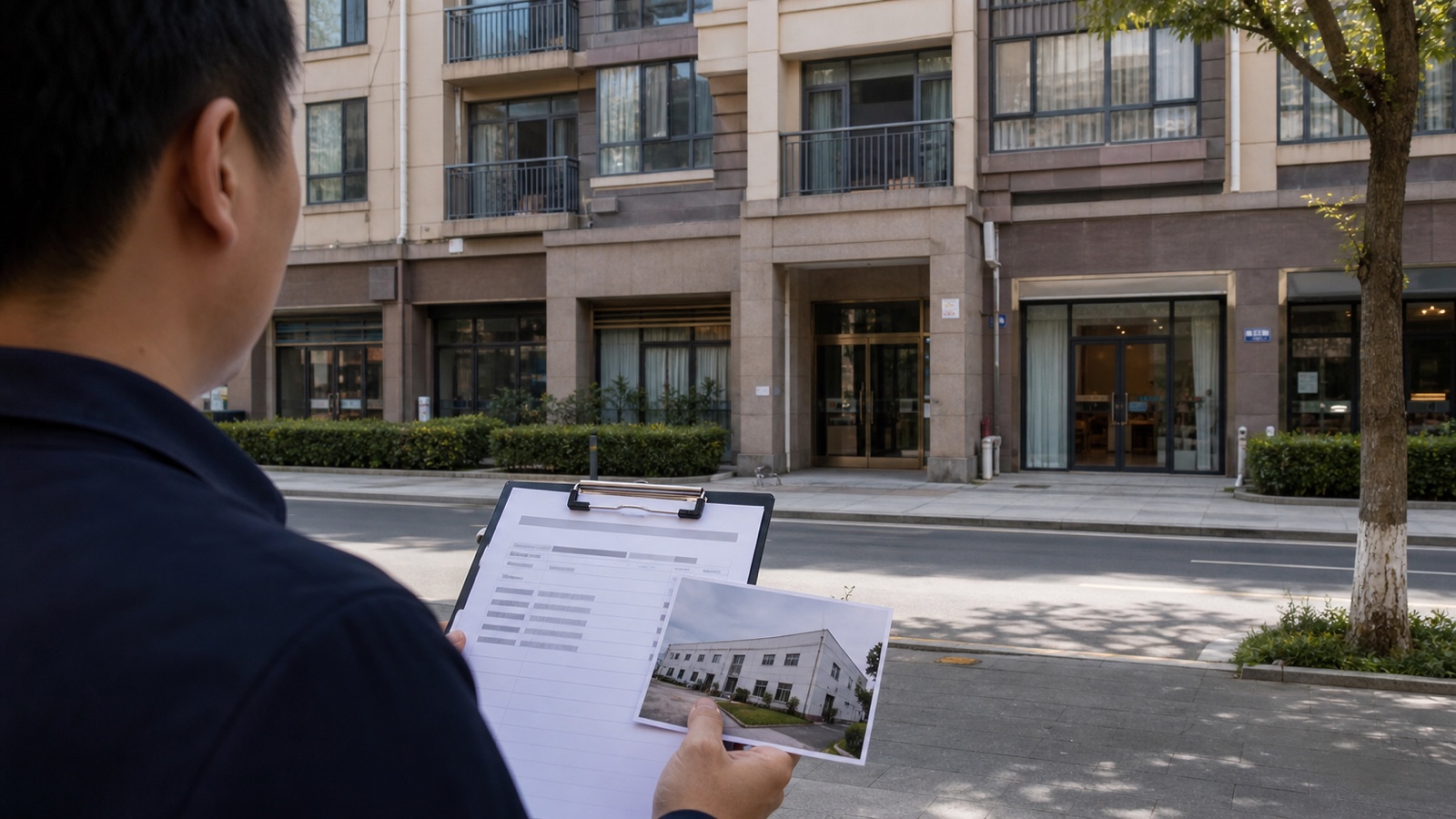
Separate four facts hidden inside one address
Building appearance is what a dated street photograph, public-area visit, or map image seems to show. “Apartment-style,” “mixed-use,” and “non-industrial” are defensible visual descriptions. “Illegal residential registration” is not.
Property and use basis concerns the premises' formal classification and the rules governing business use. Those facts may require property documents, a lessor or building manager, and the applicable local rule. A shopfront below apartments does not establish the use classification of Room 1206.
Registered domicile is the exact address attached to the legal entity at the query date. It supports identity and service-of-documents analysis. It does not show where every employee, machine, warehouse, or shipment is located. The broader distinction is explained in What a Chinese Registered Address Means.
Operating role is what actually happens there: management, sales, document reception, showroom activity, storage, or production. That is the fact the buyer usually needs, and it must be tested against the supplier's transaction claim rather than inferred from the licence field.
Local rules make visual shortcuts unsafe
China's national market-entity registration regulation treats domicile or principal place of business as a registration matter and generally provides for one such registered address. It also allows provincial governments to make detailed, locally appropriate rules that facilitate address registration. That local delegation is why one city's “one address, multiple licences” or centralized-registration model cannot be applied to a supplier in another city without checking the actual rule.
Property use is a separate layer. Article 279 of the Civil Code restricts changing a residence into business premises contrary to law or building-management rules and requires the unanimous consent of interested owners in addition to compliance with applicable rules. A buyer should not claim those conditions are satisfied—or violated—merely because the exterior resembles housing.
Current regional rules illustrate the variation. Anhui's 2025 domicile registration measures address the use of certain residential and other non-commercial premises and expressly state that the business licence is not proof that the property's nature has changed. Shanghai's 2024 domicile measures use non-residential premises for specified shared-address arrangements and define their own concentrated-registration and additional-premise rules. These are examples, not a nationwide checklist.
Test the claim the supplier makes about the premise
“This is our trading office”
An apartment-style office can be compatible with a small trading company. The useful evidence is mundane: the exact legal entity receives documents there, the unit exists, staff can join a live call or scheduled visit, business communications are consistent, and the contract seller and beneficiary are explained. Machinery is not expected at a trading office. The separate question is who manufactures the product.
“This is only our registered address”
Ask whether the address is a centralized-registration, cluster, incubator, or document-service arrangement and which local rule or service agreement supports it. Record who receives legal and commercial correspondence, where management actually works, and where records are kept. A credible answer names the operating locations; “every company does this” does not.
“This unit is our factory”
A residential-looking unit cannot be cleared as a plant with a reception-desk video. Request a continuous, buyer-directed path from the building entrance to the claimed workshop, then trace one relevant product through material, equipment, work instruction, in-process control, finished goods, and dispatch. Check whether noise, power, ventilation, loading access, floor area, and worker activity are plausible for the specific process. Use the manufacturer evidence stack for the capability decision.
“Our factory is at another address”
This can be a normal trading or outsourced-manufacturing structure. Obtain the factory's Chinese legal name and exact address, identify whether the seller owns, controls, contracts with, or merely buys from it, and connect the sample and production records to that operator. The factory-or-trading-company workflow keeps the seller and manufacturer from being merged into one convenient identity.
Build a premise packet that another reviewer can repeat
- Freeze the current identity. Record the Chinese legal name, USCC, exact registered address, source, and retrieval time. Preserve the original Chinese string before translating or shortening it.
- Resolve the unit. Separate compound, building, entrance, floor, and room. Confirm that the claimed unit exists without photographing residents, private doors, mailboxes, access codes, or faces.
- Identify the local basis. Ask for the premises-use or registration evidence relevant to the city and claimed arrangement. Do not demand one national document name when local systems differ.
- Test reachability. Compare dated courier acceptance, a scheduled visit, building directory information where lawfully available, and the company's own correspondence. One successful delivery supports reachability on that date; one failed delivery is not conclusive.
- Test the operating role. For an office, look for staff and business continuity. For a warehouse, look for goods, access, and dispatch records. For a factory, use product-specific production evidence. Keep each result under its own role label.
- Check official adverse records. Search the exact entity for address-related operating-abnormality events and record dates, reasons, and any later removal rather than reducing the history to a current badge.
The last step has a precise boundary. SAMR's current Enterprise Operating Abnormality List Measures include an authority's inability to contact an enterprise through its registered domicile or place of business as an official listing reason. A buyer seeing a locked lobby or receiving no reply is not the same finding. Read the event through the operating-abnormality framework.
Case file: a real office, a different factory
The fictional Hangzhou Cedar Motion Trading Co., Ltd. is registered in Room 1206 of a mixed-use tower with apartments above ground-floor shops. Its website says “our factory produces precision gearboxes,” so the buyer initially expects a plant at the registered address.
- The company record, full address, entrance, floor, and unit support the existence of a small Hangzhou office. Nothing observed supports machining or assembly there.
- The seller's scope and records are consistent with a trading role. During a live walk-through, staff show the office and document files; they do not pretend the unit contains production equipment.
- Asked to correct the factory claim, the supplier identifies the fictional Jiaxing Cedar Drive Equipment Co., Ltd. as manufacturer and provides its Chinese name and factory address.
- A separate, continuous production visit connects the Jiaxing operator, sample label, gearbox work order, inspection record, and packing line. The Hangzhou company remains the contract seller and beneficiary.
The conclusion is not “residential address cleared.” It is narrower: the Hangzhou address is supported as the seller's office and reachable domicile; it is not the factory. The Jiaxing entity is separately supported as manufacturer. Marketing language is corrected in the approval file, and both roles are written into the purchase documents.
Write a narrow finding and let exposure set the next step
Use language that matches the evidence. “Exterior appears apartment-style; property use not established” is an appearance-only finding. “Current registered address; unit and office occupancy observed on 15 July; manufacturing not observed or claimed at this premise” is a dated office finding. “Exact entity carries a current address-related abnormality event” is an official-record finding. Do not collapse them into a red or green address score.
Proceed with normal controls when the legal entity is current, the address role is plausible and supported, transaction parties align, and any separate factory is identified. Hold payment when the supplier insists an apartment unit is a production site but cannot show product-specific activity, when the registered entity cannot be reached and an official adverse event exists, or when the seller, manufacturer, invoice issuer, and beneficiary shift without a documented relationship.
A visit becomes more valuable as exposure and contradiction rise: custom tooling, safety-sensitive goods, a non-refundable deposit, a claimed in-house process, or conflicting locations justify more direct evidence. The U.S. International Trade Administration likewise emphasizes thorough partner due diligence. Scope the visit to the claim, obtain permission, and protect residents and employees from unnecessary collection.
For the address mechanics—Chinese normalization, historical district names, map reconciliation, and delivery evidence—continue with the registered-address investigation guide. This scenario is complete when the buyer can say what the premise is supported to be, what it is not supported to be, and which entity performs the work being purchased.